
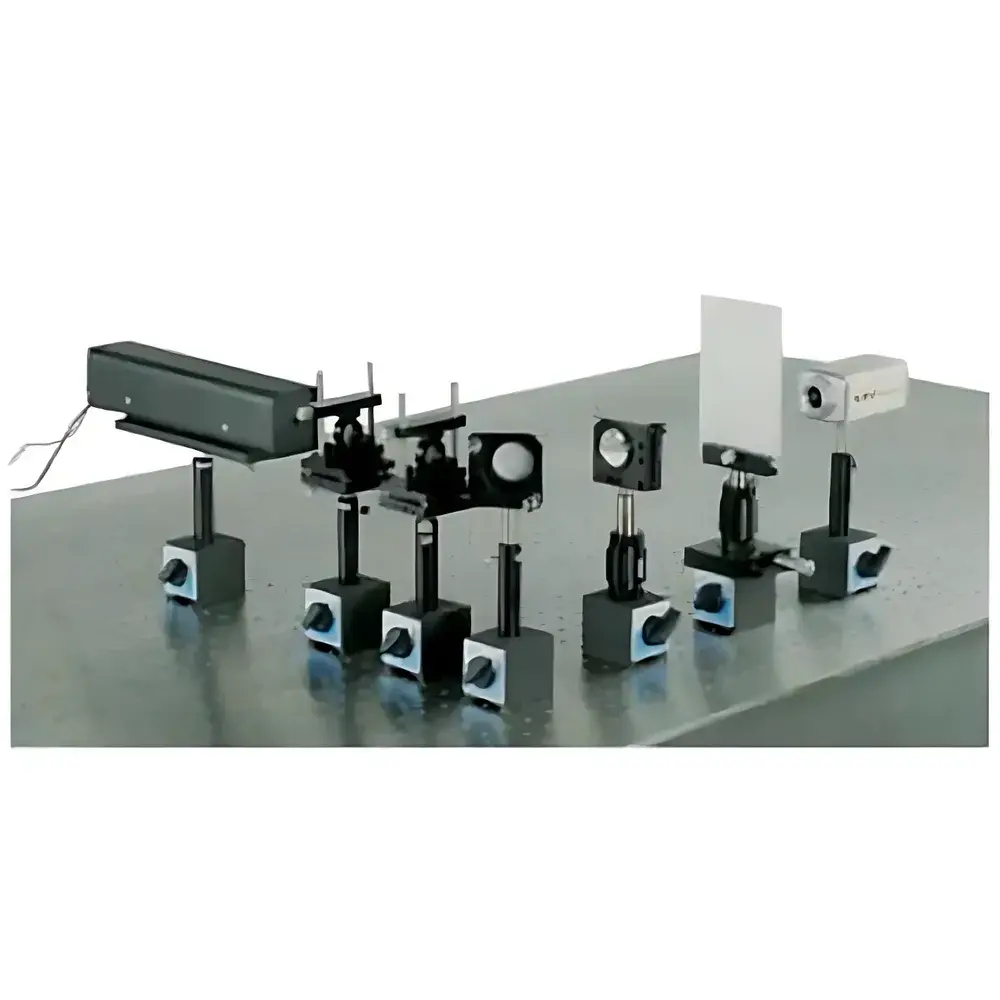
Topo WJS-1 Laser Speckle Experimental Setup
| Brand | Topo |
|---|---|
| Model | WJS-1 |
| Origin | Tianjin, China |
| Manufacturer Type | Direct Manufacturer |
| Regional Classification | Domestic (China) |
| Imaging Sensor | CCD |
| Light Source | He-Ne Laser (632.8 nm) |
| Core Function | Qualitative and quantitative analysis of laser speckle formation and in-plane displacement measurement via digital speckle correlation |
| Included Components | CCD camera, He-Ne laser module, image acquisition card, proprietary speckle analysis software, precision optical mounts & alignment rods, optical components (beam splitters, mirrors, lenses, diffusers) |
Overview
The Topo WJS-1 Laser Speckle Experimental Setup is a pedagogical instrumentation platform engineered for undergraduate and graduate-level physics and optical engineering laboratories. It enables hands-on investigation of laser speckle phenomena—statistical interference patterns generated when coherent light (e.g., from a 632.8 nm He-Ne laser) reflects from or transmits through a rough surface. The system implements digital speckle correlation (DSC), a non-contact, full-field optical metrology technique used to quantify sub-pixel in-plane displacements (typically in the range of 0.1–10 µm) by cross-correlating successive speckle intensity distributions captured with a high-sensitivity CCD camera. Unlike interferometric methods requiring stringent environmental stability, DSC offers robustness against low-frequency vibrations and ambient lighting fluctuations—making it particularly suitable for teaching labs where controlled optical benches may be limited. The WJS-1 emphasizes foundational understanding of coherence theory, statistical optics, and correlation-based measurement principles, serving as a bridge between classical wave optics and modern computational imaging techniques.
Key Features
- Modular optical train with manually adjustable mounts—supports student-led alignment of beam path, diffuser positioning, and imaging geometry to reinforce optical design fundamentals.
- Integrated 632.8 nm helium-neon laser source with stable output power (≥1 mW) and TEM00 mode profile, ensuring reproducible speckle generation under controlled coherence conditions.
- High-resolution monochrome CCD camera (1280 × 1024 pixels, 8-bit dynamic range) optimized for low-noise speckle image acquisition at frame rates up to 30 fps.
- Dedicated image acquisition card compliant with standard PCI/PCIe interfaces, enabling real-time frame buffering and hardware-triggered capture sequences.
- Proprietary speckle analysis software with intuitive GUI, supporting image preprocessing (background subtraction, contrast enhancement), region-of-interest (ROI) selection, and normalized cross-correlation (NCC) algorithm execution for displacement vector field computation.
- Comprehensive component set includes precision kinematic mirror mounts, beam splitters, collimating lenses, ground-glass diffusers, and calibrated translation stages—facilitating systematic exploration of speckle grain size dependence on aperture, wavelength, and surface roughness.
Sample Compatibility & Compliance
The WJS-1 is designed for use with optically scattering planar specimens—including painted metal plates, sandblasted glass, polymer films, and engineered diffusers—with surface roughness (Ra) ranging from 0.5 µm to 50 µm. Specimen mounting accommodates dimensions up to 150 mm × 150 mm. All optical components comply with ISO 10110 surface quality standards (scratch-dig 60-40), and the He-Ne laser meets IEC 60825-1:2014 Class 2 safety requirements. The system supports documentation practices aligned with academic laboratory accreditation frameworks (e.g., ABET Criterion 3 student outcome assessment), and raw image data export (TIFF, BMP) facilitates integration into MATLAB®, Python (OpenCV, scikit-image), or LabVIEW® environments for advanced curriculum development.
Software & Data Management
The included speckle analysis software provides audit-ready functionality: timestamped image metadata logging, user-defined experiment annotation fields, and export of displacement maps (ASCII grid format) and summary statistics (mean/max displacement, standard deviation). While not FDA 21 CFR Part 11 certified (as intended for educational—not regulated clinical or QC use), the software architecture supports GLP-aligned workflows through session-based project folders, version-stamped configuration files, and lossless image archiving. Data provenance is preserved via embedded EXIF-like headers recording exposure time, gain setting, laser power status, and operator ID.
Applications
- Teaching core concepts: spatial coherence, speckle contrast, ensemble vs. temporal averaging, and the Van Cittert–Zernike theorem.
- Quantitative demonstration of in-plane deformation under mechanical loading (e.g., cantilever bending, thermal expansion of bi-material strips).
- Calibration exercises for displacement sensitivity versus speckle size, correlation window size, and interpolation method (e.g., quadratic vs. centroid-based sub-pixel estimation).
- Comparative studies with alternative metrology tools: strain gauge validation, comparison to electronic speckle pattern interferometry (ESPI) setups, and error analysis of decorrelation effects under large rigid-body motion.
- Student capstone projects involving algorithm modification—e.g., implementing fast Fourier transform (FFT)-based correlation or machine learning-assisted speckle tracking.
FAQ
Is the He-Ne laser replaceable with a diode laser?
Yes—though the default 632.8 nm source ensures optimal speckle contrast and compatibility with standard red-sensitive CCDs; substitution requires recalibration of exposure parameters and verification of coherence length impact on speckle grain uniformity.
Can the software run on macOS or Linux?
The native application is Windows-only (Windows 10/11, 64-bit); however, image data files are platform-agnostic and fully compatible with open-source analysis pipelines on macOS and Linux.
What is the minimum measurable displacement resolution?
Under optimal conditions (high-contrast speckle, stable thermal environment, 32×32 pixel correlation windows), theoretical sub-pixel resolution is ~0.1 pixel—translating to approximately 0.5 µm at typical working distances (300–500 mm) and magnification settings.
Does the system support real-time displacement monitoring?
No—it operates in snapshot mode with post-acquisition correlation; real-time tracking would require GPU-accelerated correlation kernels beyond the scope of this educational platform.
Are calibration certificates provided with optical components?
Individual optical elements are supplied with manufacturer-certified surface quality and transmission data; NIST-traceable displacement calibration artifacts are optional accessories, not included in the base configuration.





