
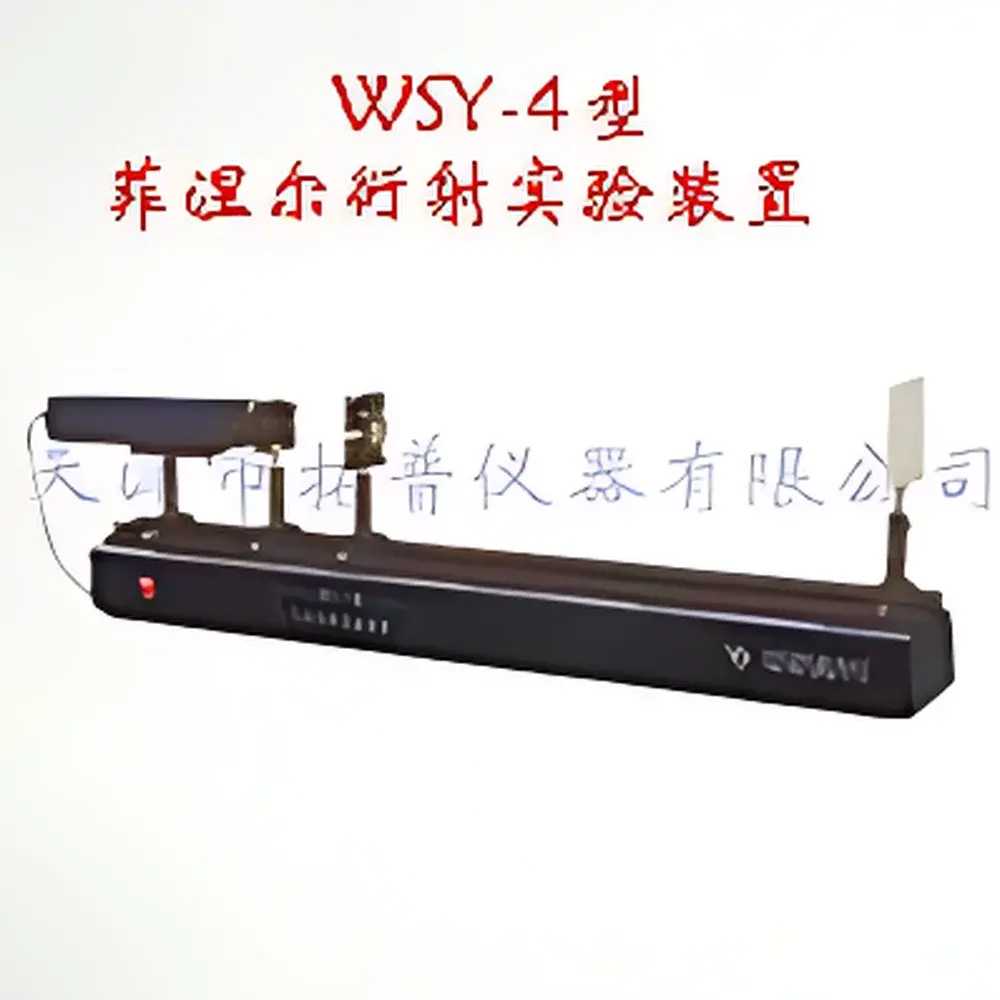
Topo WSY-4 Fresnel Diffraction Experiment Setup
| Brand | Topo |
|---|---|
| Model | WSY-4 |
| Origin | Tianjin, China |
| Manufacturer Type | Direct Manufacturer |
| Category | Domestic Optical Teaching Instrument |
| Components | Optical Rail, 2D Adjustable Mounts, Photographic Plate Holder, White Viewing Screen, Multi-Aperture Mount, Single-Slit Adjuster (One-Side Variable), He–Ne Laser (632.8 nm), Convex Lens, Straight Edge Knife Blade |
| Power Integration | Integrated AC Power Supply Unit with Rail-Mounted Enclosure |
| Design | All-in-One Modular Bench System with Tool Storage Compartment |
Overview
The Topo WSY-4 Fresnel Diffraction Experiment Setup is a pedagogically optimized optical bench system engineered for undergraduate and graduate-level instruction in physical optics and wave phenomena. It implements classical scalar diffraction theory under the Fresnel approximation—where the observation distance satisfies z ≫ a²/λ (with a as aperture characteristic dimension and λ the wavelength)—enabling quantitative analysis of near-field diffraction patterns without requiring far-field (Fraunhofer) conditions. The system centers on a rigid, metric-scaled aluminum optical rail (1200 mm nominal length) that serves as both mechanical backbone and alignment reference. All optomechanical components—including laser source, apertures, lenses, and edge obstructions—are mounted via standardized kinematic interfaces to ensure repeatable positioning and angular stability. This architecture supports direct visualization and spatial mapping of intensity distributions using a calibrated white viewing screen or photographic emulsion plate, facilitating comparative analysis between theoretical predictions (e.g., Fresnel integrals, Cornu spiral parameterization) and experimental observations.
Key Features
- Integrated power management: AC mains input (220 V ±10%, 50 Hz) feeds a regulated low-noise DC supply for the He–Ne laser and optional auxiliary modules, housed within a rail-integrated enclosure with cable routing channels.
- Modular component set: Includes precision-machined 2D translation/rotation mounts (±0.02 mm linear resolution, ±0.1° angular resolution) for independent control of slit width, lens focal plane, and knife-edge position.
- Variable single-slit assembly: One-side adjustable slit mechanism enables continuous width variation from 0.1 mm to 2.0 mm with vernier scale readout (0.05 mm graduation), supporting systematic study of slit-width–dependent diffraction envelope modulation.
- Dual-aperture capability: Multi-hole mount accommodates interchangeable circular apertures (diameters: 0.3 mm, 0.5 mm, 1.0 mm) and straight-edge blade for comparative analysis of circular, linear, and half-plane diffraction geometries.
- Laser source specification: Stabilized helium–neon gas laser (632.8 nm, TEM00 mode, output power ≥1.0 mW, coherence length >20 cm) with integrated beam expander and collimation optics.
- Teaching-optimized ergonomics: Tool storage compartment built into rail base housing Allen keys, alignment pins, aperture templates, and calibration charts—reducing setup time and minimizing component misplacement.
Sample Compatibility & Compliance
The WSY-4 system is designed exclusively for controlled classroom and laboratory use with stable, non-hazardous optical elements. It accommodates standard 35 mm photographic plates (for permanent pattern recording) and reusable matte-white acrylic screens (200 × 200 mm active area, diffuse reflectance >92% at 632.8 nm). No sample preparation or consumables are required beyond standard optical cleaning supplies. While not certified to industrial standards such as ISO/IEC 17025, the apparatus conforms to pedagogical best practices outlined in the American Association of Physics Teachers (AAPT) Laboratory Guidelines and aligns with curriculum frameworks adopted by ABET-accredited physics programs. All electrical components meet GB 4793.1–2019 (equivalent to IEC 61010-1) safety requirements for laboratory equipment.
Software & Data Management
The WSY-4 operates as a stand-alone optical platform with no embedded firmware or proprietary software dependency. Experimental data acquisition relies on external tools: digital CCD/CMOS cameras (e.g., Thorlabs DCC1545M) interfaced via USB for image capture, followed by post-processing in open-source platforms including ImageJ (with Fresnel Diffraction Analysis plugin) or Python-based libraries (NumPy, SciPy, Matplotlib) for numerical integration of Fresnel integrals and intensity profile fitting. Raw image datasets support export in TIFF or PNG formats, enabling traceable documentation compliant with institutional GLP-aligned lab notebook standards. Optional integration with LabVIEW or MATLAB via analog voltage outputs (available on custom-order laser driver modules) permits real-time intensity monitoring across scan axes.
Applications
- Quantitative verification of Fresnel diffraction theory through measurement of fringe spacing, intensity null positions, and transition zone boundaries in single-slit, circular aperture, and straight-edge configurations.
- Experimental determination of wavelength using known slit or aperture dimensions and measured fringe geometry—serving as a primary metrology exercise in introductory optics labs.
- Investigation of edge diffraction effects relevant to optical system design, including knife-edge testing of beam quality and M² factor estimation.
- Comparative analysis of Fresnel vs. Fraunhofer regimes by varying propagation distance z while maintaining constant a and λ, illustrating the validity boundary of the Fresnel approximation.
- Student-led inquiry projects involving perturbation studies—e.g., effect of partial coherence, aperture edge roughness, or ambient vibration on pattern fidelity.
FAQ
Is the He–Ne laser included with the base WSY-4 configuration?
Yes—the standard delivery includes a factory-aligned, pre-collimated 632.8 nm He–Ne laser module with integrated power supply and mounting bracket.
Can the system be upgraded to support digital imaging integration?
Absolutely. The rail features standardized M4 threaded holes spaced at 25 mm intervals, enabling secure attachment of camera mounts, translation stages, and motorized actuators compatible with common OEM accessories.
What safety certifications apply to this apparatus?
The laser subsystem complies with Class IIIB requirements per IEC 60825-1:2014; full compliance documentation—including laser hazard analysis and interlock schematics—is provided upon request for institutional laser safety officer review.
Are replacement slits or apertures available as spare parts?
Yes. Topo offers a catalog of calibrated aperture sets (single slits, double slits, circular pinholes, and Ronchi rulings) with NIST-traceable dimensional certification, sold separately under part numbers WSY-AP-XXX.
Does the system support quantitative intensity calibration?
While the base unit lacks a built-in photodetector, the optical layout allows insertion of calibrated silicon photodiodes (e.g., Thorlabs S120VC) at any axial position along the rail, enabling absolute irradiance measurement when paired with a reference-grade power meter.



