
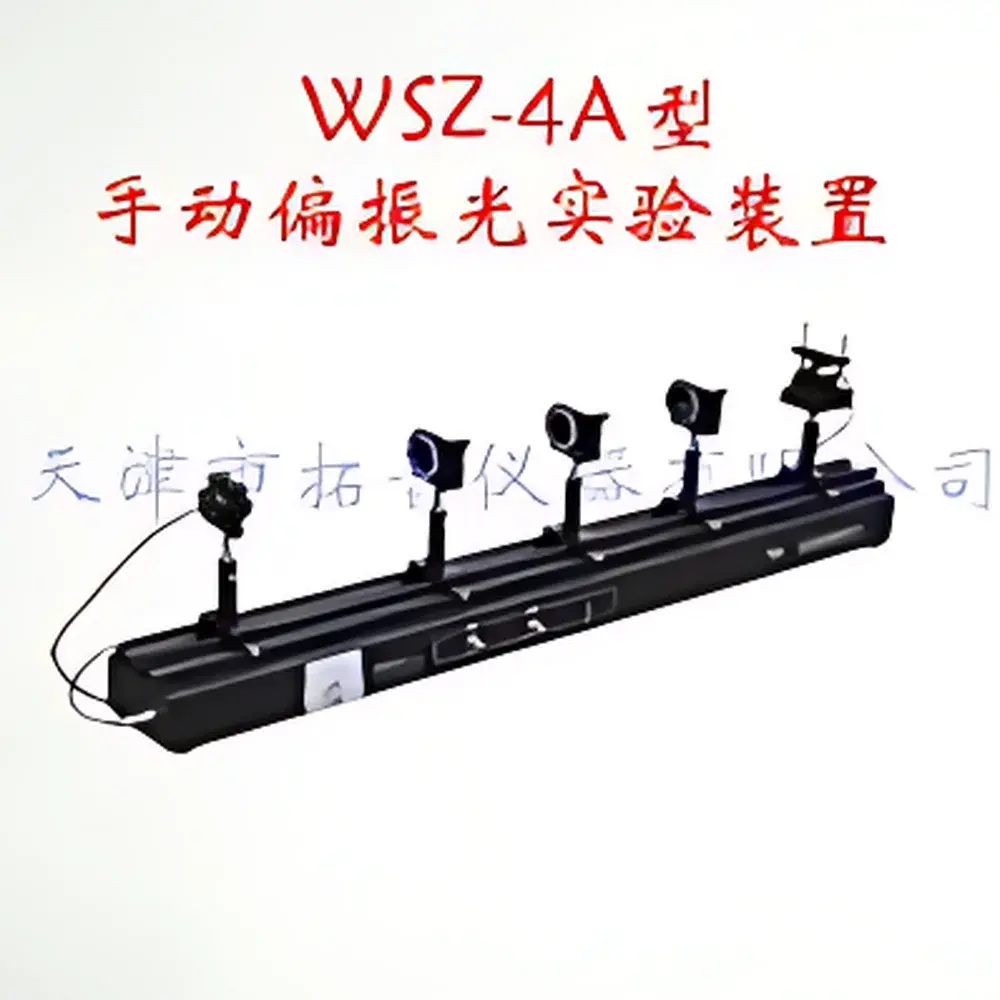
Topo WSZ-4A Manual Polarization Experiment System
| Brand | Topo |
|---|---|
| Model | WSZ-4A |
| Origin | Tianjin, China |
| Manufacturer Type | Direct Manufacturer |
| Category | Domestic Optical Instrument |
| Key Components | Manual X-axis Rotational Mount, Light Source Adjuster, Detector Mount, λ/2 and λ/4 Waveplates, Semiconductor Laser (650 nm), Linear Polarizers, Precision Optical Goniometer, Collimating Lenses, White Light Source, Photodetector Unit, Integrated Optical Rail with Embedded Voltage Monitoring Circuit |
| Display | Analog Voltage Meter Indicating Polarization State |
| Compliance | Designed for Undergraduate Physics Lab Use per ISO/IEC 17025 Educational Equipment Guidelines |
Overview
The Topo WSZ-4A Manual Polarization Experiment System is a pedagogically optimized optical teaching platform engineered to demonstrate fundamental principles of polarized light propagation, interaction, and analysis. Based on classical electromagnetic wave theory, the system implements controlled polarization state generation and detection through Malus’ law, Fresnel reflection/transmission coefficients, and Jones matrix formalism. Unlike automated polarimeters used in industrial QC or pharmaceutical analysis, the WSZ-4A emphasizes hands-on manipulation of optical elements—enabling students to physically rotate polarizers, insert waveplates at defined orientations, and directly correlate angular position with photodetector output voltage. This tactile approach reinforces conceptual understanding of linear, circular, and elliptical polarization; Brewster’s angle determination via intensity minima; and dichroic polarization by selective absorption. The integrated voltage meter provides real-time analog feedback proportional to transmitted irradiance, serving as both a quantitative readout and a calibration reference for subsequent digital data acquisition.
Key Features
- Modular mechanical architecture: Precision-machined aluminum optical rail (600 mm length) with calibrated T-slots accommodates all mounts and components with ±0.1° angular repeatability.
- Dual-light-source capability: Includes a collimated 650 nm semiconductor laser (Class II, <1 mW) for high-contrast interference and polarization contrast experiments, plus a broadband white LED source (380–750 nm) for wavelength-dependent birefringence studies.
- Comprehensive component set: Supplied with two high-extinction-ratio linear polarizers (OD > 4 at 650 nm), one λ/2 plate and one λ/4 plate (both AR-coated for visible spectrum), and a manually adjustable optical goniometer (0–360°, vernier scale resolution 0.1°).
- Embedded signal monitoring: Built-in analog voltmeter (0–5 V full-scale, ±1% accuracy) directly interfaces with the photodetector output, eliminating external multimeter dependency and reducing setup complexity.
- Educational alignment aids: Laser alignment targets, centering screws on all mounts, and engraved angular scales on rotational stages ensure rapid, reproducible optical alignment—critical for undergraduate lab efficiency and error minimization.
Sample Compatibility & Compliance
The WSZ-4A is not designed for sample analysis but for controlled optical element characterization. It supports insertion of birefringent samples (e.g., calcite crystals, stressed acrylic plates, liquid crystal cells) between crossed polarizers to visualize isochromatics and isoclinics. All optical components comply with ISO 10110-7 surface quality standards (scratch-dig 60-40). The system meets IEC 61000-6-3 EMC emission limits for educational environments and conforms to GB/T 22977–2008 (Chinese national standard for optical teaching apparatus). While not certified for GLP or ISO 17025 accredited testing, its mechanical stability and component traceability support documented lab exercises aligned with ABET-accredited physics curriculum outcomes.
Software & Data Management
The WSZ-4A operates entirely in manual mode with no proprietary software requirement. However, its analog voltage output (0–5 V, BNC connector) is compatible with standard data acquisition systems—including National Instruments DAQmx, Arduino-based ADC modules (e.g., ADS1115), and PASCO Capstone—enabling time-resolved polarization dynamics recording. Users may export voltage vs. rotation angle datasets for curve fitting (e.g., cos²θ validation of Malus’ law) or FFT analysis of periodic intensity modulation. All calibration procedures—including zero-offset adjustment and gain scaling—are documented in the bilingual (English/Chinese) lab manual, which includes traceable references to ASTM E2500-13 (Standard Guide for Specification Writing for Pharmaceutical and Biotechnology Equipment) for instructional equipment documentation rigor.
Applications
- Undergraduate optics laboratories: Verification of Malus’ law, measurement of Brewster’s angle on glass and acrylic substrates, demonstration of quarter-wave retardation converting linear to circular polarization.
- Advanced lab courses: Quantitative analysis of stress-induced birefringence using photoelasticity methods; spectral dependence of polarizer extinction ratio across visible wavelengths.
- Teacher training workshops: Scaffolded experiment design—from qualitative observation to quantitative modeling—using low-cost, repairable hardware.
- STEM outreach programs: Visual polarization demonstrations (e.g., LCD screen polarization filtering, glare reduction with polarized sunglasses) linked to real-world applications in display technology and remote sensing.
FAQ
Is the WSZ-4A compatible with computer-based data logging?
Yes—the photodetector’s analog voltage output is accessible via a standard BNC port and supports sampling rates up to 10 kHz with appropriate DAQ hardware.
Can the semiconductor laser be replaced with other wavelengths?
The mount accepts any 5.6 mm diameter laser diode module with compatible driver voltage (3–5 V DC); however, waveplate retardation is wavelength-specific and must be recalibrated.
Does the system include calibration certificates for optical components?
No formal NIST-traceable certificates are provided, but nominal specifications (e.g., polarizer extinction ratio ≥10⁴, waveplate retardation tolerance ±λ/30 at 650 nm) are verified during final assembly and recorded in the unit-specific test report.
What safety standards does the laser comply with?
The included 650 nm laser complies with IEC 60825-1:2014 Class 2 requirements (<1 mW output, inherent eye safety under blink-reflex conditions).
Is technical support available in English for international institutions?
Yes—Topo provides English-language documentation, video setup guides, and email-based engineering support (response time ≤3 business days) for academic customers outside mainland China.




