
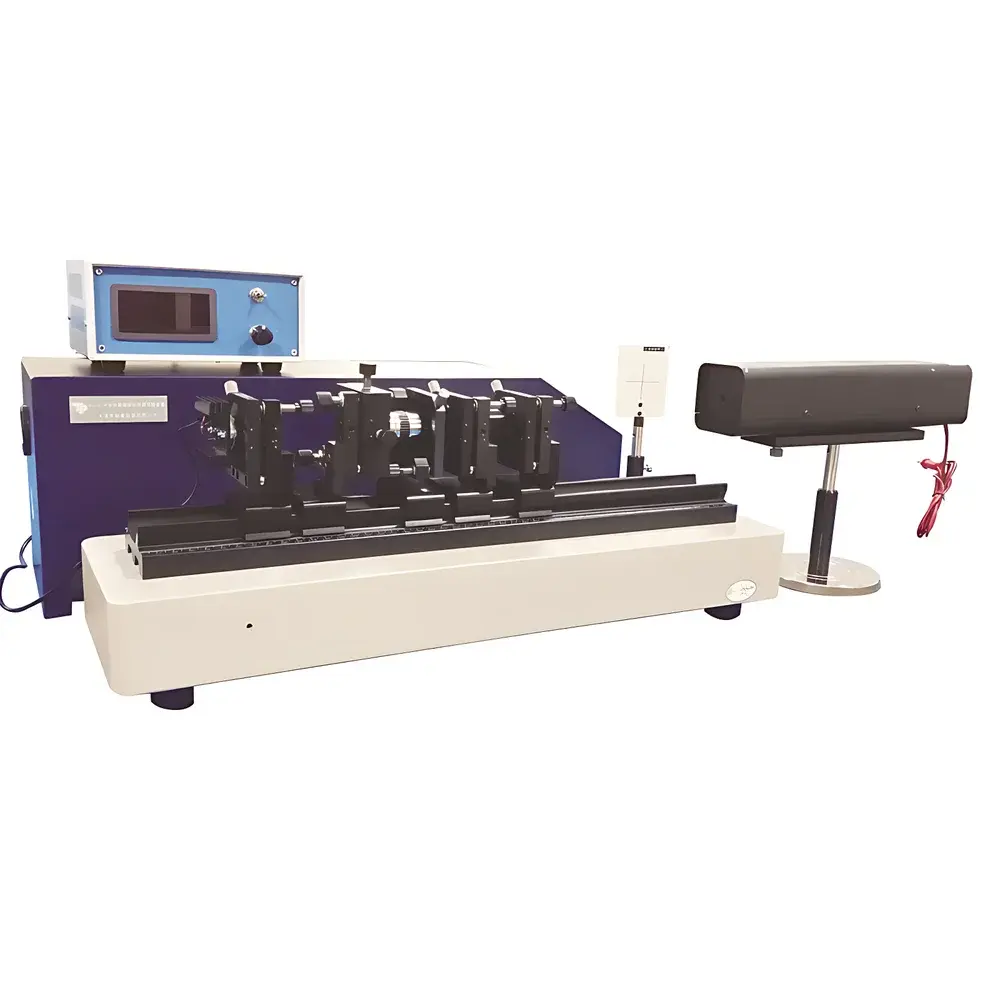
Topo XGL-2A Semiconductor Pumped Laser Principle Experiment System
| Brand | Topo (TP) |
|---|---|
| Origin | Tianjin, China |
| Manufacturer Type | Direct Manufacturer |
| Product Origin | Domestic |
| Model | XGL-2A |
| Price Range | USD 1,400 – 7,000 |
Overview
The Topo XGL-2A Semiconductor Pumped Laser Principle Experiment System is a pedagogical optical instrumentation platform engineered for undergraduate and graduate-level instruction in modern physics, quantum electronics, and nonlinear optics. It implements a diode-pumped solid-state (DPSS) laser architecture based on the fundamental principles of stimulated emission, cavity resonance, and second-harmonic generation (SHG). The system integrates an 808 nm semiconductor laser diode (LD) as the pump source, a Nd:YVO4 gain medium operating at 1064 nm, and a type-II phase-matched KTP crystal for efficient frequency doubling to 532 nm green light. Designed explicitly for hands-on laboratory pedagogy, the XGL-2A enables students to assemble, align, and characterize a complete DPSS laser system — from threshold determination and slope efficiency measurement to angular phase-matching verification and beam parameter analysis — under controlled, safe, and reproducible conditions.
Key Features
- Modular, optomechanically stable architecture built on a precision-calibrated 1000 mm × 80 mm aluminum optical rail with 1 mm scale resolution and compatible kinematic mounts
- Dual-wavelength alignment and diagnostic capability: integrated He–Ne laser (632.8 nm, ≥1.5 mW, TEM00) with safety-rated high-voltage connectors and rigid mounting
- Optimized crystal set: Nd:YVO4 (3 × 3 × 1 mm, AR-coated at 1064 nm) and KTP (2 × 2 mm, AR-coated for both 532 nm and 1064 nm)
- Adjustable optical components: two-axis pump LD mount, three-axis focusing objective mount (10× microscope objective), two-axis crystal and output coupler mounts, knife-edge and aperture assemblies
- Dual-band power detection: calibrated laser power meter covering 532 nm, 633 nm, and 650 nm wavelengths with 0–200 mW range and 0.001 µW display resolution
- Comprehensive educational support: structured lab manual, technical documentation, and standardized experimental procedures aligned with university physics curricula
Sample Compatibility & Compliance
The XGL-2A is designed for use with standard solid-state laser materials and common nonlinear optical crystals. All optical coatings meet ISO 10110 surface quality specifications (scratch-dig 20–10), and laser safety components comply with IEC 60825-1:2014 Class 3R requirements when operated within specified power limits. The system supports quantitative experiments consistent with ASTM E1423–20 (Standard Guide for Measurement of Laser Beam Parameters) and facilitates data collection methods suitable for GLP-compliant academic reporting. No hazardous chemicals or vacuum subsystems are required; operation is confined to ambient laboratory environments.
Software & Data Management
The XGL-2A operates as a hardware-only educational platform with no embedded firmware or proprietary software. All measurements — including pump power, fundamental and SHG output power, beam profile width (via knife-edge scan), and far-field divergence angle — are acquired using external analog/digital instruments (e.g., power meters, photodiodes, CCD beam profilers) and recorded manually or via third-party acquisition tools (e.g., LabVIEW, Python-based PyVISA scripts). This design emphasizes foundational metrology skills and ensures full transparency in data provenance, supporting audit-ready lab notebooks compliant with institutional academic integrity policies.
Applications
- Characterization of diode-pumped solid-state laser thresholds and slope efficiencies
- Experimental verification of phase-matching conditions in birefringent nonlinear crystals
- Measurement of second-harmonic conversion efficiency as a function of pump intensity and crystal angle
- Beam propagation analysis: M2-relevant parameters (beam waist, Rayleigh range, divergence) derived via knife-edge and scanning-slit techniques
- Comparative study of thermal lensing effects in Nd:YVO4 under varying pump duty cycles
- Introduction to cavity stability criteria, mode matching, and resonator alignment sensitivity
FAQ
Is the XGL-2A compatible with data acquisition systems such as National Instruments DAQ or Arduino-based sensors?
Yes — all optical outputs (fundamental and SHG beams) and detector signals are accessible via standard BNC or SMA interfaces; analog voltage outputs from the included power meter can be directly interfaced with external DAQ hardware.
Does the system include safety interlocks or emission indicators?
No integrated electronic interlocks are provided; however, the He–Ne alignment laser includes certified Class 2 safety labeling, and the 808 nm pump diode is housed in a fully enclosed, interlocked module per IEC 60825-1 Annex D requirements.
Can the Nd:YVO4 and KTP crystals be replaced with alternative gain or nonlinear media?
Yes — the crystal mounts are standardized kinematic platforms (SM1-threaded), enabling substitution with other AR-coated Nd-doped crystals (e.g., Nd:YAG, Nd:YLF) or SHG crystals (e.g., LBO, BBO) subject to appropriate cavity re-optimization.
What calibration standards are traceable for the included power meter?
The power sensor is factory-calibrated against NIST-traceable reference detectors at 532 nm and 633 nm; calibration certificates are supplied with each unit upon request.
Is technical support available for curriculum integration or custom experiment development?
Topo provides application engineering consultation for course mapping, lab syllabus alignment, and advanced experiment extension — delivered via secure remote collaboration and documented in English-language technical bulletins.




