
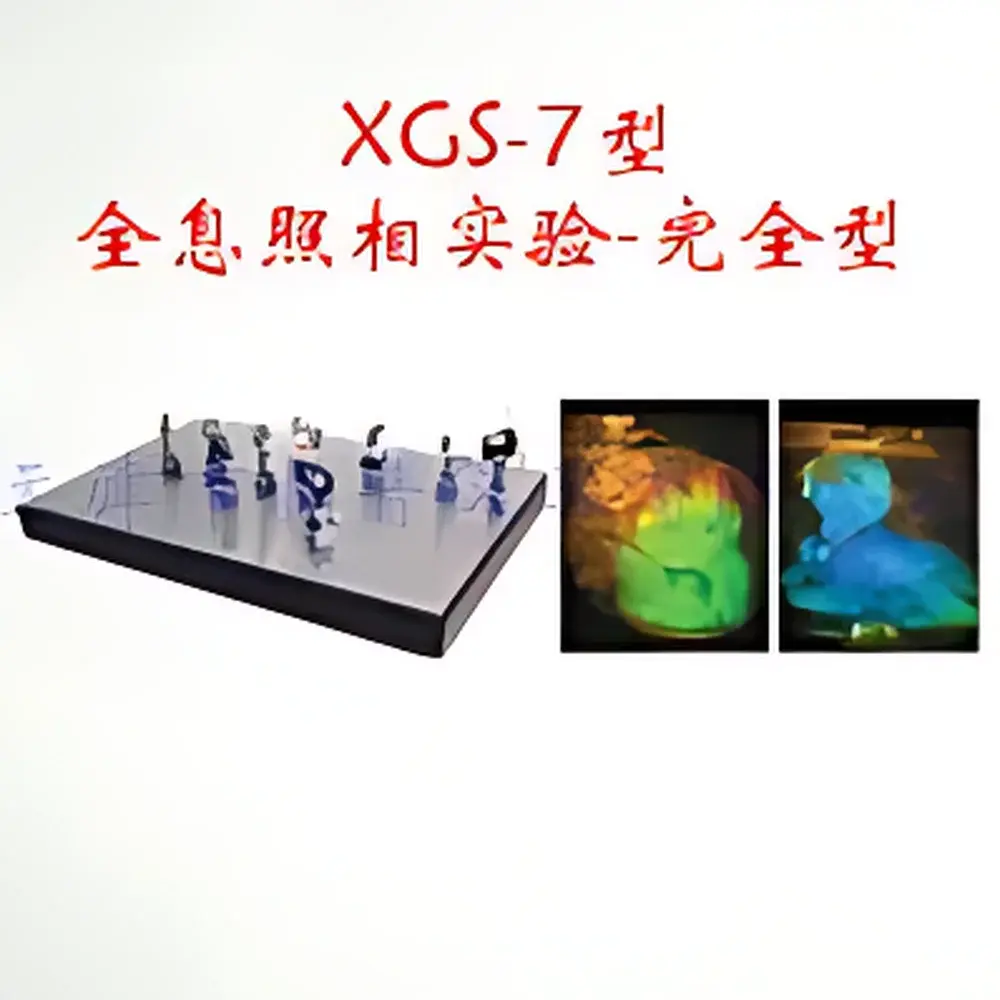
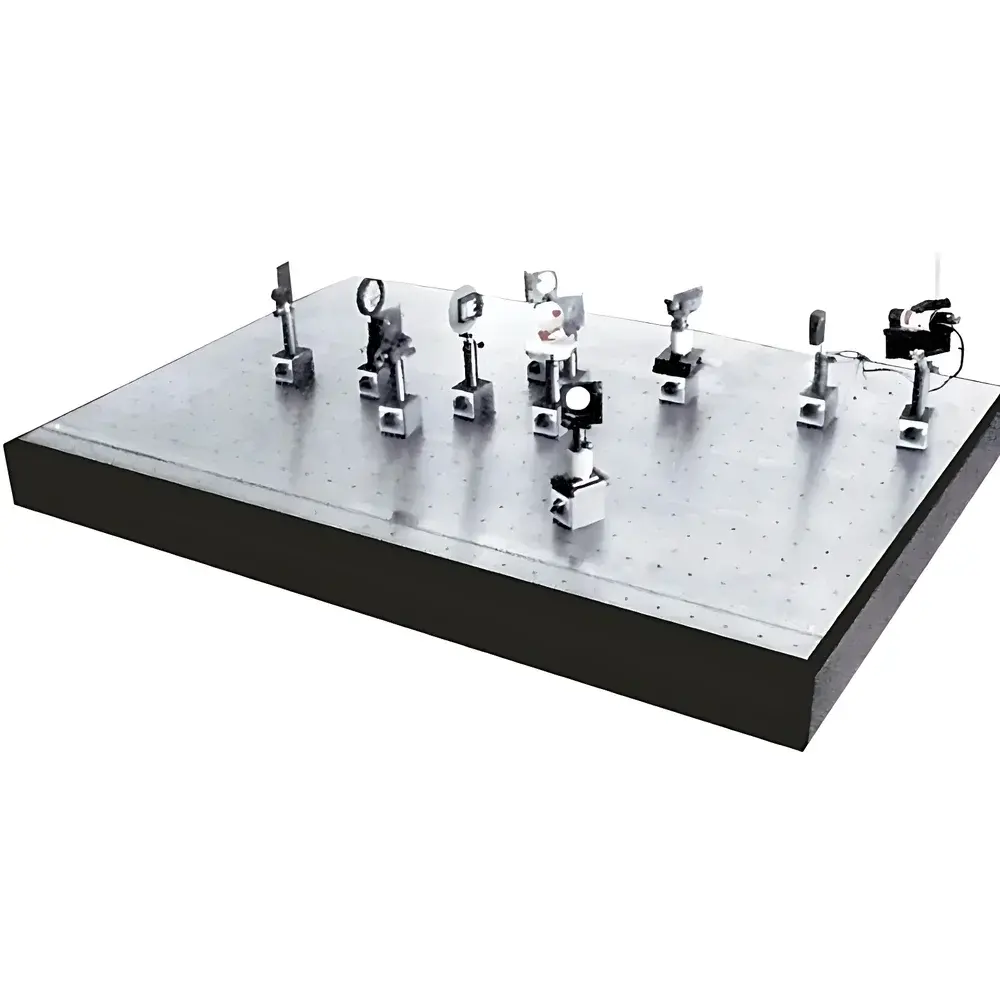
Topo XGS-7 Holography Experiment System – Complete Edition
| Brand | Topo/TP |
|---|---|
| Origin | Tianjin, China |
| Manufacturer Type | Direct Manufacturer |
| Country of Origin | China |
| Model | XGS-7 |
| Pricing | Upon Request |
| Light Source | 40 mW Semiconductor Laser |
| Recording Media | Photopolymer & Silver-Halide Holographic Plates |
| Operating Environments | Ambient Light (White-Light Room) & Darkroom |
| Exposure Control | Digital Electronic Timer (Manual & Auto Modes) |
| Safety Illumination | Red/Yellow/Green Darkroom Lamps |
| Optional Accessories | Portable Lux Meter (Wide Range, High Accuracy) |
Overview
The Topo XGS-7 Holography Experiment System – Complete Edition is a pedagogically optimized, research-capable optical platform engineered for comprehensive instruction and hands-on exploration of holographic principles and techniques. Based on the fundamental physics of coherent light interference and diffraction, the system enables precise recording and reconstruction of both transmission and reflection holograms under controlled optical conditions. It supports classical holographic configurations—including Denisyuk (reflection), Gabor (in-line), rainbow (single-step and two-step), image-plane, and volume holograms—as well as practical applications such as holographic grating fabrication and high-density optical data storage demonstrations. Designed for university physics laboratories, optics teaching centers, and undergraduate research modules, the XGS-7 integrates industrial-grade stability with academic flexibility, allowing users to implement standard curricular experiments while also developing custom interferometric setups.
Key Features
- Dual-recording-medium capability: Compatible with both silver-halide emulsions (high sensitivity, fine grain, archival stability) and photopolymer plates (dry processing, ambient-light handling, rapid development)
- Stable 40 mW continuous-wave semiconductor laser source with TEM00 mode output, wavelength typically at 650 nm or 532 nm (configurable per order), offering long operational lifetime (>10,000 hours) and low power drift (<±2% over 4 hours)
- Digital electronic exposure timer with LED display, supporting manual trigger and programmable durations from 0.1 s to 999.9 s in 0.1 s increments
- Multi-spectrum darkroom illumination system: Independent red (625 nm), yellow (590 nm), and green (525 nm) safelights with adjustable intensity—each certified for spectral compatibility with common holographic emulsions
- Modular optical breadboard base (600 × 450 mm, M6 tapped holes) with kinematic mounts, beam splitters, mirrors, lenses, and spatial filters included as standard equipment
- Expandable architecture: Supports integration of optional components including vibration-isolated optical tables, spatial light modulators (SLMs), CCD-based real-time reconstruction monitors, and USB spectrometers for wavelength characterization
Sample Compatibility & Compliance
The XGS-7 accommodates standard-format holographic plates (e.g., 10 × 12.5 cm silver-halide plates and 10 × 12.5 cm photopolymer sheets), with adjustable holder stages enabling angular alignment within ±5°. All optical components comply with ISO 10110-7 (surface quality) and ISO 9022-3 (environmental resistance). The laser subsystem conforms to IEC 60825-1:2014 Class 3R safety requirements, and includes integrated key-switch interlock, emission indicator LED, and beam shutter. Documentation includes full CE-conformity declarations, laser safety training materials aligned with ANSI Z136.1–2022, and lab setup guidelines compliant with university-level radiation safety protocols.
Software & Data Management
While the XGS-7 operates as a hardware-dominant analog-optical platform, it interfaces seamlessly with third-party acquisition and analysis tools. The included portable lux meter outputs analog voltage (0–5 V) and RS-232 signals, compatible with LabVIEW™, MATLAB®, and Python-based logging scripts (sample Jupyter notebooks provided). Experimental parameters—including exposure time, incident irradiance (mW/cm²), plate type, and reconstruction geometry—are recorded via standardized lab report templates aligned with AAPT (American Association of Physics Teachers) curriculum standards. Audit trails for calibration logs, maintenance records, and student experiment metadata can be maintained in accordance with GLP-compliant documentation practices.
Applications
- Undergraduate optics laboratories: Interference fringe analysis, coherence length measurement, diffraction-limited resolution testing
- Holographic imaging education: Reconstruction angle dependence, wavelength selectivity, Bragg condition verification
- Optical data storage labs: Bit-error-rate evaluation in multiplexed holographic memory architectures
- Materials science projects: Characterization of photopolymer shrinkage, refractive index modulation (Δn), and diffraction efficiency vs. exposure dose
- Engineering design courses: Custom holographic optical element (HOE) prototyping, diffractive beam shaping, and wavefront reconstruction validation
FAQ
What types of holograms can be produced with the XGS-7?
Transmission, reflection (Denisyuk), rainbow (one-step and two-step), image-plane, Fourier-transform, and volume holograms—all using either silver-halide or photopolymer media.
Is the system suitable for use outside a dedicated optics lab?
Yes—the compact footprint (750 × 550 × 220 mm), integrated darkroom lighting, and white-light-compatible photopolymer workflow enable deployment in general-purpose teaching spaces with minimal infrastructure.
Does the system support quantitative diffraction efficiency measurements?
Yes—when paired with the optional calibrated lux meter and reference photodiode, users can calculate absolute diffraction efficiency using standard ISO 14644-1 methodology for optical component characterization.
Are safety certifications included with shipment?
Yes—each unit ships with IEC 60825-1 Class 3R compliance documentation, laser safety eyewear (OD 4+ at operating wavelength), and a complete set of institutional laser safety officer (LSO)-reviewable setup checklists.
Can the XGS-7 be upgraded for digital holography applications?
Yes—via optional add-ons including CMOS-based digital holographic microscopy (DHM) kits, phase-shifting interferometry modules, and FPGA-accelerated reconstruction engines compatible with MATLAB and Python APIs.




