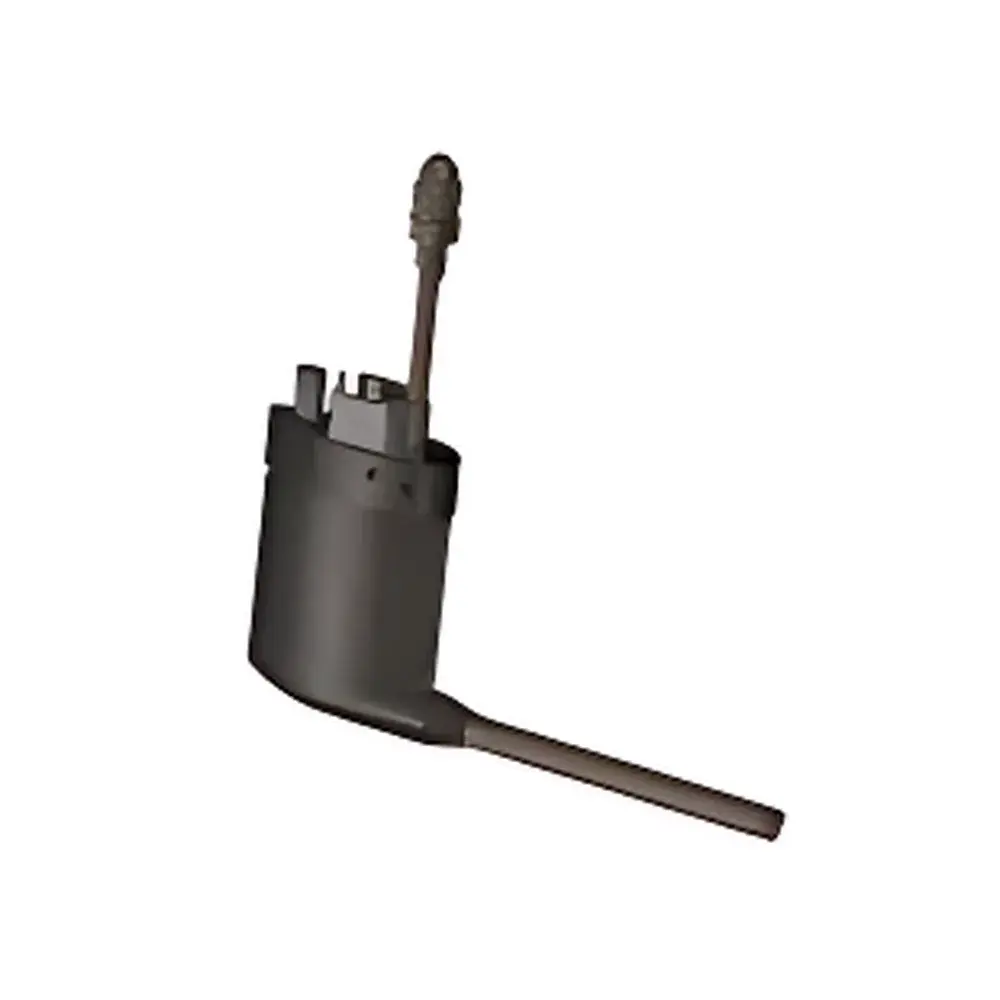
Total Pressure Probe (Pitot Tube) 4380 Series L-Type
| Brand | — |
|---|---|
| Origin | Beijing, China |
| Manufacturer Type | Authorized Distributor |
| Origin Category | Domestic (China-made) |
| Model | 4380 Series L-Type |
| Pricing | Upon Request |
| Dimensions (in/mm) | 2.86 × 6.36 in (72.64 × 162.54 mm) |
| Mass | 0.35 lb (0.159 kg) |
| Max Calibrated Equivalent Airspeed | 450 knots |
| Heating | Integrated heater for total pressure port |
| Aircraft Compatibility | Fixed-wing aircraft, rotary-wing aircraft, UAVs |
| Mechanical Interface | Requires AN5812 and AN5814 fittings |
| Documentation | CAD models and dimensional/technical specification PDF available |
Overview
The 4380 Series L-Type Total Pressure Probe (commonly referred to as a Pitot tube) is an aerodynamic sensing device engineered for precise measurement of stagnation (total) pressure in airflow environments typical of flight test, wind tunnel validation, and onboard air data systems. Operating on the fundamental principle of fluid dynamics—where total pressure equals static pressure plus dynamic pressure—the probe captures the full pressure rise experienced by air brought to rest isentropically at its forward-facing orifice. Its L-shaped configuration enables compact installation in constrained airframe locations while maintaining minimal flow disturbance and consistent pressure recovery characteristics across a broad Mach and angle-of-attack range. Designed for integration into certified and non-certified platforms, this probe supports primary and auxiliary air data functions including airspeed computation, altitude derivation (when paired with static pressure sensors), and flight control system inputs.
Key Features
- L-shaped structural geometry optimized for flush or semi-flush mounting on fuselage, wing leading edges, or empennage surfaces
- Integrated resistive heating element at the total pressure port to prevent ice accumulation during high-humidity or sub-zero operational conditions
- Stainless steel construction (304 or equivalent) ensuring mechanical robustness, corrosion resistance, and long-term dimensional stability under thermal cycling
- Standardized 1/8″ NPT or AN-type pressure port interface compatible with industry-standard tubing and transducer connections
- Calibrated performance traceable to NIST-traceable reference standards; calibration certificate available upon request
- Low-profile external dimensions (72.64 mm × 162.54 mm) and lightweight design (0.159 kg) minimize aerodynamic drag and inertial loading
Sample Compatibility & Compliance
The 4380 Series L-Type probe is validated for use on fixed-wing general aviation aircraft, turbine-powered business jets, rotorcraft (including helicopters and tiltrotors), and unmanned aerial vehicles (UAVs) operating up to 450 knots calibrated airspeed (CAS). It meets baseline mechanical interface requirements per SAE AS5812 (for mounting flanges) and AS5814 (for threaded pressure fitting specifications). While not inherently certified to DO-160 or EASA CS-25 Annex A without system-level qualification, the probe’s materials, thermal management, and pressure response characteristics align with environmental testing profiles applicable to Category A and B avionics installations. It supports compliance pathways for FAA Part 23/27/29 and EASA CS-23 amendments when integrated into air data systems undergoing full DO-254/DO-178C certification.
Software & Data Management
As a passive analog sensor, the 4380 Series probe outputs raw total pressure as a pneumatic signal—requiring connection to a calibrated pressure transducer (e.g., piezoresistive or capacitive type) for conversion into digital voltage or current (typically 0–5 VDC or 4–20 mA). When interfaced with modern air data computers (ADCs) or data acquisition systems (e.g., NI CompactRIO, Curtiss-Wright DAQ units), it supports time-synchronized logging compliant with ARINC 429, CAN bus (SAE J1939), or Ethernet-based protocols (e.g., UDP over Avionics Full-Duplex Switched Ethernet). All associated calibration data—including temperature-compensated pressure coefficients and uncertainty budgets—is documented in accordance with ISO/IEC 17025 principles and supports audit-ready traceability for GLP and GMP-aligned test programs.
Applications
- Flight test instrumentation for certification and performance envelope expansion
- Wind tunnel model testing where spatial constraints limit probe placement options
- UAV air data subsystems requiring low-mass, low-drag sensing solutions
- Engine inlet pressure monitoring and thrust calculation support
- Redundant total pressure sensing in dual-channel air data architectures
- Ground-based atmospheric research stations measuring wind speed profiles via pitot-static arrays
FAQ
Is the 4380 Series L-Type probe certified for use in Part 23 certified aircraft?
No standalone certification is issued for the probe itself; airworthiness approval requires integration into a qualified air data system and demonstration of compliance with applicable sections of FAR Part 23 Appendixes A and B.
What is the maximum operating temperature range for the heated version?
The integrated heater supports continuous operation from –55 °C to +70 °C ambient, with surface temperature limited to ≤120 °C to prevent polymer degradation in adjacent airframe components.
Can this probe be used for subsonic and transonic applications?
Yes—its pressure recovery coefficient remains stable up to Mach 0.85 at zero angle of attack; supersonic use requires shock-corrected calibration and is not recommended without wind tunnel validation.
Does the probe include static pressure sensing capability?
No—this is a total pressure-only probe; static pressure must be measured separately using a dedicated static port or combined pitot-static probe.
Are CAD models provided in standard formats?
Yes—STEP (.stp), IGES (.igs), and Parasolid (.x_t) files are supplied with purchase, along with GD&T-annotated drawings compliant with ASME Y14.5.