
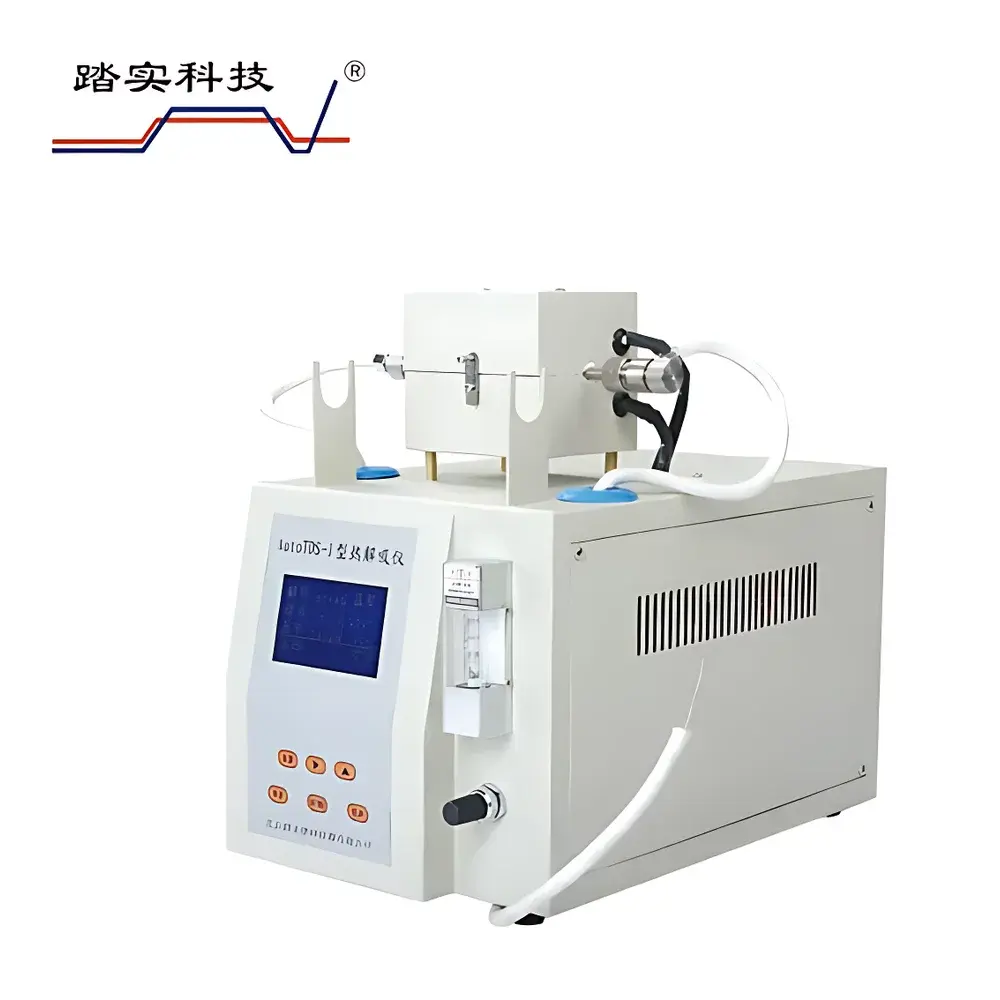
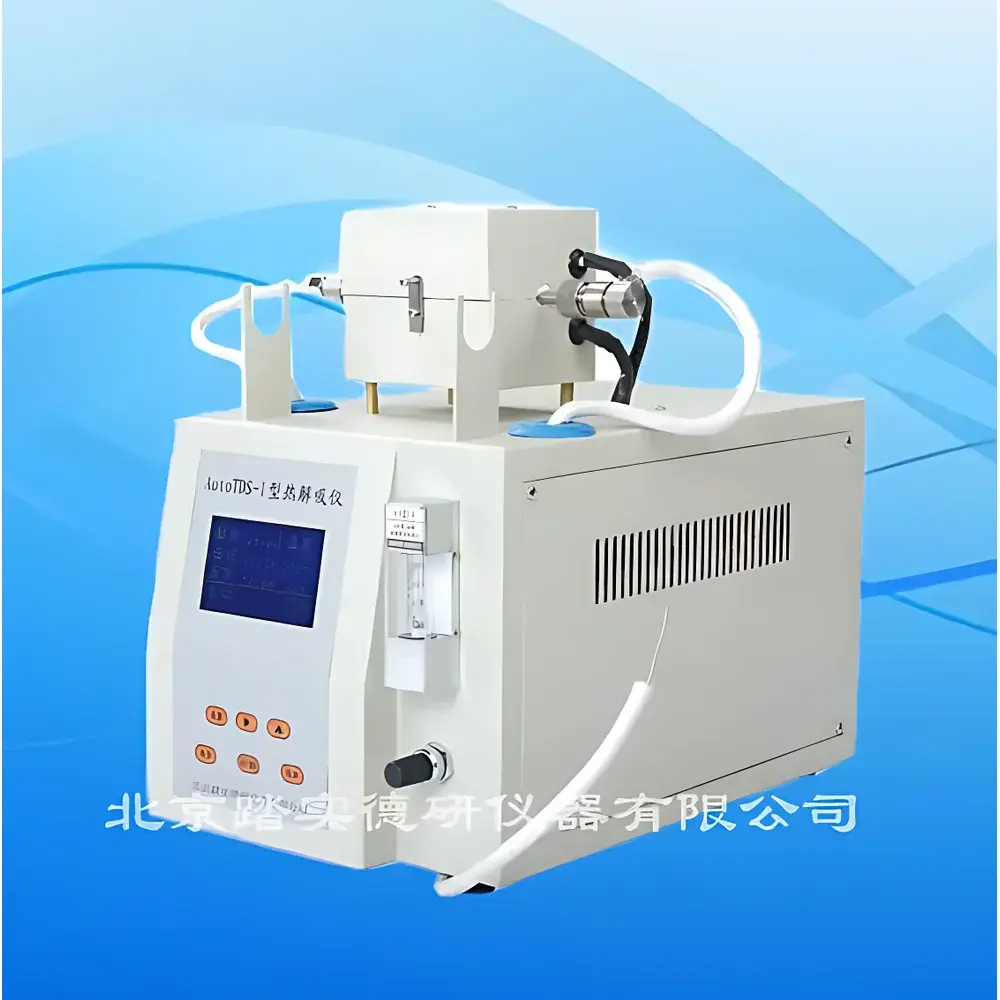
TouchScience AutoTDS-I Automated Thermal Desorber
| Brand | TouchScience |
|---|---|
| Model | AutoTDS-I |
| Origin | Beijing, China |
| Manufacturer Type | Direct Manufacturer |
| Instrument Type | Single-Stage Thermal Desorber |
| Automation Level | Semi-Automated (Programmable Sequence Control) |
| Desorption Heater Temperature Range | 50–380 °C |
| Transfer Line Temperature Range | 50–180 °C |
| Temperature Control Accuracy | ±1 °C |
| Sample Position Capacity | 1 tube |
| Power Supply | 220 VAC, 50 Hz |
| Power Consumption | <200 VA |
| Timing Range | 1 s to 99 min 59 s |
| Timing Accuracy | <0.1% |
| Pneumatic System Pressure Rating | >0.4 MPa |
| Synchronization Outputs | Two TTL-compatible switch signals (1–2 s duration) |
| Dimensions (H×W×D) | 300 mm × 200 mm × 350 mm |
| Compliance | GB 50325–2020, HJ 583–2010 |
Overview
The TouchScience AutoTDS-I Automated Thermal Desorber is a benchtop, single-stage thermal desorption system engineered for precise, reproducible release of volatile and semi-volatile organic compounds (VOCs and SVOCs) from sorbent tubes prior to gas chromatographic analysis. It operates on the principle of controlled thermal desorption—where analytes adsorbed onto packed or coated sorbent media (e.g., Tenax TA, Carbopack B/C, or multi-bed traps) are thermally volatilized under inert carrier gas flow, then transferred quantitatively into a GC inlet via a heated transfer line. Unlike fully automated high-throughput systems, the AutoTDS-I implements programmable sequence control over three critical phases: tube heating and desorption, GC injection (via electrically actuated 6-port valve), and post-desorption purging (backflush). Its dual-zone independent temperature control—separate setpoints for the sample tube heater block and transfer line—ensures minimal condensation and optimal analyte transfer efficiency. Designed for integration with standard split/splitless inlets and GC data systems, it delivers synchronized TTL-level trigger pulses to initiate GC oven ramping and data acquisition at the exact moment of analyte introduction.
Key Features
- Microprocessor-based controller with user-programmable method storage for repeatable desorption protocols
- Dual independent heating zones: sample tube heater (50–380 °C) and transfer line (50–180 °C), each with ±1 °C stability
- Robust pneumatic architecture using motorized 6-port valve and solenoid valves for reliable, low-dead-volume switching between desorption, injection, and purge modes
- Two TTL-compatible synchronization outputs (1–2 s pulse width) for deterministic triggering of GC start time and data system acquisition
- Integrated timing module with adjustable resolution from 1 second to 99 minutes 59 seconds and <0.1% timing accuracy
- Onboard simulation mode for calibration verification and method development without consumable tube usage
- Compact footprint (300 × 200 × 350 mm) suitable for shared lab benches and regulated analytical environments
Sample Compatibility & Compliance
The AutoTDS-I accepts standard 6 mm OD stainless steel or quartz sorbent tubes (e.g., ASTM D6196-compliant formats) and supports both single-bed and multi-bed configurations. It is validated for use with EPA TO-17, ISO 16017-1, and Chinese national standards including GB 50325–2020 (Control Standard for Indoor Environmental Pollution in Civil Building Engineering) and HJ 583–2010 (Determination of Aromatic Hydrocarbons in Ambient Air by Solid Adsorption/Thermal Desorption–Gas Chromatography). While not certified for 21 CFR Part 11 compliance out-of-the-box, its deterministic timing, method logging capability, and hardware-triggered synchronization support audit-ready workflows when deployed within GLP- or GMP-aligned laboratories using validated software platforms.
Software & Data Management
The AutoTDS-I operates as a hardware controller with embedded firmware; no proprietary PC software is required for basic operation. All method parameters—including temperature ramps, hold times, valve sequencing logic, and sync pulse timing—are configured locally via membrane keypad and LCD interface. For traceability, users may manually log method IDs, operator initials, and tube lot numbers in laboratory notebooks or LIMS. When integrated with chromatography data systems (CDS) such as Thermo Chromeleon, Agilent OpenLab, or Shimadzu GCsolution, the instrument’s TTL triggers ensure unambiguous alignment between desorption events and chromatographic run metadata. Optional RS-232 or USB-to-serial adapters enable external script-based control for labs implementing custom automation frameworks.
Applications
- Indoor air quality monitoring: quantification of benzene, toluene, ethylbenzene, xylenes (BTEX), formaldehyde precursors, and other priority VOCs per GB 50325–2020
- Ambient air analysis for regulatory reporting under HJ 583–2010 and local environmental protection bureau requirements
- Occupational hygiene assessments in manufacturing, printing, and coating facilities
- Material emission testing (e.g., carpets, adhesives, furniture composites) using small-chamber or micro-chamber sampling protocols
- Method development and validation studies requiring precise thermal desorption parameter optimization
FAQ
Is the AutoTDS-I compatible with all gas chromatographs?
Yes—provided the GC accepts external TTL start triggers and features a standard split/splitless inlet capable of receiving a heated transfer line (OD ≤ 1/16″). Compatibility has been verified with Agilent 7890/8890, Thermo ISQ, and Shimadzu GC-2030 systems.
Does it support cold trap focusing or cryo-concentration?
No—the AutoTDS-I is a single-stage desorber without cryogenic trapping capability. It is intended for direct transfer applications where analyte volatility and column sensitivity permit adequate detection without pre-concentration.
Can multiple tubes be processed sequentially without manual intervention?
No—this model accommodates only one tube per run. Unattended multi-tube operation requires a carousel-based autosampler add-on, which is not supported by the AutoTDS-I platform.
What maintenance is required for long-term reliability?
Routine inspection of valve seals, periodic cleaning of the transfer line interior with methanol, and annual verification of temperature sensor calibration using NIST-traceable reference thermometers are recommended.
Related Products





