
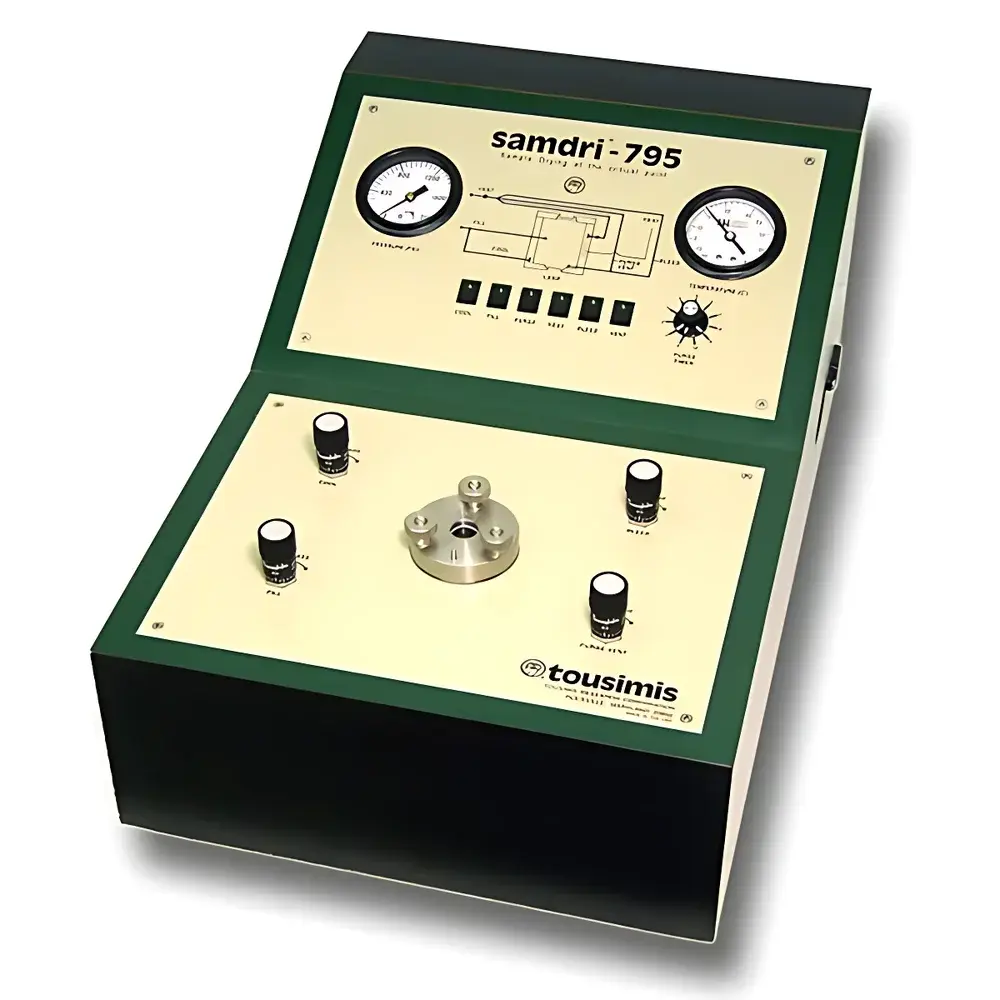
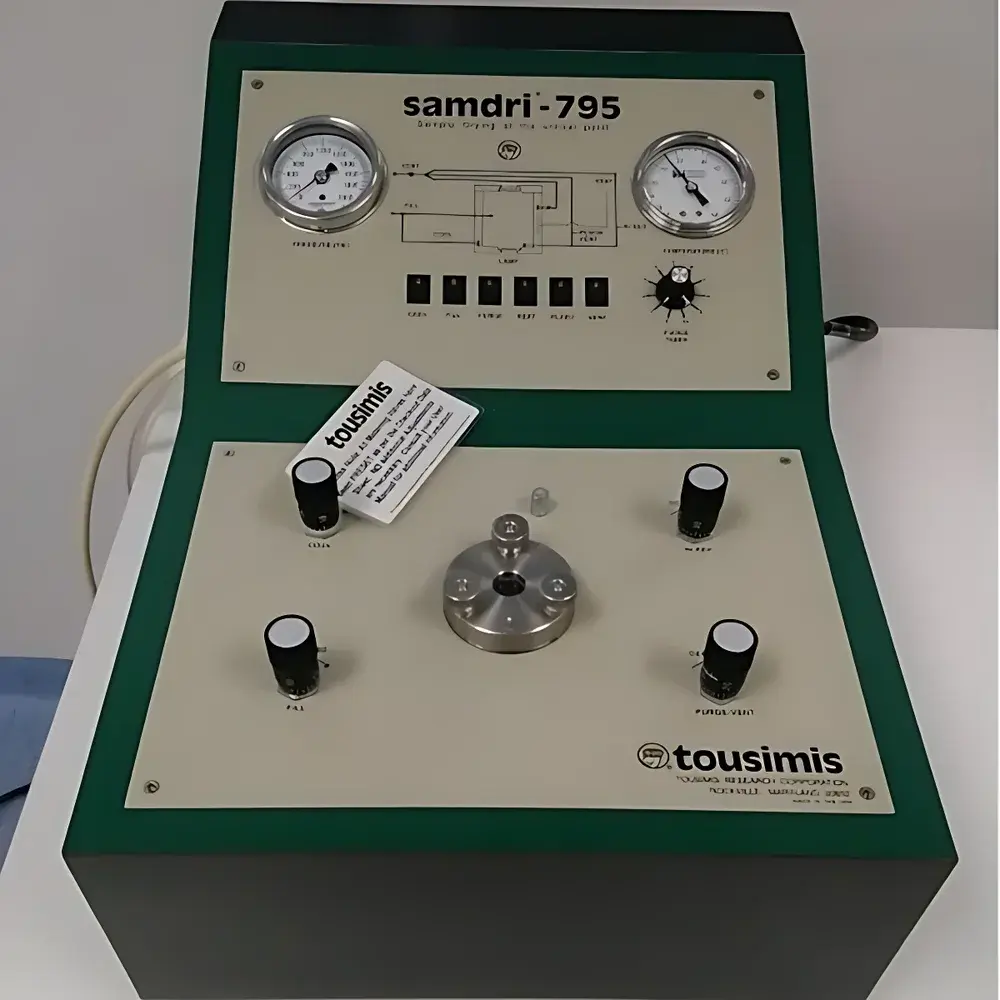
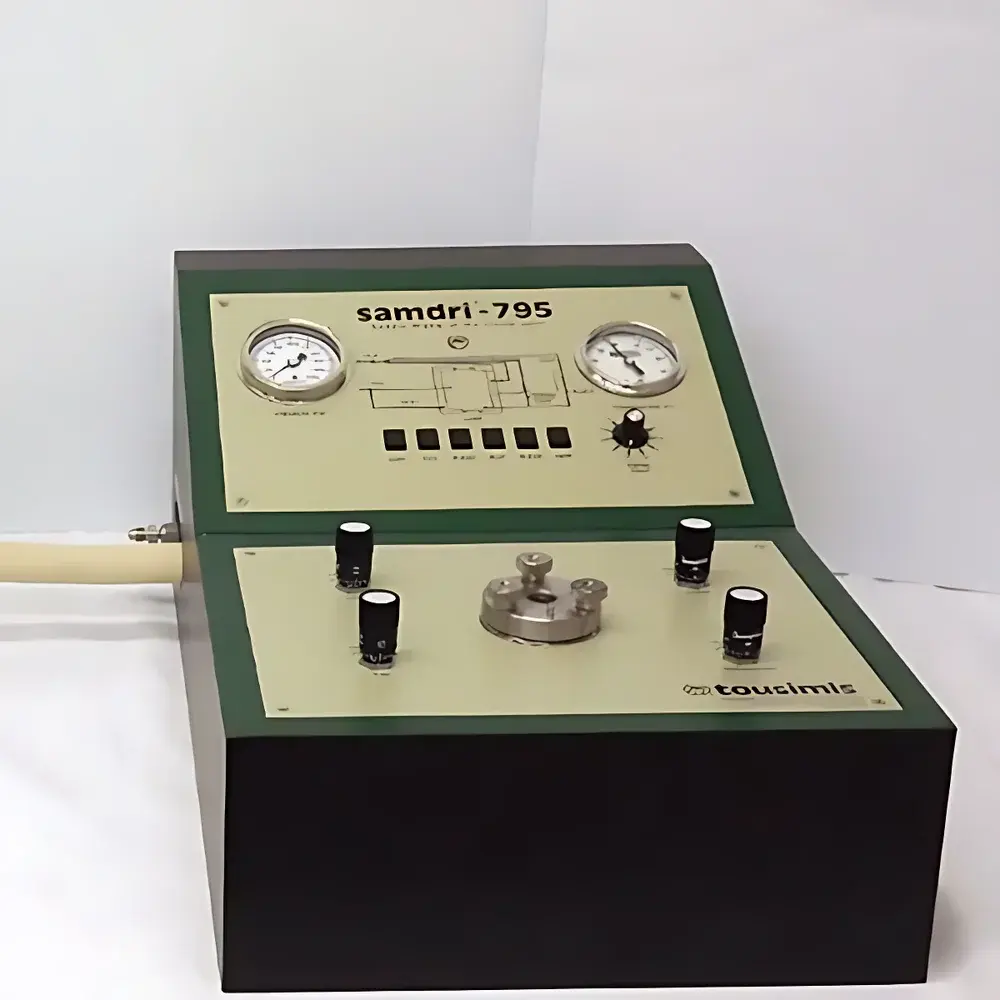
Tousimis SAMDRI-795 Semi-Automatic Critical Point Dryer
| Brand | Tousimis |
|---|---|
| Origin | USA |
| Model | SAMDRI-795 |
| Chamber ID | 1.25" |
| Temperature Range | −30 °C to 60 °C |
| Pressure Range | 0–2,000 psi |
| Control Mode | Semi-Automatic with Integrated Temperature/Pressure Regulation |
| Cooling Time | ~1 min (from ambient) |
Overview
The Tousimis SAMDRI-795 Semi-Automatic Critical Point Dryer is an engineered solution for high-fidelity sample preservation in electron microscopy (SEM/TEM), materials science, and nanotechnology laboratories. It operates on the principle of supercritical fluid drying—specifically using carbon dioxide (CO₂) as the transitional medium—to eliminate capillary forces that cause structural collapse during conventional air or vacuum drying. At its critical point (31.1 °C, 1072 psi), CO₂ exhibits zero surface tension and continuous phase behavior between liquid and gas states, enabling complete removal of solvents—such as ethanol or acetone—from hydrated or solvent-suspended specimens without inducing mechanical stress. This physical principle ensures faithful retention of delicate 3D microarchitectures found in biological tissues, hydrogels, aerogels, MOFs, carbon nanotubes, graphene monolayers, and MEMS devices. Unlike water-based critical point drying (requiring 374 °C and 3212 psi), CO₂-based drying is thermally benign and compatible with temperature-sensitive organic and polymeric matrices.
Key Features
- Semi-automatic operation with intuitive push-button interface and real-time LED status indicators for each process stage (fill, purge, heat, equilibrate, vent, cool)
- Top-loading cylindrical chamber (1.25″ internal diameter) with borosilicate viewing window for visual monitoring of sample integrity and fluid dynamics during drying cycles
- Precision-machined internal surfaces fabricated from CO₂- and high-purity ethanol-resistant alloys, ensuring long-term chemical compatibility and minimal particulate shedding
- Integrated particulate filtration system upstream of the chamber inlet, protecting both valves and samples from contaminants introduced via CO₂ supply lines
- Automated temperature–pressure coordination logic that maintains setpoint stability within defined safety margins per ASTM E2812 and ISO 16700 guidelines for supercritical processing equipment
- Rapid thermal recovery: chamber cools from operating temperature to ambient in approximately 60 seconds, minimizing turnaround time between runs
- Standard inclusion of flexible stainless-steel braided CO₂ delivery hose, liquid CO₂ particulate/water/oil filter assembly, anti-static vent exhaust tubing, and spare O-rings, chamber lamp, and fuses
Sample Compatibility & Compliance
The SAMDRI-795 accommodates a broad range of specimen types requiring non-destructive dehydration: fixed biological tissues (e.g., plant stomata, insect cuticles, mammalian cells), cryo-fixed soft materials, sol–gel-derived aerogels, porous silicon, lithographically patterned MEMS structures, and semiconductor wafers up to 100 mm (4″) in diameter. Its design conforms to standard laboratory infrastructure requirements for Class 1000 cleanroom-adjacent use (non-cleanroom variant), with optional upgrades available for ISO Class 5 integration. All control firmware supports audit-ready logging (time-stamped temperature, pressure, and valve actuation events), aligning with GLP and GMP documentation expectations where traceability is mandated. While not certified under FDA 21 CFR Part 11 out-of-the-box, the system’s deterministic sequence execution and hardware-enforced interlocks provide foundational compliance readiness for regulated environments.
Software & Data Management
As a semi-automatic platform, the SAMDRI-795 relies on embedded microcontroller logic rather than PC-hosted software. Process parameters—including target temperature, ramp rate, hold duration, and vent profile—are configured via front-panel controls and stored in non-volatile memory. Each cycle generates a timestamped operational log accessible via serial output (RS-232) for external capture into LIMS or custom data acquisition systems. The absence of graphical user interface dependencies enhances reliability in resource-constrained lab settings and reduces validation overhead. For laboratories requiring enhanced traceability, optional RS-232-to-USB adapters enable integration with third-party scripting environments (e.g., Python-based automation frameworks) for scheduled batch processing and CSV-formatted event export.
Applications
- High-resolution SEM/TEM sample preparation for ultrastructural analysis of hydrated biological specimens without shrinkage artifacts
- Drying of mesoporous metal–organic frameworks (MOFs) and silica aerogels while preserving pore volume and BET surface area
- Post-lithography release of MEMS cantilevers, microfluidic channels, and NEMS resonators sensitive to capillary adhesion
- Stabilization of graphene oxide films and carbon nanotube networks prior to electrical characterization
- Processing of polymer-based hydrogels and tissue-engineered scaffolds for morphological quantification via micro-CT or profilometry
- Preparation of photonic crystal templates and colloidal assemblies requiring intact lattice periodicity
FAQ
What solvents are compatible with the SAMDRI-795?
Ethanol and acetone are the standard intermediate solvents used to displace water prior to CO₂ exchange. The chamber and fluid path components are chemically rated for repeated exposure to both.
Is the system suitable for cleanroom use?
The SAMDRI-795 is classified as a non-cleanroom instrument. For ISO Class 5 or better environments, Tousimis offers the Autosamdri®-815 Series B and Autosamdri®-93x C-Series platforms with HEPA-filtered purge gas inlets and electrostatic-dissipative housings.
Can multiple samples be processed simultaneously?
Yes—the 1.25″ chamber accommodates standard 12.7 mm SEM stubs or multi-well carriers; typical throughput includes 3–5 small biological specimens or one 100 mm wafer per cycle.
How is safety ensured during high-pressure operation?
The system incorporates redundant pressure transducers, hardware-limited maximum pressure cutoff (2,000 psi), burst-disc protection, and automatic thermal shutdown if chamber temperature exceeds 65 °C.
What maintenance is required for routine operation?
Recommended quarterly inspection of O-rings, particulate filter replacement every 50 cycles, and annual calibration of temperature and pressure sensors using NIST-traceable references.



