
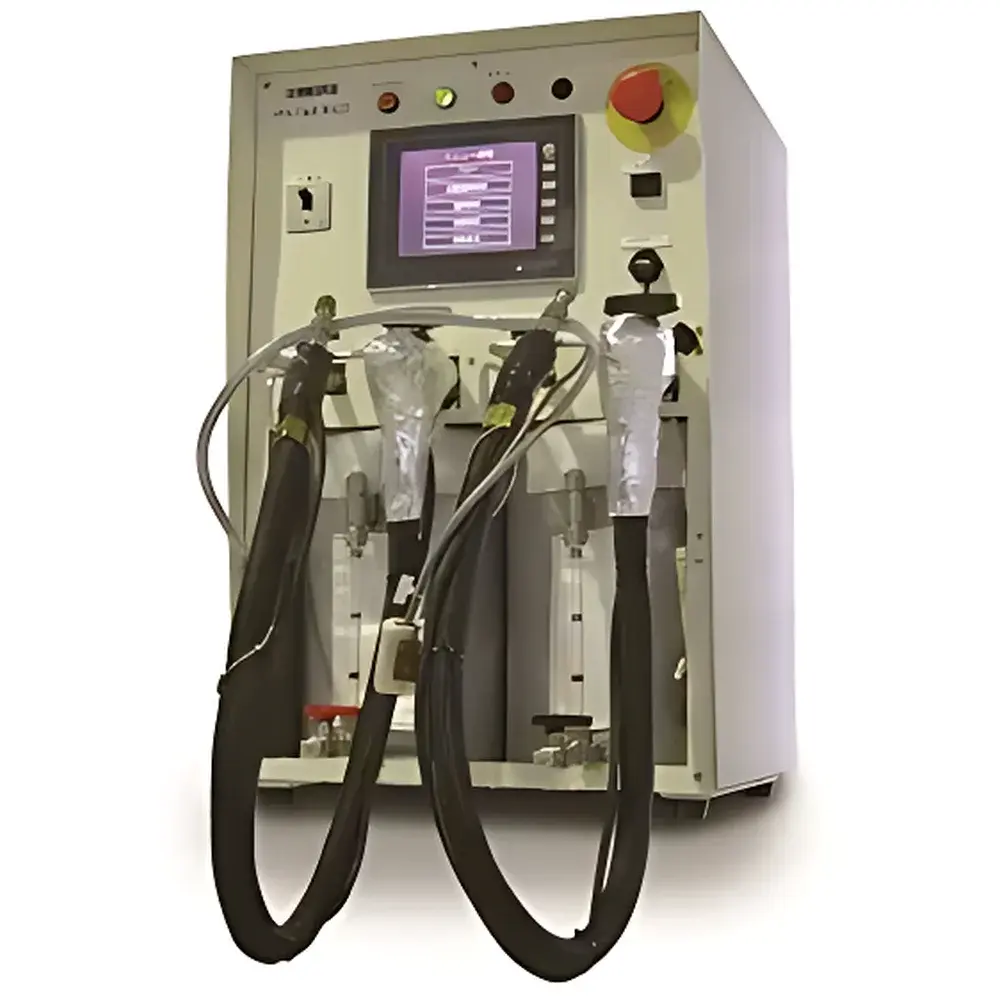
TOYO Corporation MiniTest3000 PEM Fuel Cell Testing System with Integrated Electrochemical Workstation
| Brand | TOYO Corporation (Japan) |
|---|---|
| Origin | Japan |
| Model | MiniTest3000 |
| Instrument Type | Electrochemical Workstation |
| Current Range | 4 nA – 1 A (10 decades) |
| Current Accuracy | ±0.2% of reading |
| Potential Accuracy | ±0.2% of reading |
| Potentiostatic Range | ±10 V |
| EIS Frequency Range | 10 µHz – 1 MHz |
| Anode MFC Flow | H₂, up to 1.0 L/min (adjustable) |
| Cathode MFC Flow | Air, up to 2.0 L/min (adjustable) |
| Humidification Control | Dew point stabilized at 80 °C ±2 °C |
| Cell Temperature Control | RT +10 °C to 180 °C |
| Electronic Load | Kikusui PLZ164W or PLZ164WA (165 W, 33 A, 0–150 V) |
| Footprint | 400 × 350 mm |
Overview
The TOYO Corporation MiniTest3000 is a fully integrated, benchtop-scale PEM fuel cell testing system engineered for high-stability, long-duration electrochemical characterization under controlled gas, thermal, and humidification conditions. Unlike conventional electrochemical workstations that require external PCs and auxiliary subsystems, the MiniTest3000 embeds core measurement electronics, programmable electronic load control, gas flow regulation (H₂ and air), precision dew-point humidification, and closed-loop temperature management into a single compact unit. Its architecture follows the principles of galvanostatic/potentiostatic control, electrochemical impedance spectroscopy (EIS), and dynamic polarization curve acquisition—enabling rigorous evaluation of membrane electrode assembly (MEA) performance, degradation kinetics, catalyst stability, and water management behavior in proton exchange membrane fuel cells. Designed specifically for R&D laboratories, quality assurance teams, and academic groups conducting accelerated stress testing (AST) or lifetime validation per DOE, ISO 8528-12, and IEC 62282-2 standards, the system operates autonomously without host PC dependency—ensuring uninterrupted data continuity over weeks or months.
Key Features
- Self-contained operation: All control logic—including gas sequencing, load profiling, humidification setpoint tracking, and thermal ramping—is managed internally via an industrial-grade PLC and a 7-inch resistive touchscreen HMI.
- High-fidelity electrochemical measurement: Dual-channel potentiostat/galvanostat with 10-decade current range (4 nA–1 A), ±0.2% accuracy on both current and potential, and full-frequency EIS capability from 10 µHz to 1 MHz.
- Dew-point-controlled humidification: Independent anode/cathode humidifiers maintain stable inlet gas dew points at 80 °C ±2 °C—critical for reproducible membrane hydration and minimizing ohmic drift during extended tests.
- Thermal management: Peltier-assisted heating/cooling with PID control enables precise cell temperature regulation from ambient +10 °C up to 180 °C—compatible with thin-film MEAs and high-temperature PEM variants.
- Compact footprint: 400 × 350 mm base area minimizes lab space requirements while retaining full functionality—ideal for shared instrumentation facilities or modular test benches.
- Robust data handling: Measurement logs (voltage, current, temperature, flow rates, EIS spectra) are timestamped and stored directly onto USB flash drives in CSV and binary formats; no proprietary software installation required.
- Comprehensive safety architecture: Includes hydrogen leak detection (optional), overpressure relief valves, emergency shutdown interlocks, redundant thermal cutoffs, and fail-safe gas shutoff protocols compliant with JIS B8401 and NFPA 55 guidelines.
Sample Compatibility & Compliance
The MiniTest3000 supports standard 5 cm², 10 cm², and 25 cm² active-area PEM fuel cells, as well as custom MEA configurations using GDLs with microporous layers and Nafion-based membranes (e.g., N115, N212, NR211). It accommodates both serpentine and parallel flow-field designs and integrates seamlessly with industry-standard bipolar plates (graphite or stainless steel). All operational parameters—including gas stoichiometry, relative humidity, backpressure, and current density sweeps—are configurable to align with ASTM D7279 (fuel cell performance testing), ISO/TS 14687-2 (hydrogen purity), and USP analytical instrument qualification (AIQ) frameworks. The embedded electronic load (Kikusui PLZ164W/PLZ164WA) meets IEC 61000-4-30 Class A power quality requirements, ensuring traceable load fidelity during dynamic cycling.
Software & Data Management
Operation is executed entirely through the onboard touch interface—eliminating reliance on third-party software or driver dependencies. Users define multi-step test sequences (e.g., hold → sweep → EIS → rest → repeat) with conditional branching based on voltage thresholds, elapsed time, or cumulative charge. Each sequence stores metadata including operator ID, calibration timestamps, firmware version, and environmental logs. Exported datasets include synchronized analog inputs (Tₐₙₒdₑ, Tcₐₜₕ, RH, ΔP), digital I/O states, and complex impedance spectra (Z′, Z″, phase, |Z|). Data files conform to ASTM E2500-18 Annex A3 structural conventions and support direct import into MATLAB, Python (via pandas), or commercial analysis tools such as Thales or EC-Lab—without format conversion. Audit trails and user access levels (Operator/Engineer/Admin) comply with GLP/GMP documentation expectations and FDA 21 CFR Part 11 electronic record requirements when paired with networked time servers and digital signature modules.
Applications
- Accelerated stress testing (AST) of catalyst layers under cyclic OCV hold, load cycling, and humidity swing protocols per DOE targets.
- In-situ monitoring of membrane resistance evolution via high-resolution low-frequency EIS (≤100 mHz) during startup/shutdown events.
- Quantification of mass transport losses through polarization curve deconvolution and Kramers–Kronig validated impedance modeling.
- Evaluation of novel hydrophobic/hydrophilic GDL treatments under variable stoichiometry and backpressure conditions.
- Validation of humidifier bypass strategies and condensate management schemes in real-time stack-relevant environments.
- Support for DOE Hydrogen Program Record #18002 and IEA Task 32 benchmarking methodologies.
FAQ
Does the MiniTest3000 require a connected PC for basic operation?
No—core measurement, sequencing, and data logging are fully autonomous. A PC is optional only for advanced post-processing or remote monitoring via Ethernet (available as add-on module).
Can the system perform simultaneous dual-electrode measurements (e.g., reference electrode integration)?
Yes—the potentiostat supports three-electrode configuration with dedicated RE input; optional low-resistance meter (1 kHz/10 kHz) enables contact resistance correction for accurate cathode/anode overpotential separation.
Is the humidification system capable of sub-ambient dew point control?
No—it is optimized for PEM operating ranges (40–100 °C dew point); sub-zero humidification requires external chilled-mirror systems not integrated into this platform.
What calibration standards are supported for traceable electrochemical verification?
The system accepts NIST-traceable dummy cells (e.g., Gamry RC calibration kits) and supports user-defined gain/offset adjustments with full audit logging per ISO/IEC 17025 Clause 6.6.
Are firmware updates provided, and how are they deployed?
TOYO releases quarterly firmware patches addressing EIS algorithm refinements, safety logic enhancements, and compliance alignment; updates are installed via USB drive with rollback capability and version-signed integrity checks.





