
TOYO Corporation PEM Fuel Cell Water Balance Measurement System
| Brand | TOYO Corporation (Japan) |
|---|---|
| Origin | Japan |
| Manufacturer Type | Authorized Distributor |
| Origin Category | Imported |
| Model | Water Balance Measurement System |
| Pricing | Available Upon Request |
Overview
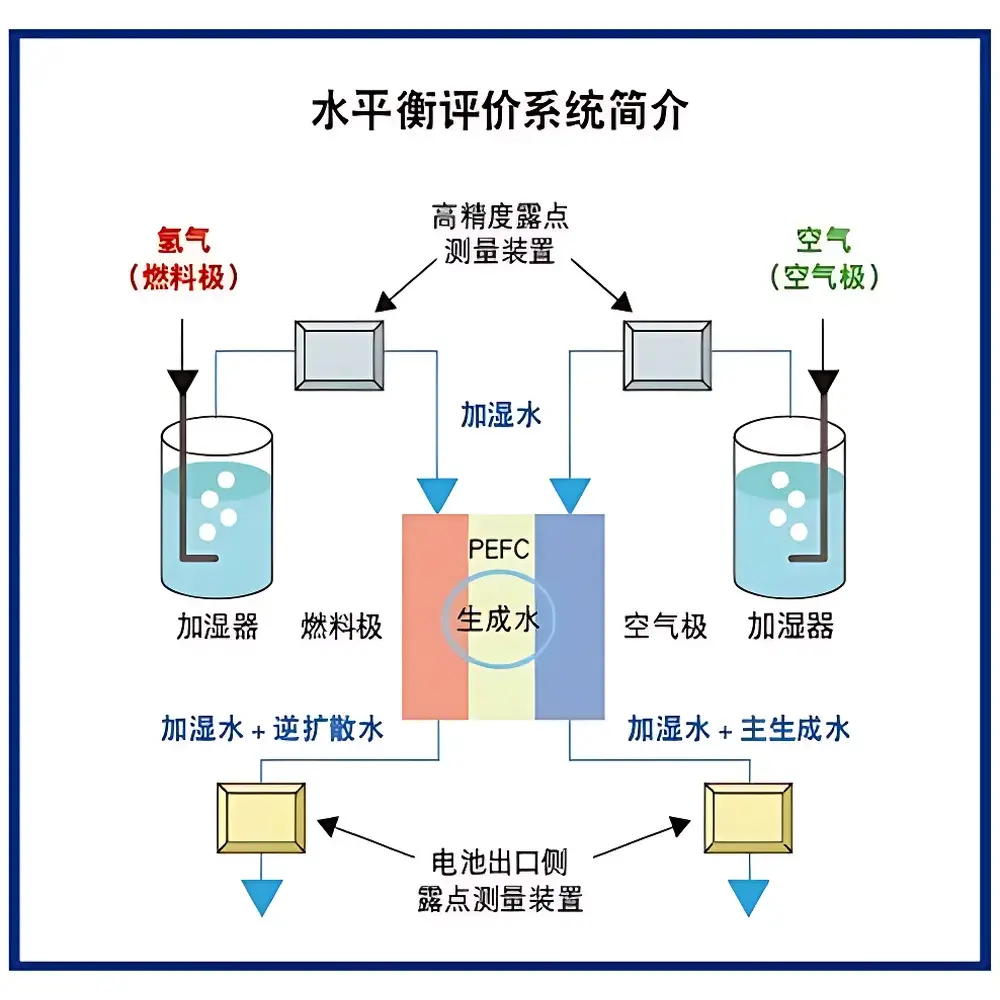
The TOYO Corporation PEM Fuel Cell Water Balance Measurement System is an engineered instrumentation platform designed for quantitative, real-time analysis of water transport dynamics across proton exchange membrane (PEM) fuel cells under operational conditions. It operates on the fundamental principle of mass-balance-based water accounting—integrating high-accuracy dew point measurement, pressure monitoring, and gas flow control to determine net water generation, migration, and removal at both anode and cathode streams. Unlike conventional condensate-collection methods subject to phase-change losses and temporal averaging errors, this system captures total water content—including vapor-phase water in supersaturated outlet streams—enabling sub-milligram-level water mass closure with traceable uncertainty. The system is specifically configured for single-cell or short-stack testing in laboratory and R&D environments, supporting iterative design optimization of membrane electrode assemblies (MEAs), flow-field architectures, and humidification strategies.
Key Features
- High-precision mirror-surface dew point hygrometers installed directly in gas supply and exhaust lines, with measurement range of −30 °C to +80 °C (extendable to +115 °C upon calibration verification)
- Integrated pressure transducers adjacent to each dew point sensor, enabling real-time calculation of water molar fraction (xH₂O) and absolute water content (mol·s−1) via ideal gas law and saturation vapor pressure correlation (e.g., Antoine equation)
- Supersaturation-tolerant condensate capture module capable of quantifying total liquid water exiting the cell—even under cathode flooding conditions—eliminating systematic underestimation inherent in traditional drain-only collection
- Synchronized acquisition interface for concurrent electrochemical impedance spectroscopy (EIS), allowing time-resolved correlation between water distribution states and frequency-domain impedance parameters (e.g., membrane ionic resistance, charge-transfer resistance, oxygen diffusion impedance)
- No requirement for modified or instrumented cells; compatible with standard serpentine, parallel, or interdigitated flow fields using industry-standard gasketed MEAs
- Modular pneumatic architecture supporting independent control of anode H2 and cathode air stoichiometry, backpressure, inlet humidity, and temperature gradients
Sample Compatibility & Compliance
The system is validated for use with Nafion®-based and hydrocarbon-based PEMs, carbon-supported Pt/C and PtCo catalysts, and standard gas diffusion layers (GDLs). It supports test protocols aligned with ASTM D7284 (Standard Test Method for Determination of Water Uptake by Proton Exchange Membranes), ISO 14687-2 (Hydrogen fuel quality—Part 2: Proton exchange membrane (PEM) fuel cell applications), and DOE Hydrogen Program’s PEMFC Water Management Validation Guidelines. All dew point sensors are NIST-traceable and calibrated per ISO/IEC 17025 requirements. Data acquisition firmware complies with GLP audit trails and supports optional 21 CFR Part 11-compliant electronic signatures when integrated with validated LIMS platforms.
Software & Data Management
The embedded control software provides synchronized logging of dew point, pressure, temperature, current, voltage, and EIS spectra at user-defined intervals (100 ms minimum resolution). Raw data exports to CSV and HDF5 formats; post-processing modules include water balance closure error estimation (<±2.5% typical at 1.0 A·cm−2), cumulative water accumulation mapping, and differential water flux profiling across operating regimes. Batch analysis templates support DOE-defined operating condition matrices (e.g., variable stoichiometry, RH ramping, load cycling). Audit logs record all parameter changes, calibration events, and user actions with timestamp and operator ID.
Applications
- Quantifying reverse water diffusion across the membrane under low-anode-humidity or high-cathode-backpressure conditions
- Correlating localized cathode flooding incidence and duration with high-frequency resistance (HFR) drift and mass-transport overpotential onset
- Evaluating the impact of microporous layer (MPL) hydrophobicity on liquid water ejection kinetics
- Validating two-phase CFD models of water transport through porous electrodes and flow channels
- Supporting accelerated stress testing (AST) protocols per DOE’s PEMFC Durability Protocol, particularly humidity cycling and open-circuit voltage hold sequences
- Guiding humidifier bypass ratio optimization for system-level efficiency improvement without membrane dry-out risk
FAQ
Can this system measure water balance in a full-size automotive stack?
No—it is designed for single-cell and short-stack (≤5 cells) characterization. Stack-level water balance requires distributed sensor networks and thermal compensation not included in this configuration.
Is calibration of dew point sensors performed in-house or by the user?
Factory calibration is provided with NIST-traceable certificate; field recalibration using certified humidity standards (e.g., Saturated Salt Solutions or chilled-mirror reference) is supported annually per ISO 9001 maintenance schedule.
Does the system support automated humidity ramping during polarization sweeps?
Yes—via programmable gas humidifier controllers interfaced through analog I/O or Modbus TCP, enabling RH sweep tests synchronized with current loading.
What is the minimum detectable water mass flux under typical operating conditions?
At 60 °C, 150 kPa, and 1.0 A·cm−2, the combined uncertainty in water molar flow rate is ≤0.015 mol·min−1, corresponding to ~0.27 mg·min−1 mass resolution.
Are third-party EIS instruments compatible with the synchronization interface?
Yes—IEEE-488 (GPIB), USB-TMC, and LAN-based SCPI command sets are supported for lock-step triggering with commercial potentiostats (e.g., BioLogic SP-300, Gamry Interface 5000E).
Related Products




