
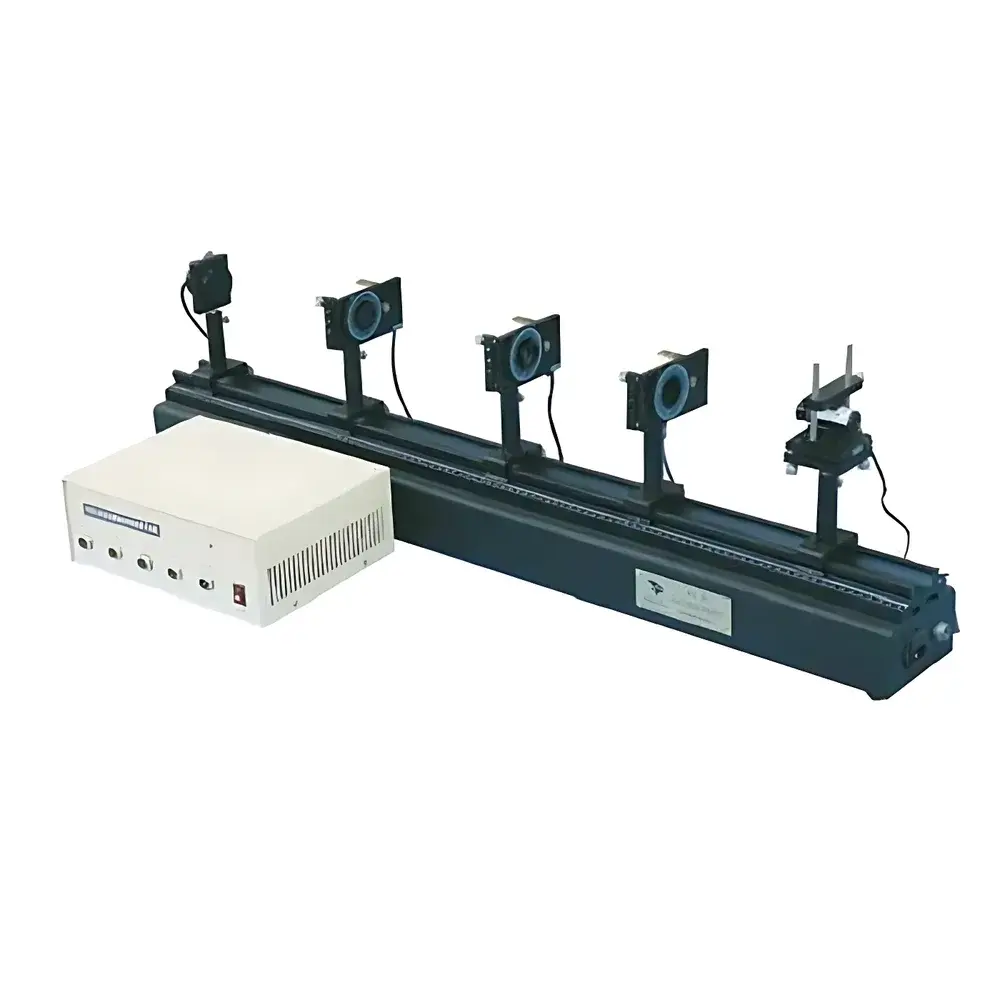
TP WSZ-3A Automated Polarimeter System
| Brand | TP |
|---|---|
| Model | WSZ-3A |
| Origin | Tianjin, China |
| Manufacturer Type | Direct Manufacturer |
| Instrument Category | Domestic (China-Made) |
| Light Source | 650 nm Semiconductor Laser |
| Wavelength | 650 nm |
| Polarization Detection Method | Real-time Photoelectric Intensity Analysis with Motorized Rotating Polarizer |
| Output Interface | USB 2.0 |
| Software Platform | Windows-compatible Control & Data Acquisition Suite |
| Compliance | Designed for Academic & QC Lab Use per ISO 11146 (Laser Beam Parameters) and ASTM E1318 (Polarimetric Measurement Practice) |
| Sample Stage | Motorized X-axis Rotation Mount (0.1° resolution, ±180° range) |
| Accessories Included | Optical Rail with Sliding Carriages, Precision-Mounted Polarizers (Dichroic & Birefringent), λ/2 & λ/4 Waveplates (mounted), Variable-Aperture 2D Holder, Detector Mount with Integrated Photodiode Receiver, Control Enclosure with Embedded Microcontroller, Power Supply Unit, USB Cable, Calibration Certificate |
| User-Provided | Windows PC (Win 10/11, ≥4 GB RAM), Printer (optional for lab report generation) |
Overview
The TP WSZ-3A Automated Polarimeter System is an integrated optical measurement platform engineered for undergraduate physics laboratories, materials science education, and quality control environments requiring quantitative polarization characterization. It operates on the principle of photoelectric intensity modulation: a collimated 650 nm semiconductor laser beam passes sequentially through a motorized polarizer, sample region (e.g., waveplate or birefringent material), and a fixed analyzer; the transmitted intensity is measured in real time as the input polarizer rotates under closed-loop stepper motor control. By fitting the intensity vs. angle curve to Malus’ law (I = I₀ cos²θ), the system determines polarization state parameters—including azimuth angle, ellipticity, and retardance—with high angular reproducibility (< ±0.2°). Unlike manual polarimeters, the WSZ-3A eliminates human reading error and enables dynamic acquisition of polarization evolution during thermal, mechanical, or electro-optic perturbations.
Key Features
- Motorized X-axis polarizer rotation stage with 0.1° angular resolution and programmable speed (0.5–10°/s), enabling precise angular sweeps for Malus’ law verification and extinction angle detection.
- Integrated optical rail assembly with precision-machined sliding carriages and metric scale markings, ensuring repeatable component alignment and minimizing beam walk-off.
- High-stability 650 nm diode laser (output power: 5 mW, TEM₀₀ mode, power stability < ±2% over 1 h) with built-in current regulation and thermal feedback.
- Optically mounted, AR-coated polarizers (extinction ratio > 10⁴:1) and waveplates (λ/2 and λ/4, specified at 650 nm, retardance tolerance ±λ/300) sourced from certified international suppliers.
- Digital photodetector module with logarithmic amplifier circuitry (dynamic range: 10⁻⁶–10⁻¹ A), analog-to-digital conversion (12-bit), and USB 2.0 interface for direct data streaming to host PC.
- Embedded microcontroller-based control box providing isolated digital I/O, motor driver circuitry, and hardware-level safety interlocks (e.g., laser enable/disable via shutter command).
Sample Compatibility & Compliance
The WSZ-3A supports transmission-mode polarization analysis of solid, liquid, and thin-film samples placed between the polarizer and analyzer. Compatible specimens include polymer films, liquid crystal cells, stressed glass, sugar solutions (for concentration studies), and crystalline waveplates. The system meets pedagogical and industrial calibration requirements outlined in ASTM E1318–22 (“Standard Practice for Polarimetric Measurements”) and aligns with optical alignment methodologies referenced in ISO 11146–2:2019 (“Lasers and laser-related equipment — Test methods for laser beam widths, divergence angles and beam propagation ratios”). While not FDA-cleared or CE-marked for clinical use, its architecture supports GLP-compliant documentation when paired with validated software logging and user access controls.
Software & Data Management
The included Windows-native application provides real-time intensity plotting, automatic curve fitting (least-squares regression to cos²θ model), and export of raw angular-intensity datasets in CSV and Excel formats. Software features include multi-scan averaging, background subtraction, zero-angle calibration wizard, and annotation tools for lab report generation. Audit trail functionality records operator ID, timestamp, instrument configuration, and calibration status per session—supporting traceability in teaching labs adhering to ISO/IEC 17025:2017 clause 7.7 (Results Reporting). Data files are structured for interoperability with MATLAB, Python (NumPy/Pandas), and OriginLab for advanced polarization ellipse modeling.
Applications
- Verification of Malus’ law using dichroic and birefringent polarizers under variable incident angles.
- Quantitative determination of quarter-wave and half-wave plate retardance via intensity null detection and phase-shift analysis.
- Visualization and classification of polarization states (linear, circular, elliptical) using Poincaré sphere projection tools embedded in the software.
- Measurement of optical activity in chiral media (e.g., sucrose solutions) when combined with a temperature-controlled cuvette holder (optional accessory).
- Stress-induced birefringence mapping in transparent polymers and glasses using crossed-polarizer imaging protocols.
- Teaching modules aligned with AP Physics C: Electricity & Magnetism and university-level Optics curricula (e.g., Hecht’s Optics, Chapter 8).
FAQ
What computer specifications are required to run the WSZ-3A software?
A Windows 10 or 11 PC with ≥4 GB RAM, USB 2.0 port, and administrator privileges for driver installation is mandatory. Graphics capability must support OpenGL 3.3+ for real-time polarization ellipse rendering.
Is the 650 nm laser Class II compliant?
Yes—the laser module complies with IEC 60825-1:2014 Class II limits (≤1 mW accessible emission limit); actual output is 5 mW but incorporates an internal neutral density filter and mechanical shutter to ensure user-safe operation.
Can the system measure ellipticity or degree of polarization (DOP) directly?
It calculates ellipticity (ε) and azimuth (ψ) by fitting acquired intensity data to the generalized Jones matrix formalism; DOP requires additional unpolarized reference measurements and is supported via optional dual-channel detector upgrade.
Does the software support automated report generation with institutional branding?
Yes—customizable templates allow insertion of lab name, course code, student ID fields, and signature lines; exported PDF reports include embedded metadata (date, instrument SN, software version) for academic integrity tracking.




