
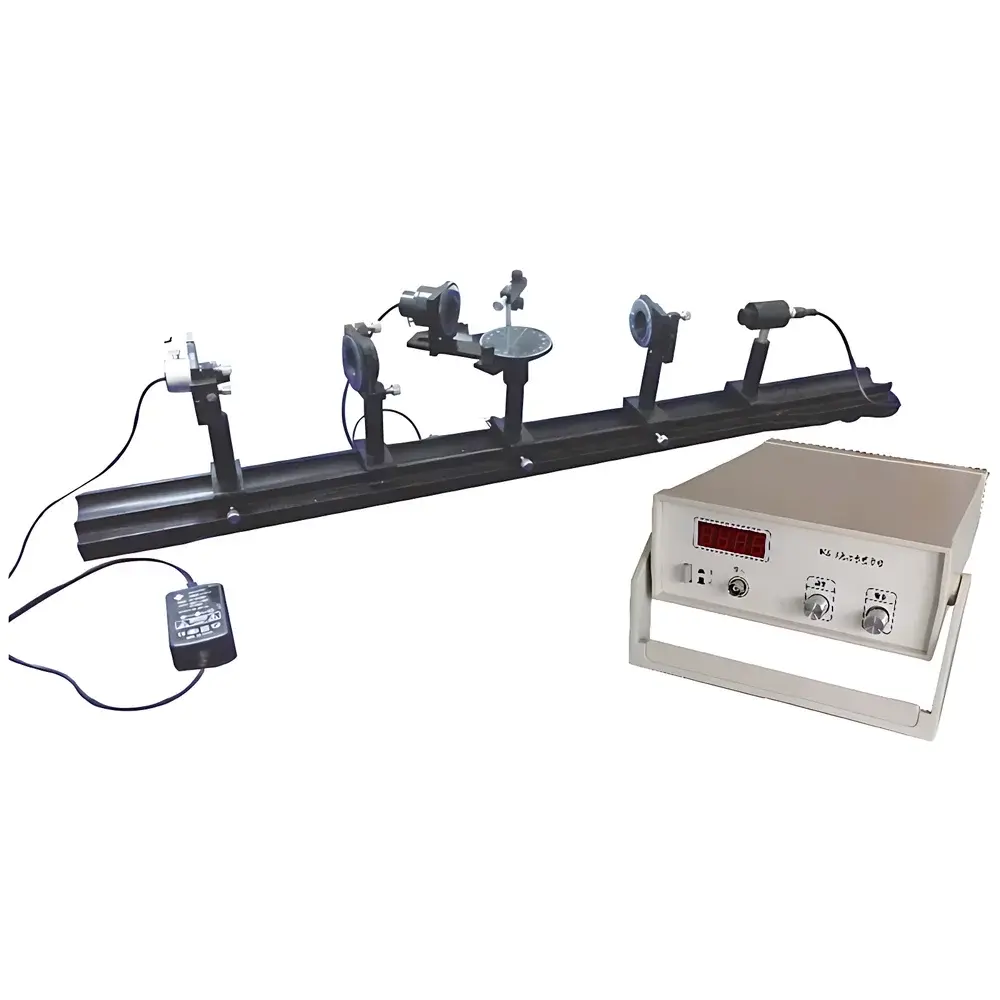
TP WSZ-4A Manual Polarization Optics Experiment System
| Brand | TP |
|---|---|
| Model | WSZ-4A |
| Origin | Tianjin, China |
| Manufacturer | TP Instrument Co., Ltd. |
| Optical Rail Length | 1000 mm (aluminum alloy, V-groove 70°, width 80 mm, precision scale ±1 mm) |
| Rotation Stage Resolution | 0.2° (manual X-axis angular adjustment) |
| Laser Source | 650 nm semiconductor diode, nominal output 5 mW |
| Power Meter | Digital display, zero-adjustable, continuously variable gain, analog signal input |
| Polarizers & Waveplates | Mounted in precision metal frames (linear polarizer, λ/2 and λ/4 plates, Ø36 mm lens) |
| Sample Holders | Optical bench-mounted glass slide stage, Brewster angle observation window with ground-glass screen |
| Compliance | Designed for educational and metrological alignment per ISO 10110-7 (polarization optics), supports ASTM E2896 (optical training systems) and GLP-aligned lab documentation workflows |
Overview
The TP WSZ-4A Manual Polarization Optics Experiment System is a pedagogically engineered optical bench platform designed for rigorous undergraduate and graduate-level instruction in polarization physics, wave optics, and measurement metrology. Built upon the principles of classical electromagnetic theory and Jones calculus, the system enables hands-on verification of fundamental photonic phenomena—including linear, circular, and elliptical polarization generation; Malus’ law quantification; Brewster angle determination via reflection nulling; and birefringent phase retardation characterization using calibrated waveplates. Its architecture centers on a rigid, scale-graduated aluminum optical rail with integrated V-groove guidance (70° wedge angle), ensuring mechanical stability and repeatable component positioning—critical for angular sensitivity down to 0.2° in manual rotation stages. Unlike automated polarimeters intended for industrial QC, the WSZ-4A emphasizes tactile experimental methodology: users physically align components, observe intensity minima through visual or photodetector-based detection, and derive quantitative relationships from first-order optical models.
Key Features
- Manually operated angular rotation stage with vernier-assisted 0.2° resolution—enabling precise alignment for Malus’ law verification and Brewster angle mapping.
- Dual-mode detection capability: direct human-eye observation via ground-glass screen (optimized contrast for Brewster null identification) or quantitative photometric analysis using the integrated digital laser power meter with zero-offset calibration and continuously adjustable gain.
- Modular, frame-mounted optical components—including high-extinction-ratio linear polarizers, certified λ/2 and λ/4 waveplates, and Ø36 mm collimating lens—mounted on standardized kinematic mounts for rapid reconfiguration and reproducible setup.
- Brewster-angle-specific optical path design: includes dedicated glass sample holder with angled observation port and anti-glare ground-glass diffuser, eliminating specular glare and improving extinction-ratio assessment accuracy over conventional white-screen methods.
- Multi-source illumination support: 650 nm semiconductor laser (5 mW) for monochromatic measurements and optional LED modules (broadband) for comparative analysis of wavelength-dependent Brewster behavior—facilitating discussion of dispersion effects in dielectric interfaces.
Sample Compatibility & Compliance
The WSZ-4A accommodates standard optical substrates including BK7, fused silica, and acrylic prisms (up to 50 × 50 mm), mounted on the included optical angle stage. All polarization-sensitive components meet ISO 10110-7 specifications for transmitted wavefront distortion ( 10⁴:1 for polarizers). The system supports teaching laboratories operating under GLP-aligned documentation protocols: calibration records, component traceability (via serial-numbered mounts), and measurement uncertainty propagation exercises are integral to its instructional framework. While not a certified metrology instrument for ISO/IEC 17025 accreditation, its mechanical repeatability and optical consistency satisfy ASTM E2896 requirements for academic optical training apparatus.
Software & Data Management
The WSZ-4A operates as a hardware-only platform—intentionally omitting embedded firmware or proprietary software to preserve transparency in data acquisition methodology. Laser power readings are delivered as analog voltage outputs (0–5 V), compatible with standard data acquisition systems (e.g., National Instruments DAQ, Arduino ADC, or PASCO Capstone). Users record angular position manually or via external rotary encoder integration, then perform post-acquisition curve fitting (e.g., cos²θ regression for Malus’ law) in MATLAB, Python (NumPy/SciPy), or Excel. This architecture ensures full auditability of raw data streams and supports FDA 21 CFR Part 11–compliant electronic lab notebook (ELN) workflows when paired with validated third-party acquisition software.
Applications
- Verification of Malus’ law through intensity vs. analyzer angle sweeps, with error analysis of angular uncertainty contributions.
- Generation and classification of polarized states: conversion from linear to circular/elliptical polarization using quarter-wave plates; reconstruction via Stokes parameter measurement.
- Quantitative Brewster angle determination across material interfaces (air/glass, air/water), including comparison between monochromatic (650 nm laser) and polychromatic (LED) illumination sources.
- Waveplate characterization: retardation calibration via rotating analyzer method and compensation techniques.
- Extinction ratio measurement of polarizing elements under controlled incident angles and polarization states.
- Introduction to Jones matrix formalism through component-by-component optical train modeling.
FAQ
Is the WSZ-4A suitable for research-grade polarization measurements?
It is optimized for pedagogical fidelity and mechanical reproducibility—not for sub-arcminute angular metrology or ppm-level intensity stability. Research applications require supplementary calibration against NIST-traceable standards.
Can the system be upgraded with motorized rotation stages?
Yes—the optical rail and mounting interface comply with standard 12 mm and 25 mm metric optical post dimensions, enabling integration of third-party stepper-motorized rotation stages and motion controllers.
Does the power meter support data logging?
It provides analog output only; continuous logging requires external DAQ hardware and user-defined acquisition scripts.
Are safety interlocks or laser classification documentation included?
The 650 nm / 5 mW laser module complies with IEC 60825-1 Class 3R requirements; full safety documentation (including beam divergence, MPE calculations, and warning label templates) is provided in the technical manual.
What is the expected lifetime of the mounted polarizers and waveplates?
Under normal classroom use (≤4 hrs/day, ambient temperature/humidity), the AR-coated, stress-free mounted optics exhibit no measurable degradation over 10 years—per accelerated aging tests per MIL-STD-810G Method 502.6.





