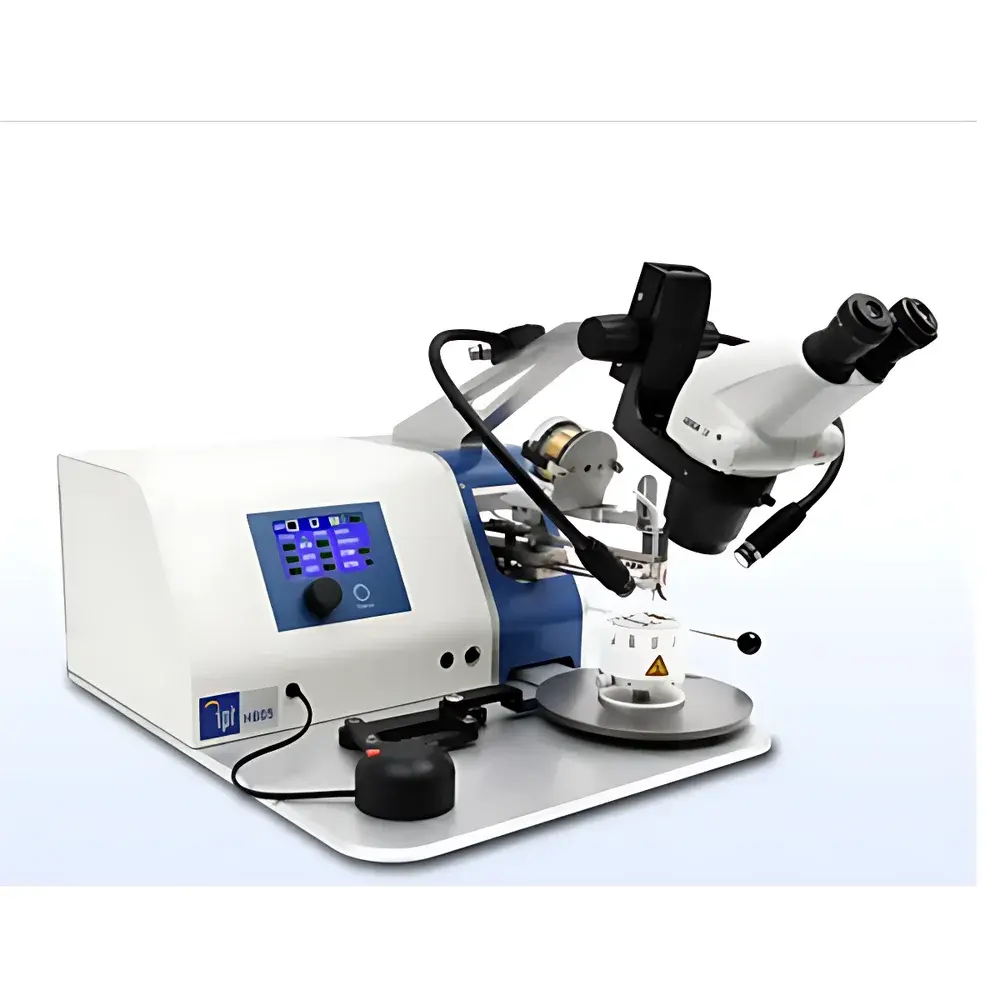
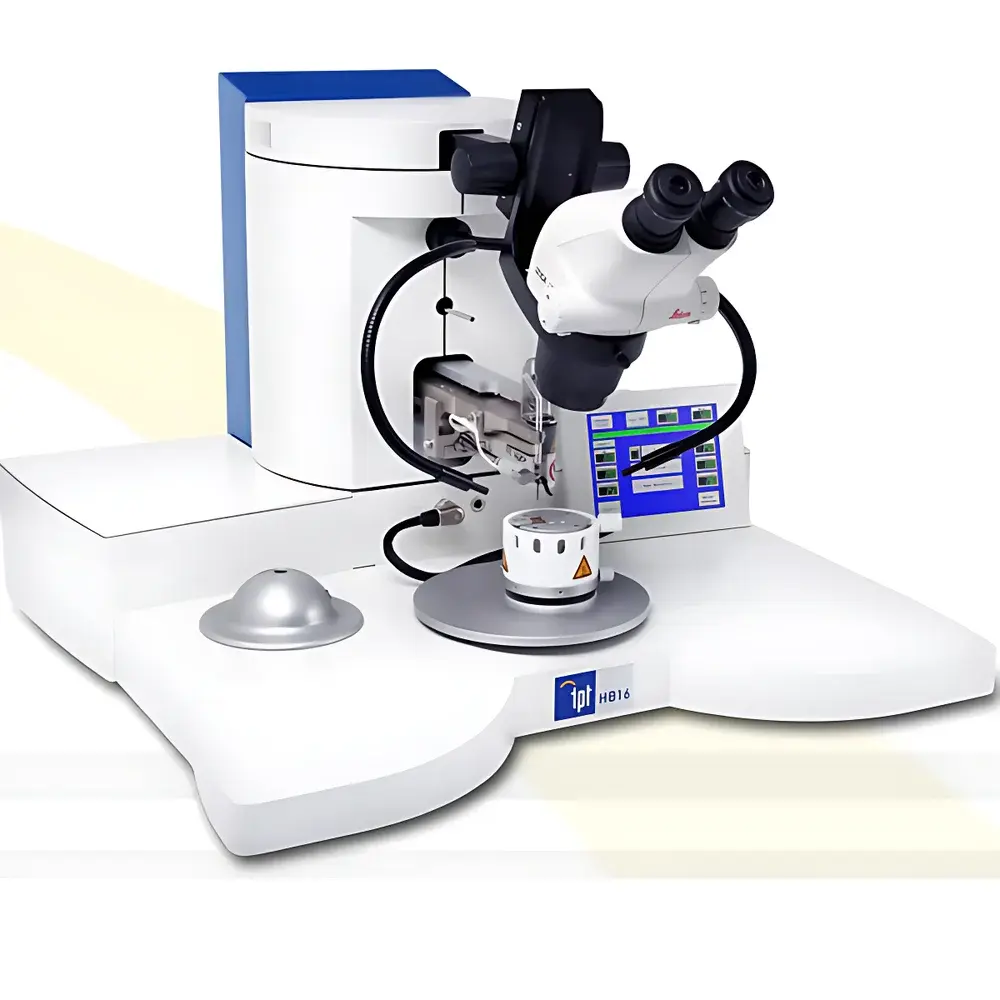
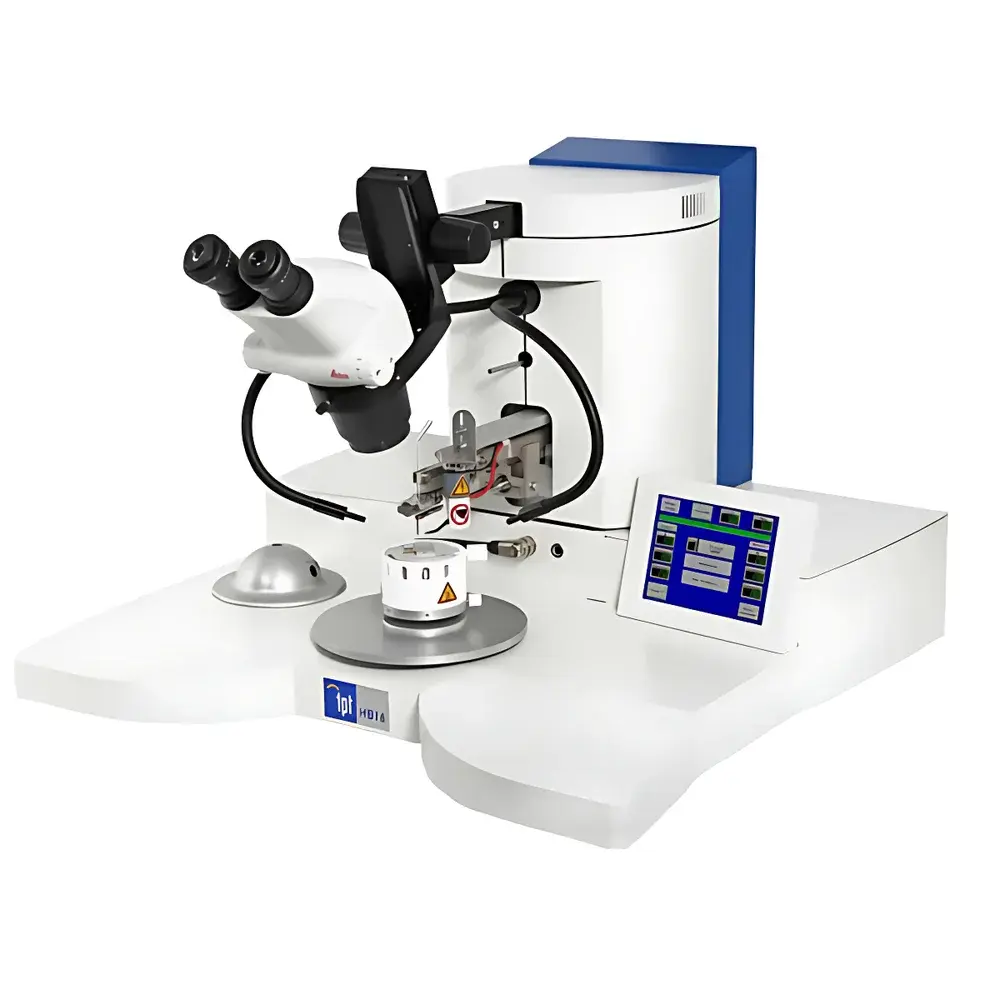
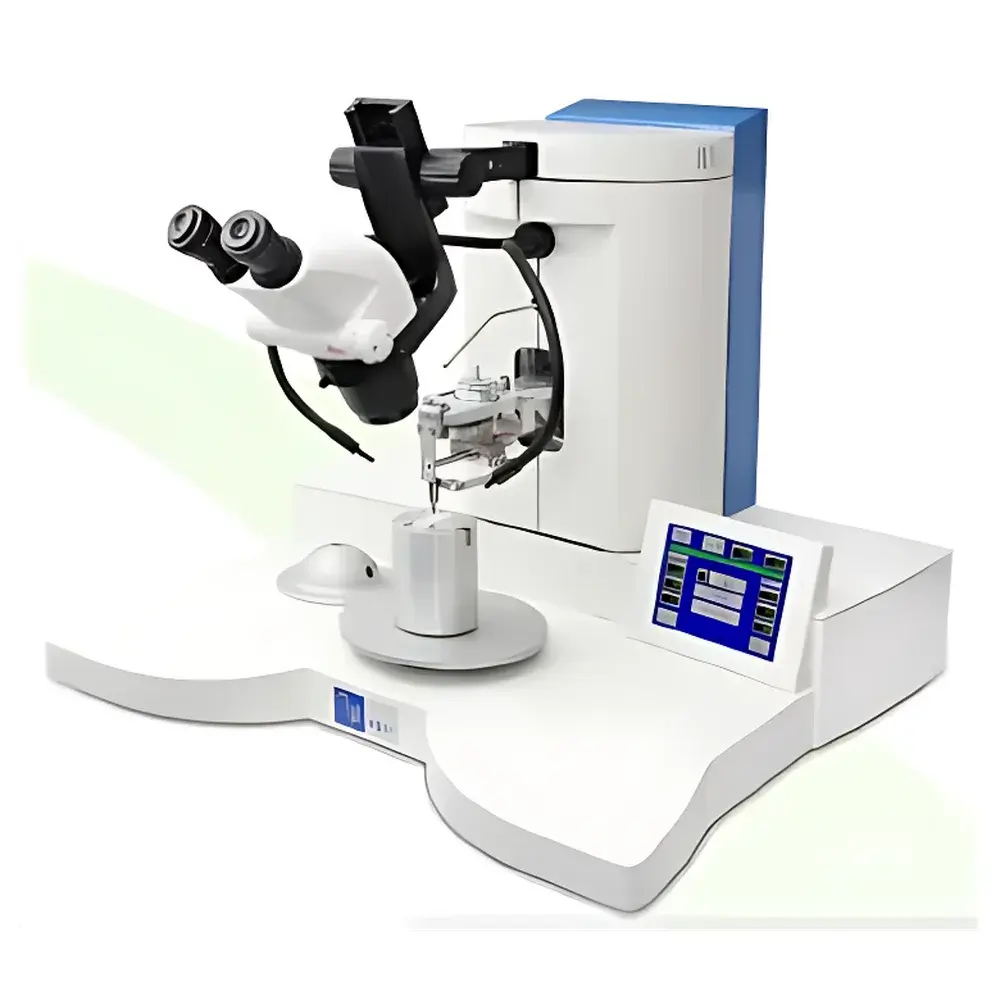
TPT HB05/10/16/30 Manual & Semi-Automatic Thermosonic Wire Bonder
| Brand | TPT |
|---|---|
| Origin | Germany |
| Model | HB05 / HB10 / HB16 / HB30 |
| Bonding Methods | Ball-Wedge, Wedge-Wedge, Ribbon & Bump Bonding |
| Wire Diameter Range | 17–75 µm (Au/Al) for HB05/HB10/HB16 |
| Ribbon Size | Up to 25 × 250 µm |
| Ultrasonic Frequency | 62 kHz (PLL-controlled) |
| Ultrasonic Power Output | 0–5 W (HB05/HB10/HB16), 0–50 W (HB30) |
| Bond Force Range | 5–130 cNm (HB05), 5–150 cNm (HB10/HB16), 50–1500 cN (HB30) |
| Bond Time | 0–1 s (HB05), 0–10 s (HB10/HB16/HB30) |
| Temperature Control | Up to 250 °C ±1 °C |
| Display | 4.3″ LCD (HB05), 6.5″ capacitive touchscreen (HB10/HB16/HB30) |
| Programmable Memory | 20 programs (HB05), 100 programs (HB10/HB16/HB30) |
| Motorized Axes | Z-axis only (HB10), Z+Y axes (HB16/HB30), Y-axis retract up to 17 mm (HB30) |
| Bond Head Clearance | 16 mm depth |
| Bond Arm Length | 165 mm |
| Capillary | Ø1.58 mm × 19 mm |
| Wire Spool | 50.8 mm (2″) motorized |
| Wire Cut | Bond head or clamp cut, 90° feed angle |
| Ball Diameter Control | Electronic |
| Pull Test Option | Available (HB10/HB16/HB30) |
| Ribbon Bonding & Seam Welding | Supported |
| USB Data Backup | Yes (HB10/HB16/HB30) |
| Dimensions (W×D×H) | 550×450×250 mm (HB05), 680×640×490 mm (HB10/HB16/HB30) |
| Net Weight | 25 kg (HB05), 42 kg (HB10/HB16), 50 kg (HB30) |
Overview
The TPT HB05, HB10, HB16, and HB30 series are precision-engineered manual and semi-automatic thermosonic wire bonders designed for R&D laboratories, pilot lines, and low-volume production environments in semiconductor packaging, MEMS, power electronics, and optoelectronics. These instruments operate on the principle of thermosonic bonding—simultaneously applying ultrasonic energy, controlled heat, and precise mechanical force to form metallurgical interconnections between fine wires (gold, aluminum, or copper) and substrate pads or leadframes. Each model shares a common modular architecture centered on a high-stiffness bond head, motorized motion control, and real-time parameter feedback, enabling reproducible bond formation across ball-wedge, wedge-wedge, ribbon, and bump bonding configurations. The HB05 serves as an entry-level platform with intuitive LCD interface and single-axis manual positioning; HB10 introduces motorized Z-axis actuation and touchscreen operation; HB16 adds independent Y-axis control for dynamic loop shaping and arc optimization; while HB30 is engineered specifically for coarse aluminum wire (100–500 µm), featuring higher ultrasonic power (50 W), extended force range (up to 1500 cN), and seam welding capability.
Key Features
- Multi-mode bonding compatibility: supports ball-wedge, wedge-wedge, ribbon (up to 25 × 250 µm), and bump bonding on a single bond head—only capillary change required
- Thermosonic transduction system with PLL-synchronized 62 kHz ultrasonic generator (HB05/HB10/HB16) or high-power 62 kHz US module (HB30), ensuring stable amplitude delivery and minimal frequency drift under load
- Motorized Z-axis (HB10+) and dual-axis (Z+Y) programmable motion control enables precise stitch placement, loop height modulation, and arc profile editing—critical for cavity-down packages and stacked die applications
- Electronic ball diameter control with closed-loop feedback ensures consistent ball formation across varying wire types and diameters (17–75 µm Au/Al; 100–500 µm Al for HB30)
- Integrated temperature controller with ±1 °C stability over 25–250 °C range, compliant with JEDEC J-STD-020 moisture sensitivity level (MSL) pre-conditioning requirements
- High-resolution 6.5″ capacitive touchscreen interface (HB10/HB16/HB30) with graphical parameter mapping, real-time waveform visualization, and password-protected user levels
- Onboard storage for up to 100 process recipes with timestamped versioning, supporting ISO 9001 traceability and internal SOP enforcement
Sample Compatibility & Compliance
The TPT wire bonder series accommodates standard semiconductor substrates including silicon wafers (up to 8″), ceramic packages (QFN, DFN, SOIC), leadframes (Cu, FeNi), and flexible PCBs. All models accept industry-standard capillaries (Ø1.58 mm shank, 19 mm length) and spools (50.8 mm). Ribbon bonding capability supports flat conductor interconnects used in high-current power modules. Device compliance includes CE marking per Machinery Directive 2006/42/EC and Electromagnetic Compatibility Directive 2014/30/EU. Software architecture supports audit trail generation and electronic signature per FDA 21 CFR Part 11 when integrated with validated LIMS or MES platforms. Process parameters adhere to IPC-7095B (Design and Assembly Process Implementation for BGAs) and JEDEC JESD22-B116 (Wire Bond Pull Test Standard).
Software & Data Management
Firmware-based control architecture eliminates reliance on external PCs, reducing electromagnetic interference risks in cleanroom environments. Parameter configuration, real-time monitoring, and diagnostic logging occur natively via embedded OS. USB 2.0 port enables secure firmware updates and encrypted recipe backup/restore—no cloud dependency. Optional Ethernet interface (available on HB16/HB30) supports MODBUS TCP integration for factory-wide equipment monitoring. All bond cycles record timestamp, force curve, ultrasonic envelope, temperature ramp, and final bond image (when paired with optional machine vision module). Raw data exports in CSV format for statistical process control (SPC) analysis using JMP or Minitab.
Applications
- R&D validation of novel wire materials (e.g., palladium-coated Cu, silver alloys) and low-k dielectric stack compatibility
- Pilot-line qualification of advanced packaging schemes: fan-out wafer-level packaging (FOWLP), chiplets, and heterogeneous integration
- Reliability testing—including thermal cycling, HAST, and accelerated life testing—requiring repeatable bond geometry and force profiles
- Failure analysis labs performing cross-sectional SEM correlation with bond integrity metrics (e.g., intermetallic layer thickness, void fraction)
- University microelectronics teaching labs where hands-on understanding of bonding physics (frictional heating, plastic deformation, diffusion kinetics) is essential
- Medical device packaging requiring hermetic seal verification and biocompatible material bonding (e.g., PtIr wires to titanium substrates)
FAQ
What bonding methods does the TPT HB series support?
Ball-wedge, wedge-wedge, ribbon bonding, and bump bonding—all configurable via capillary exchange and software selection.
Is copper wire bonding supported?
Yes—HB10, HB16, and HB30 models include optimized ultrasonic waveforms and elevated temperature profiles for reliable Cu wire bonding (25–50 µm); HB30 supports coarse Cu-compatible ribbons.
Can the system be integrated into an automated production line?
While primarily semi-automatic, HB16 and HB30 offer digital I/O and Ethernet interfaces for PLC handshake, tooling alignment verification, and MES-triggered recipe loading.
Does the instrument meet GLP/GMP documentation requirements?
Yes—audit trails, electronic signatures, and 21 CFR Part 11–compliant data archiving are achievable through optional validation packages and third-party IQ/OQ protocols.
What maintenance intervals are recommended for the ultrasonic transducer and bond head?
Transducer calibration and bond head backlash verification are recommended every 6 months or after 5,000 bond cycles—service logs are auto-generated and exportable.