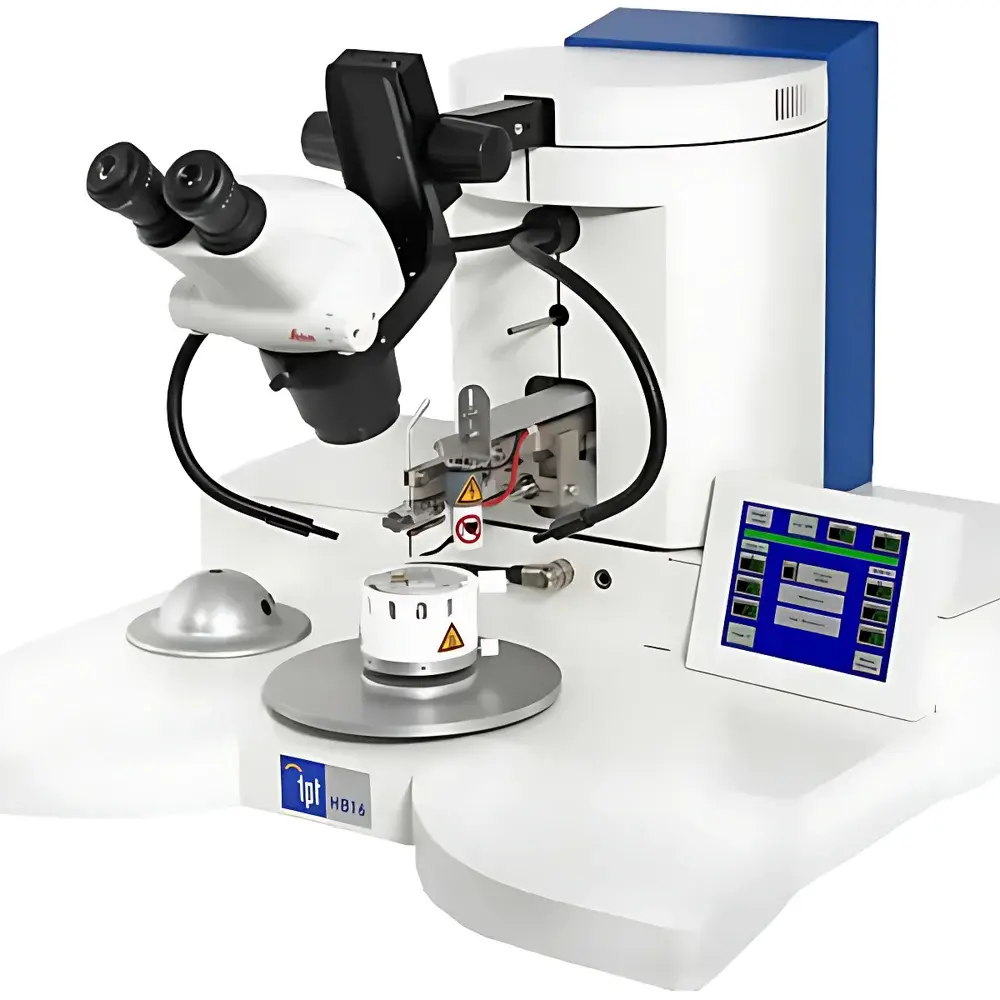
TPT HB16 Semi-Automatic Thermosonic Wire Bonder
| Brand | TPT |
|---|---|
| Origin | Germany |
| Model | HB16 |
| Bonding Methods | Wedge-Wedge, Ball-Wedge, Ribbon & Bump Bonding |
| Wire Diameter | 17–75 µm (Au/Al) |
| Ribbon Size | up to 25 × 250 µm |
| Ultrasonic Frequency | 62 kHz, PLL-controlled |
| Ultrasonic Power Output | 0–5 W |
| Bond Time | 0–10 s |
| Bond Force | 5–150 cNm (350 cNm optional) |
| Motorized Z-Axis Travel | 17 mm |
| Motorized Y-Axis Travel | 7 mm |
| Bond Head Cavity Depth | 16 mm |
| Bond Arm Length | 165 mm |
| Touchscreen | 6.5" LCD |
| Programmable Recipes | 100 |
| Temperature Control Range | up to 250 °C ±1 °C |
| Power Supply | 100–240 V ±10%, 50/60 Hz, max. 10 A |
| Dimensions (W×D×H) | 680 × 640 × 490 mm |
| Net Weight | 42 kg |
Overview
The TPT HB16 Semi-Automatic Thermosonic Wire Bonder is an engineered solution for precision interconnect formation in semiconductor packaging R&D, prototyping, and low-volume production environments. Designed around thermosonic bonding principles—combining controlled heat, ultrasonic energy, and precise mechanical force—the HB16 enables reliable metallurgical bonds between microelectronic devices (e.g., IC dies, sensors, optoelectronics) and leadframes or substrates. Its compact desktop footprint (680 × 640 × 490 mm) and modular architecture make it ideal for cleanroom-limited labs, university microfabrication facilities, and pilot-line integration where flexibility, repeatability, and process transparency are critical. The system supports both ball and wedge bonding configurations on a single bond head via quick-change tooling—eliminating mechanical reconfiguration downtime—and accommodates gold, aluminum, and copper wires as well as flat ribbon and bump structures.
Key Features
- Motorized Z- and Y-axis positioning with high-resolution encoders ensures sub-micron placement accuracy and consistent bond geometry across repeated cycles.
- 6.5-inch capacitive touchscreen interface provides intuitive access to all process parameters—including ultrasonic power, bond time, force profile, temperature ramp rate, and arc trajectory—with real-time feedback and on-screen calibration prompts.
- Programmable recipe storage for up to 100 distinct bonding protocols, each supporting multi-step sequences (e.g., preheat → ball formation → first bond → loop control → second bond → pull test), with timestamped version history.
- Deep-cavity bond head (16 mm cavity depth) and 165 mm bond arm length enable access to high-wall packages, stacked die configurations, and substrates with elevated thermal pads or shielding structures.
- Electronic ball diameter control with closed-loop feedback maintains consistent free-air ball (FAB) size across wire diameters (17–75 µm) and material types (Au, Al, Cu), minimizing voids and improving shear strength reproducibility.
- Integrated USB port supports firmware updates, parameter backup/restore, and raw log export (CSV format) for external statistical process control (SPC) analysis.
- Optional pull-test module compliant with MIL-STD-883 Method 2011.9 and JEDEC JESD22-B116 enables in-situ bond strength verification without sample transfer.
Sample Compatibility & Compliance
The HB16 accommodates standard 4″ and 6″ wafers (with optional chuck adapters), discrete packaged components (QFP, SOIC, QFN), bare dies on tape-and-reel or wafer trays, and flexible PCB substrates. It supports industry-standard bonding tools—including 1.58 mm shank capillary nozzles (length 19 mm) and wedge-type bond tools—and interfaces seamlessly with common vacuum chucks, heated stages, and optical alignment systems. All thermal control subsystems meet IEC 61000-6-2/6-4 immunity and emission requirements. Process logs include audit-trail metadata (operator ID, timestamp, parameter set hash) to support GLP/GMP documentation workflows and FDA 21 CFR Part 11-compliant electronic records when paired with validated laboratory information management systems (LIMS).
Software & Data Management
Embedded firmware v3.2+ includes dual-mode operation: guided wizard mode for novice users and advanced script mode for automated sequence development using TPT’s open command protocol (TCP/IP-based ASCII commands). Real-time data streaming (via Ethernet or USB-C) delivers synchronized timestamps for ultrasonic envelope, Z-axis displacement, and thermal stage output—enabling correlation of bond quality metrics with transient process events. Exported datasets include full parameter snapshots per bond site, enabling root-cause analysis of non-uniformities in ball shear or wire pull performance. Software architecture is compatible with third-party SPC platforms (e.g., InfinityQS, Minitab Workbench) through standardized .csv and .xlsx templates.
Applications
- Research and development of advanced packaging architectures—including fan-out wafer-level packaging (FOWLP), heterogeneous integration, and 2.5D/3D IC stacking—where rapid iteration of bonding schemes is essential.
- Qualification of new wire materials (e.g., palladium-coated copper, alloyed AuAg) and low-k dielectric passivation layers under controlled thermomechanical stress profiles.
- Failure analysis laboratories performing cross-sectional validation of bond interface integrity, intermetallic compound (IMC) growth kinetics, and Kirkendall void formation.
- Contract manufacturing organizations (CMOs) requiring traceable, auditable bonding processes for automotive-grade (AEC-Q100) or medical-device (ISO 13485) qualification programs.
- Educational institutions delivering hands-on training in microelectronics assembly fundamentals, including ultrasonic transduction physics, diffusion bonding mechanisms, and DOE-based parameter optimization.
FAQ
What wire materials and diameters does the HB16 support?
The system is qualified for gold (17–75 µm), aluminum (17–75 µm), and copper (25–50 µm) wires, as well as flat ribbon (up to 25 × 250 µm) and solder bumps. Copper processing requires optional nitrogen purge and modified capillary surface treatment.
Is the HB16 compliant with ISO/IEC 17025 calibration requirements?
Yes—traceable calibration certificates are available for Z-axis encoder linearity, ultrasonic power sensor response, thermal stage uniformity, and bond force transducer sensitivity, all referenced to NIST-traceable standards.
Can the HB16 be integrated into a factory automation environment?
It supports SECS/GEM communication protocol (SEMI E30/E37) via optional Ethernet module, enabling host-directed job dispatch, status reporting, and alarm forwarding to MES systems.
What maintenance intervals are recommended for the ultrasonic transducer and bond head?
Transducer performance verification is advised every 500 operating hours; bond head cleaning and capillary alignment verification should occur before each material changeover or shift start.
Does the system support DOE-driven parameter optimization?
Yes—the built-in scripting engine allows automated sweep of up to four independent variables (e.g., US power, temperature, force, time) with automatic result logging and CSV export for ANOVA or response surface methodology (RSM) analysis.