
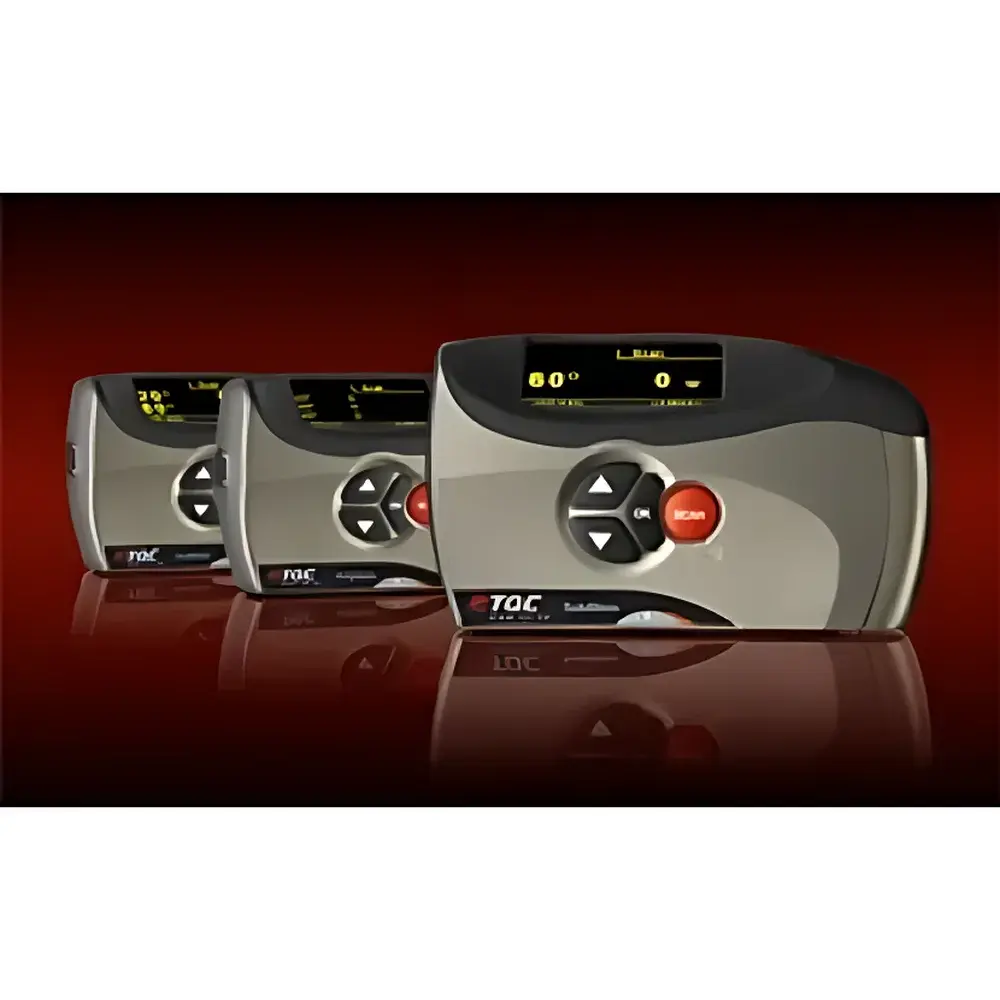
TQC SOLOGloss® 60°, DUOGloss® 20°/60°, and POLYGloss® 20°/60°/85° Portable Gloss Meters
| Brand | TQC |
|---|---|
| Origin | Netherlands |
| Model | SOLOGloss® / DUOGloss® / POLYGloss® |
| Gloss Range (20°) | 0–2000 GU |
| Gloss Range (60°) | 0–2000 GU |
| Gloss Range (85°) | 0–100 GU |
| Repeatability | ±0.1 GU |
| Measurement Angles | 20°, 60°, 85° (model-dependent) |
| Display | OLED |
| Light Source | Stable LED |
| Power | 2 × AA batteries |
| Dimensions | 90 × 140 × 45 mm |
| Weight | 398 g |
| Compliance | ISO 2813, ASTM D523, ASTM D2457, ASTM C584, BS 3900 D5, DIN 67530, JIS Z 8741, AS 1580 (602.2), ISO 7668 |
Overview
The TQC SOLOGloss®, DUOGloss®, and POLYGloss® series are precision portable gloss meters engineered for reliable, repeatable surface reflectance measurement across industrial quality control and R&D environments. Based on the principle of specular reflectance—measuring the ratio of reflected to incident light at defined geometric angles—these instruments comply with internationally recognized optical standards including ISO 2813 and ASTM D523. Unlike integrating sphere-based systems used for total transmittance or haze, TQC gloss meters employ a collimated LED source and matched photodetector aligned at fixed incidence angles (20°, 60°, or 85°), ensuring high angular accuracy and minimal stray-light interference. The 60° configuration serves as the universal reference for medium-gloss surfaces (e.g., automotive clear coats, architectural paints); the 20° angle enhances sensitivity for high-gloss substrates (e.g., polished metals, lacquered wood); and the 85° geometry enables quantitative assessment of low-gloss, matte, or textured finishes (e.g., powder-coated appliances, paperboard packaging). All models feature factory-calibrated optics traceable to NIST-traceable standards, with onboard user calibration capability to maintain long-term metrological integrity.
Key Features
- Triple-angle optical architecture (20°/60°/85°) in POLYGloss® model, enabling full-range gloss characterization from mirror-like to near-diffuse surfaces
- High-stability LED light source with <1% intensity drift over 8 hours, eliminating lamp aging-related calibration drift
- OLED display with 128 × 64 pixel resolution, offering >10,000:1 contrast ratio and wide viewing angles for consistent readability under ambient lighting or shadowed conditions
- Ergonomic, symmetrical housing designed for ambidextrous operation and stable placement on curved or inclined surfaces
- USB 2.0 interface supporting firmware updates, data export (CSV), and remote instrument control via TQC Analysis Software
- On-device menu navigation with intuitive icon-based UI—no specialized training required for routine operation
- Integrated self-diagnostic system monitoring battery voltage, sensor status, and calibration validity
Sample Compatibility & Compliance
These gloss meters accommodate rigid and semi-rigid planar or gently curved samples—including painted metal panels, plastic injection-molded parts, laminated wood veneers, coated paper, ceramic tiles, and polymer films—provided the measurement area exceeds 10 × 10 mm and surface roughness remains below Ra 0.8 µm. Surface contaminants, fingerprints, or micro-scratches must be removed prior to measurement using only the supplied microfiber cloth. The instruments meet requirements for GLP-compliant documentation workflows: each unit ships with an accredited calibration certificate (traceable to PTB/NPL standards), supports timestamped measurement logging, and retains audit trail metadata (operator ID, date/time, calibration status) within exported datasets. Regulatory alignment includes ISO/IEC 17025 calibration management protocols and compatibility with FDA 21 CFR Part 11–enabled software configurations when deployed in pharmaceutical packaging or medical device coating QC labs.
Software & Data Management
TQC Analysis Software (v3.2+, included on USB drive) provides comprehensive post-acquisition functionality: statistical process control (SPC) charting (X̄-R, Cp/Cpk), batch report generation (PDF/Excel), multi-instrument fleet management, and customizable pass/fail threshold mapping per angle and material class. Raw data files store individual readings with embedded instrument serial number, calibration date, environmental temperature (via optional external probe), and operator-defined sample ID. Export formats include UTF-8 CSV (compatible with JMP, Minitab, and LabWare LIMS) and XML for ERP integration. Firmware updates preserve historical calibration coefficients and do not reset user-defined settings. All software modules undergo annual validation against NIST SP 800-53 security controls for lab network deployment.
Applications
- Automotive: Clear coat gloss uniformity verification across body panels; OEM paint supplier qualification per GMW14872 or Ford CETP
- Coatings & Inks: Batch-to-batch consistency monitoring of solvent-borne, waterborne, and UV-curable formulations
- Packaging: Gloss specification compliance for folding cartons, flexible laminates, and metallized films (ASTM F1249)
- Furniture & Flooring: Finish durability assessment before and after abrasion, humidity cycling, or chemical exposure testing
- Electronics: Reflectance grading of appliance housings, touch-panel overlays, and EMI-shielded enclosures
- Printing & Paper: Quantitative evaluation of calendering efficiency, varnish application, and ink film thickness correlation
FAQ
What is the recommended recalibration interval for these gloss meters?
Annual recalibration is advised under normal usage conditions. Instruments subjected to frequent transport, thermal shock, or mechanical impact should undergo verification every 6 months using the supplied calibration tile.
Can the same calibration tile be used across all three angle models?
No. Each angle-specific calibration tile is optically characterized for its designated geometry. Using a 60° tile with the 20° mode introduces systematic bias exceeding ±0.5 GU.
Is the USB interface compatible with Windows 11 and macOS Ventura?
Yes. Device drivers are OS-agnostic HID-class compliant; no additional installation is required beyond TQC Analysis Software.
How does surface curvature affect measurement accuracy?
For radii <50 mm, edge effects may cause up to ±1.2 GU deviation. Use the optional curved-surface adapter (part #CSA-60) for repeatable results on cylindrical or spherical substrates.
Does the instrument support GLP audit trails for regulated industries?
Yes—when used with validated TQC Analysis Software v3.2+, all measurements record operator ID, timestamp, calibration status, and environmental metadata, satisfying ALCOA+ data integrity principles.




