
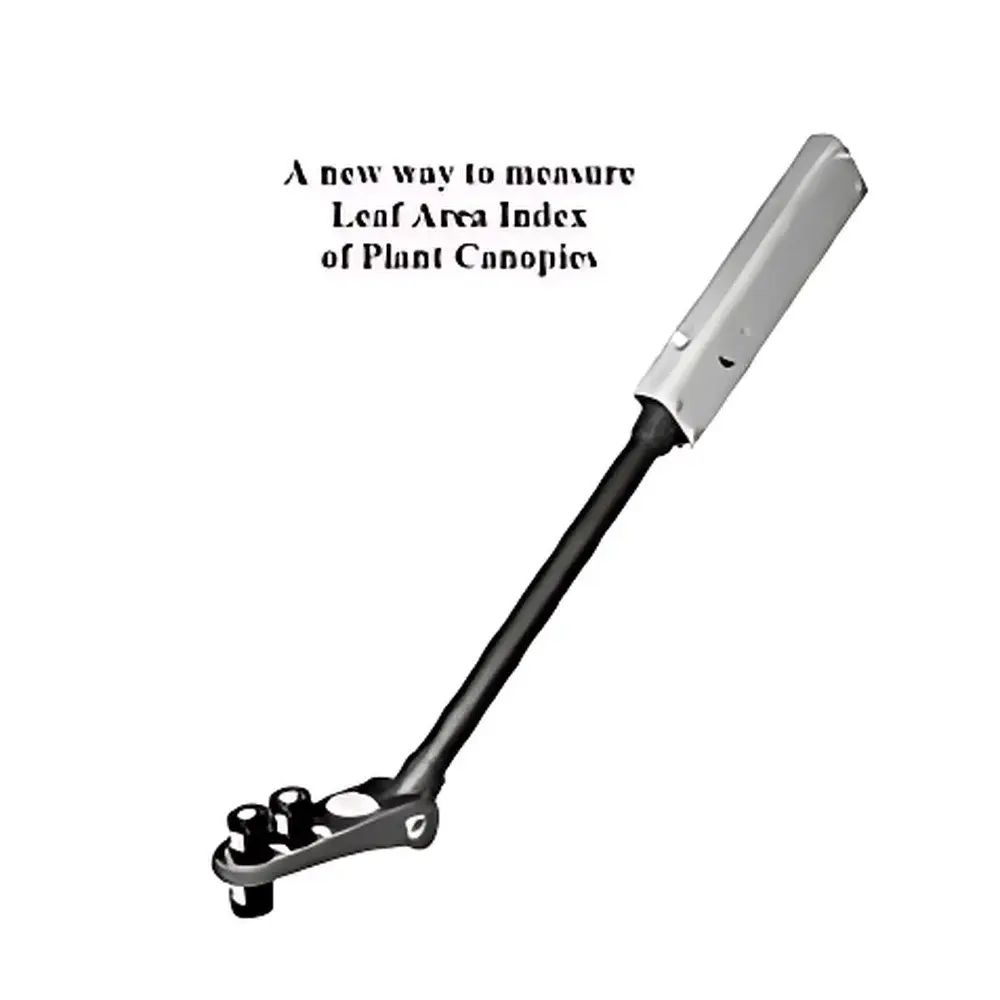
TRAC Plant Canopy Analyzer
| Origin | Canada |
|---|---|
| Manufacturer Type | Distributor |
| Origin Category | Imported |
| Model | TRAC |
| Pricing | Upon Request |
Overview
The TRAC Plant Canopy Analyzer is a field-deployable, optical instrumentation system engineered for non-destructive, in-situ quantification of key biophysical canopy parameters. It operates on the principle of gap fraction analysis derived from vertical profiles of photosynthetically active radiation (PAR) transmission beneath plant canopies. By measuring PAR (400–700 nm) at multiple points along a linear transect using three calibrated silicon photodiode sensors, the TRAC captures spatial heterogeneity in canopy structure and light interception. A built-in microprocessor applies inverse modeling—based on Beer-Lambert law assumptions and clumping corrections—to convert measured gap-size distributions into robust estimates of Leaf Area Index (LAI), Fraction of Absorbed Photosynthetically Active Radiation (FPAR), and gap size frequency distribution. Designed for ecological monitoring, agricultural research, and climate modeling validation, the TRAC delivers reproducible, traceable data without requiring destructive sampling or complex calibration protocols.
Key Features
- Tri-sensor PAR array with spectral response matched to CIE-defined photosynthetic action spectrum (400–700 nm); each sensor independently calibrated against NIST-traceable reference standards
- Integrated analog-to-digital converter (12-bit resolution) and embedded microprocessor enabling real-time signal conditioning and on-board computation
- 512 KB non-volatile memory for autonomous data logging—supports up to 10,000 measurement points per session with timestamping and GPS-optional metadata tagging
- Ruggedized aluminum housing rated IP67 for operation in high-humidity, dusty, or rain-exposed field environments (operating temperature range: −20 °C to +50 °C)
- Low-power architecture powered by a single 9 V alkaline battery (typical field life: >120 hours continuous use; battery status monitored and reported in real time)
- USB 2.0 interface compliant with USB CDC class drivers—no proprietary drivers required for Windows, macOS, or Linux host systems
Sample Compatibility & Compliance
The TRAC analyzer is compatible with a broad range of vegetation types—including deciduous and coniferous forests, herbaceous grasslands, row crops (e.g., maize, soybean), and orchard systems—provided canopy height permits horizontal sensor deployment at 0.5–2.0 m above ground level. Its non-contact optical method eliminates physical interference with plant structure, satisfying ISO 13837:2001 requirements for non-destructive LAI measurement. Data output conforms to FAO-recommended formats for FPAR reporting and supports interoperability with common ecological modeling frameworks (e.g., MODIS LAI/FPAR products, CLM, LPJ-GUESS). The device meets IEC 61326-1:2013 electromagnetic compatibility standards and complies with RoHS Directive 2011/65/EU for hazardous substance restrictions.
Software & Data Management
The TRAC is supported by TRACView—a cross-platform desktop application (Windows/macOS/Linux) developed in accordance with GLP-compliant software lifecycle practices. TRACView provides raw data visualization, gap-size histogram generation, LAI/FPAR uncertainty propagation analysis (including error estimation from sensor noise and angular response variability), and batch export to CSV, NetCDF, and ENVI-compatible BIL formats. Audit trail functionality logs all user-initiated processing steps, parameter adjustments, and file exports—meeting FDA 21 CFR Part 11 requirements for electronic records when configured with user authentication and digital signature modules. Software updates are distributed via HTTPS-secured channels with SHA-256 integrity verification.
Applications
- Long-term ecosystem monitoring programs assessing canopy structural change in response to drought, pest infestation, or land-use conversion
- Validation of satellite-derived LAI and FPAR products (e.g., Sentinel-3 OLCI, Landsat 9 OLI-2) under heterogeneous canopy conditions
- Field-scale phenotyping in crop breeding trials, particularly for traits related to light interception efficiency and canopy architecture
- Carbon flux modeling input generation for eddy covariance tower networks requiring sub-canopy PAR partitioning data
- Educational use in undergraduate and graduate-level courses on micrometeorology, plant ecophysiology, and remote sensing principles
FAQ
What is the minimum and maximum recommended transect length for accurate LAI estimation?
The TRAC is optimized for transects between 10 m and 100 m. Shorter lengths may increase sampling variance in patchy canopies; longer lengths require periodic battery recharge or replacement.
Does the TRAC require site-specific calibration before use?
No. Factory calibration is performed using PAR reference lamps traceable to NRC Canada. Field verification against a certified quantum sensor (e.g., LI-COR LI-190R) is recommended annually or after mechanical shock.
Can TRACView generate reports compliant with ISO/IEC 17025 documentation requirements?
Yes—when used with enabled audit trail, user roles, and electronic signatures, TRACView supports generation of instrument-specific calibration certificates, measurement uncertainty statements, and raw data archives suitable for accredited laboratory reporting.
Is the device compatible with external GPS modules for georeferenced sampling?
Yes—TRACView accepts NMEA 0183-formatted serial input from standard GNSS receivers, enabling spatial indexing of each measurement point within the transect.
How does the TRAC handle highly clumped canopies, such as conifer stands?
The onboard algorithm incorporates an empirical clumping index correction derived from multi-angle gap fraction analysis, improving LAI accuracy in species with needle fascicles or dense branching architectures.
Related Products







