
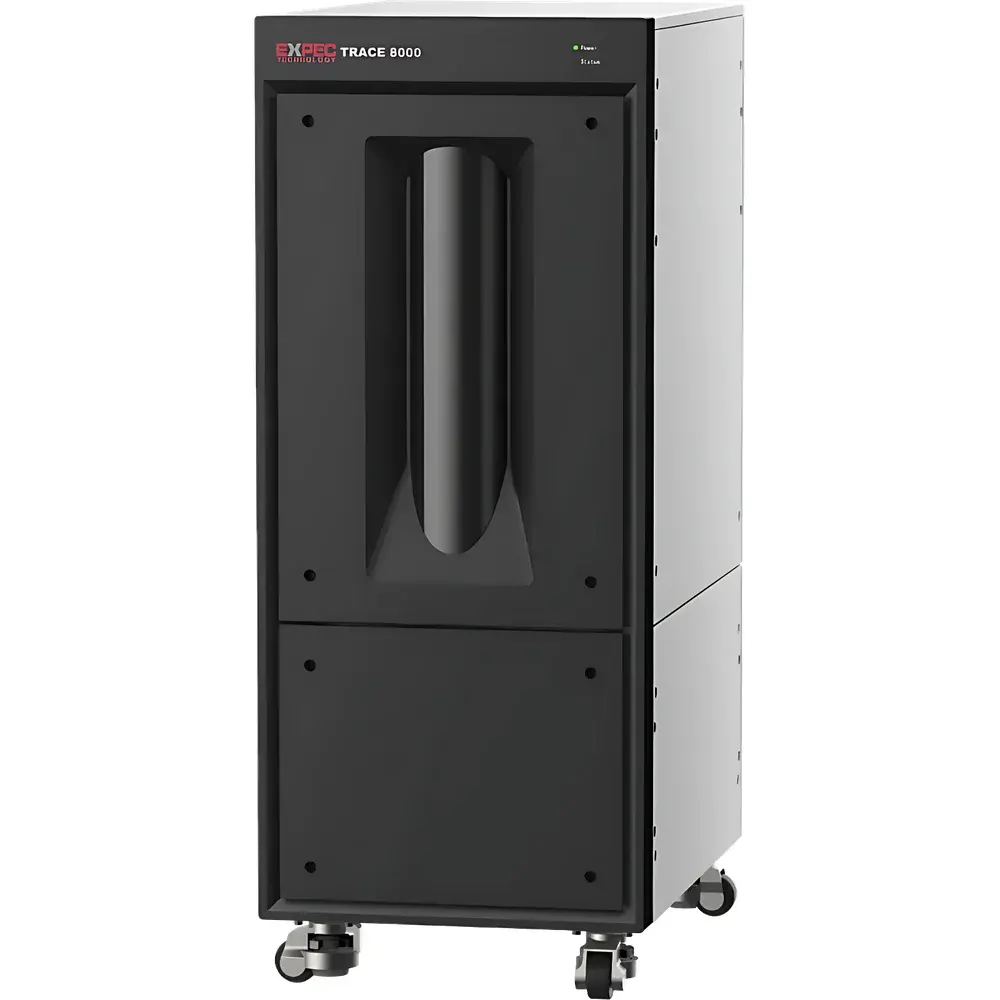
TRACE 8000 Chemical Ionization Time-of-Flight Mass Spectrometer
| Brand | EXPEC (Puyu Technology) |
|---|---|
| Model | TRACE 8000 |
| Ionization Source | Custom Glow Discharge CI Source with Reagent Gas Switching (H₃O⁺, O₂⁺, NO⁺) |
| Mass Analyzer | Orthogonal Acceleration Time-of-Flight (oa-TOF) |
| Mass Resolution (FWHM) | >4,000 at m/z 100 |
| Mass Accuracy | <3 ppm RMS (calibrated) |
| Scan Speed | ≤100 µs per spectrum |
| Detection Limit | Sub-pptv (gas phase, H₃O⁺ mode, for selected VOCs) |
| Ion Transmission Efficiency | Enhanced via High-Voltage Ion Funnel and Electrostatic Lens Optics |
| Compliance | Designed to support GLP/GMP workflows with audit-trail-capable software architecture |
| Operating Environment | Ambient air sampling |
Overview
The EXPEC TRACE 8000 Chemical Ionization Time-of-Flight Mass Spectrometer is an ambient ionization mass spectrometry platform engineered for real-time, high-sensitivity molecular detection in complex gaseous matrices. It integrates a proprietary glow discharge chemical ionization (CI) source with orthogonal acceleration time-of-flight (oa-TOF) mass analysis—enabling soft, selective ionization and high mass resolving power without chromatographic separation. Unlike electron impact (EI) sources, the TRACE 8000’s reagent-ion-driven CI process minimizes fragmentation, preserving molecular ion signals essential for unambiguous compound identification. Its microsecond-scale spectral acquisition supports transient event capture—critical for dynamic emissions profiling, industrial process monitoring, and breath analysis where temporal fidelity directly impacts diagnostic or regulatory interpretation.
Key Features
- Glow discharge-based chemical ionization source with automated reagent gas switching between H₃O⁺, O₂⁺, and NO⁺—enabling tunable ionization energy (IE) from ~6.5 eV to 12.5 eV for selective detection of aldehydes, ketones, thiols, amines, halogenated hydrocarbons, BTEX, and aliphatic/aromatic hydrocarbons.
- High-transmission ion optics incorporating a high-voltage RF ion funnel and multi-element electrostatic lens system—optimized to maintain ion kinetic energy homogeneity and reduce space-charge effects across wide dynamic concentration ranges (10⁴–10⁸ molecules/cm³).
- Orthogonal acceleration TOF analyzer with reflectron design delivering mass resolution >4,000 (FWHM) at m/z 100 and mass accuracy 24 h).
- Real-time data acquisition at ≤100 µs per full mass spectrum (m/z 20–300), enabling synchronized measurement with GPS, meteorological sensors, and process control systems for spatially resolved emission mapping.
- Modular mechanical architecture designed for field deployment: vibration-damped optical bench, sealed vacuum manifold with dual-stage turbomolecular pumping, and temperature-stabilized detector housing for consistent signal-to-noise performance under variable ambient conditions.
Sample Compatibility & Compliance
The TRACE 8000 operates in direct ambient sampling mode—requiring no sample preparation, derivatization, or pre-concentration for gas-phase analytes. It accepts inlet flows from 0.1 to 2 L/min and interfaces seamlessly with standard Tedlar bags, SUMMA canisters, permeation tubes, and real-time dilution systems. The instrument complies with ISO/IEC 17025 requirements for analytical method validation when used with documented SOPs. Software logging adheres to FDA 21 CFR Part 11 principles—including electronic signatures, user access controls, and immutable audit trails—for regulated environments such as pharmaceutical manufacturing, semiconductor cleanroom AMC monitoring, and environmental compliance reporting. All firmware and control logic are validated per IEC 62304 Class B software safety standards.
Software & Data Management
The TRACE Control Suite provides integrated instrument control, real-time spectral visualization, and multivariate data processing. It supports batch calibration using internal reference standards (e.g., deuterated toluene, perfluorotributylamine), peak alignment across mobile datasets, and library matching against NIST MS Search, Wiley Registry, and custom-built ambient ionization spectral libraries. Raw data are stored in open-format HDF5 containers with embedded metadata (GPS coordinates, pressure, temperature, humidity, reagent ion identity). Export modules generate ASTM D7922-compliant reports for VOC speciation and EPA Method TO-15/TO-17 equivalent quantification workflows. Remote diagnostics and firmware updates are performed via TLS-secured HTTPS endpoints—fully auditable within enterprise IT governance frameworks.
Applications
- Mobile Emissions Monitoring: Vehicle-mounted deployment for fence-line VOC mapping, refinery leak detection, and urban atmospheric chemistry studies—supporting EPA OTM-42 and EU Directive 2010/75/EU compliance.
- Semiconductor Manufacturing: Real-time monitoring of airborne molecular contaminants (AMCs) including amines, aldehydes, and sulfur compounds in photolithography zones—meeting SEMI F21-0320 specifications.
- Food & Flavor Science: In-line headspace analysis of fermentation volatiles, roasting off-gases, and packaging migration compounds—enabling rapid sensory correlation and shelf-life modeling.
- Forensic & Security Screening: Field-deployable detection of explosives precursors (e.g., nitroglycerin, PETN), illicit drugs (fentanyl analogues), and chemical warfare agent simulants under ISO 17025-accredited protocols.
- Clinical Breath Research: Quantitative tracking of exhaled biomarkers (e.g., acetone, isoprene, hydrogen sulfide) across diurnal cycles or therapeutic interventions—validated against GC-MS reference methods per CLSI EP25-A2 guidelines.
FAQ
Does the TRACE 8000 require helium or other carrier gases?
No—it operates with ambient air as both sample matrix and collision gas; only reagent gases (H₂O vapor, O₂, NO) are consumed during ionization, delivered via certified gas standards or permeation sources.
Can it be integrated into existing SCADA or DCS systems?
Yes—via Modbus TCP, OPC UA, or RESTful API interfaces; all telemetry (mass spectra, intensity traces, status flags) is timestamped to UTC with nanosecond precision using PTPv2 synchronization.
What maintenance intervals are recommended for field operation?
Ion source cleaning every 200 hours of continuous use; TOF reflectron voltage calibration quarterly; vacuum pump oil replacement annually—documented in ISO 9001-aligned maintenance logs.
Is method transfer supported between laboratory and mobile configurations?
Yes—method files (.trc) include full instrument parameter sets, calibration coefficients, and spectral processing rules, ensuring identical data reduction pipelines across platforms.
How is data integrity ensured during long-term unattended operation?
All raw acquisitions are checksummed (SHA-256), written to redundant NVMe storage with automatic failover, and mirrored to network-attached storage with write-verified acknowledgment—meeting ALCOA+ data governance criteria.





