
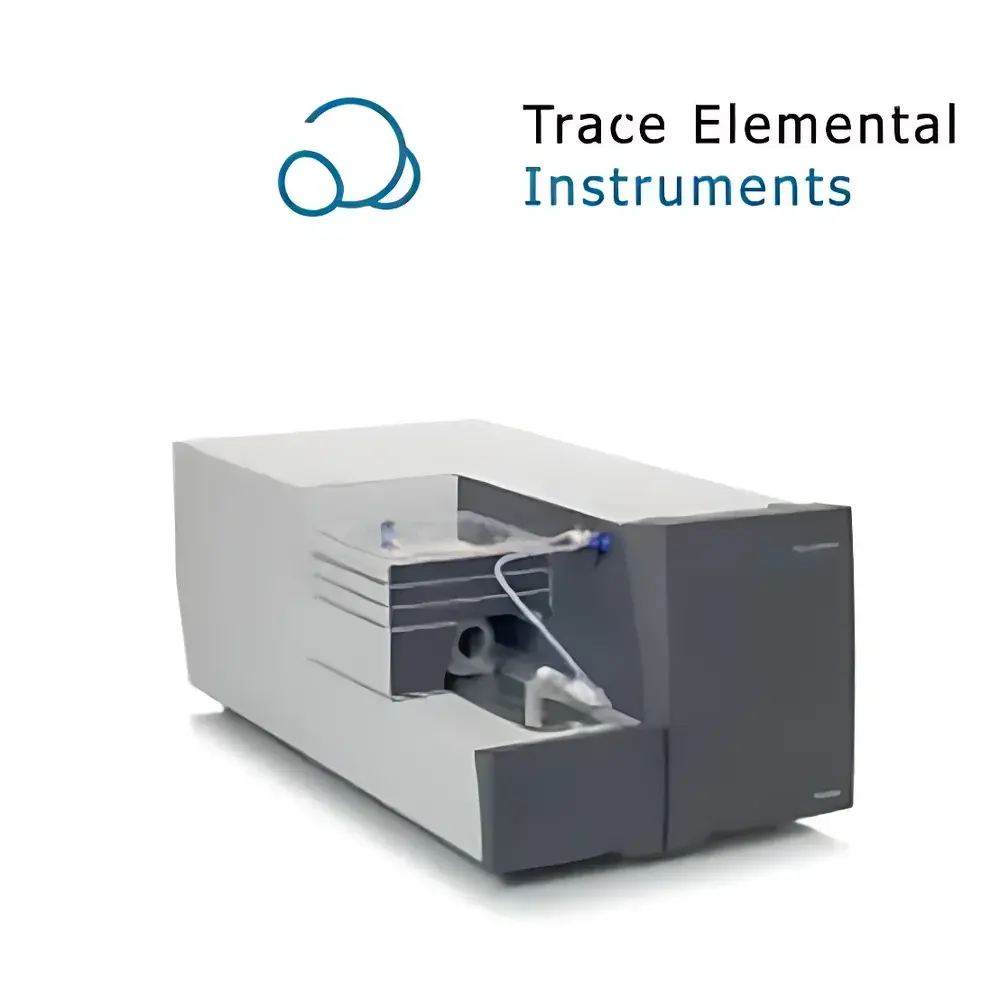
Trace Elemental Instruments XPLORER AOX Total Organic Halogen (TOX) Analyzer
| Brand | TE/Trace Elemental Instruments |
|---|---|
| Origin | Netherlands |
| Model | XPLORER AOX |
| Measurement Principle | High-Temperature Combustion–Coulometric Titration |
| Measurement Range | 0.0025–1000 µg Cl/L |
| Accuracy | <3% @ 200 ppb Cl |
| Repeatability | <2.5% RSD |
| LOD | 0.0025 µg Cl |
| Resolution | 0.0025 µg Cl |
| Combustion Temperature | Up to 1150 °C |
| Sample Introduction | 5–1000 mg (solid) or 0.1–10 mL (liquid) |
| Analysis Time (per sample) | 3–10 min (excluding pre-treatment) |
| Carrier Gases | O₂ (99.6%), Ar (99.998%) |
| Autosampler | Standard 20-position, expandable to 60-position |
| Software | TEIS 2 Online Control & Data Processing Platform |
| Compliance | ISO 9562:2004, EN ISO 9562, DIN 38409-H17, EPA Method 1650, HJ 1214–2021, GB/T 34845–2017, GB/T 35613–2017, GB/T 41533–2022, GB/T 22904–2008, GB/T 15959 |
Overview
The Trace Elemental Instruments XPLORER AOX is a fully automated total organic halogen (AOX) analyzer engineered for high-precision quantification of adsorbable organic halogens (AOX), total organic halogens (TOX), purgeable organic halogens (POX), and extractable organic halogens (EOX) in environmental and industrial matrices. It operates on the internationally validated high-temperature combustion–coulometric titration principle: samples are combusted quantitatively at up to 1150 °C in an oxygen-rich atmosphere, converting all covalently bound halogens (Cl, Br, I) into hydrogen halides (HX). These gases are swept through a scrubber system to remove interferences (e.g., SO₂, NOₓ), then absorbed into an electrolyte solution where halide ions are electrochemically titrated via coulometric generation of silver ions (Ag⁺). The charge required for complete titration is directly proportional to halogen mass—enabling trace-level detection with metrological traceability.
Key Features
- Compact benchtop architecture—the smallest footprint among high-sensitivity AOX analyzers—optimized for regulated laboratory environments with space constraints.
- Patented temperature-controlled coulometric titration cell enabling continuous 24/7 operation without drift or recalibration, critical for multi-day batch analysis under GLP/GMP conditions.
- Low-voltage high-efficiency furnace design extending thermal element service life beyond 5,000 h while maintaining ±2 °C temperature stability at 1150 °C.
- Modular hardware architecture supporting seamless integration of alternative sample introduction modules (e.g., purge-and-trap for POX, solvent extraction interface for EOX) without instrument downtime.
- Automated method sequencing: full control over combustion parameters, gas flow rates, absorption timing, and titration thresholds via embedded logic—minimizing operator intervention and inter-laboratory variability.
- TEIS 2 software platform compliant with FDA 21 CFR Part 11 requirements, including electronic signatures, audit trail logging, user role-based access control, and data integrity safeguards aligned with ALCOA+ principles.
Sample Compatibility & Compliance
The XPLORER AOX accommodates heterogeneous solid and liquid matrices without manual derivatization. Validated applications include aqueous effluents (wastewater, surface water, groundwater, brine), pulp and paper mill discharges, sludge, sediments, soils, and lipid-rich waste oils. Solid samples are processed using standardized column adsorption (per ISO 9562) or oscillatory adsorption protocols; liquids undergo direct injection or dilution-assisted dosing. All operational parameters adhere strictly to regulatory method requirements—including ISO 9562:2004, EN ISO 9562, DIN 38409-H17, EPA Method 1650, and Chinese national standards (HJ 1214–2021, GB/T 34845–2017, GB/T 41533–2022). Instrument performance verification includes daily system suitability tests (SST) per ISO/IEC 17025:2017 clause 7.7, ensuring measurement uncertainty remains within declared specifications across calibration ranges.
Software & Data Management
TEIS 2 provides integrated instrument control, real-time process monitoring, and regulatory-grade data handling. It supports automated calibration curve generation (linear and quadratic), spike recovery calculation per sample, and automatic flagging of outliers based on user-defined RSD thresholds. Raw coulometric current traces, temperature profiles, and gas flow logs are archived with immutable timestamps. Export formats include CSV, PDF analytical reports (with digital signature), and XML for LIMS integration. All data modifications are recorded in a tamper-evident audit trail—including user ID, timestamp, action type, and pre-/post-change values—meeting requirements for ISO/IEC 17025 accreditation and pharmaceutical environmental monitoring programs.
Applications
- Regulatory compliance testing for AOX discharge limits in wastewater treatment plants (EU Urban Wastewater Directive, US Clean Water Act).
- Environmental impact assessment of pulp and paper manufacturing—monitoring chlorinated dioxin/furan precursors in bleach plant effluents.
- Quality control of recycled fiber products and tissue papers per GB/T 35613–2017 green product certification criteria.
- Screening of textile processing effluents for organohalogen residues (e.g., chlorophenols, brominated flame retardants) in accordance with GB/T 41533–2022.
- Soil and sediment risk assessment at former industrial sites contaminated with PCBs, chlorinated pesticides, or halogenated solvents.
FAQ
What sample preparation is required prior to AOX analysis?
Solid samples require homogenization and adsorption onto activated carbon columns per ISO 9562; liquid samples may be injected directly or pre-concentrated via solid-phase extraction depending on expected concentration.
Can the XPLORER AOX quantify bromine and iodine in addition to chlorine?
Yes—the coulometric detection principle responds equivalently to Cl⁻, Br⁻, and I⁻ ions; results are reported as µg X/L (X = Cl, Br, or I) or converted to µg Cl-equivalent using stoichiometric factors.
Is method validation documentation provided with the instrument?
Yes—each system ships with a comprehensive IQ/OQ/PQ protocol package, including certified reference material (CRM) test reports, linearity verification data, and inter-laboratory precision studies aligned with ISO 5725.
How does the instrument handle high-sulfur or high-nitrogen samples?
Integrated dual-stage scrubbers (NaOH + AgNO₃) quantitatively remove SO₂ and NOₓ prior to halide absorption, preventing electrode poisoning and ensuring long-term titration cell stability.
What maintenance intervals are recommended for routine operation?
Daily: electrode cleaning and electrolyte replacement; quarterly: furnace insulation inspection and gas line leak check; annually: full system performance verification using NIST-traceable AOX standards.
Related Products







