
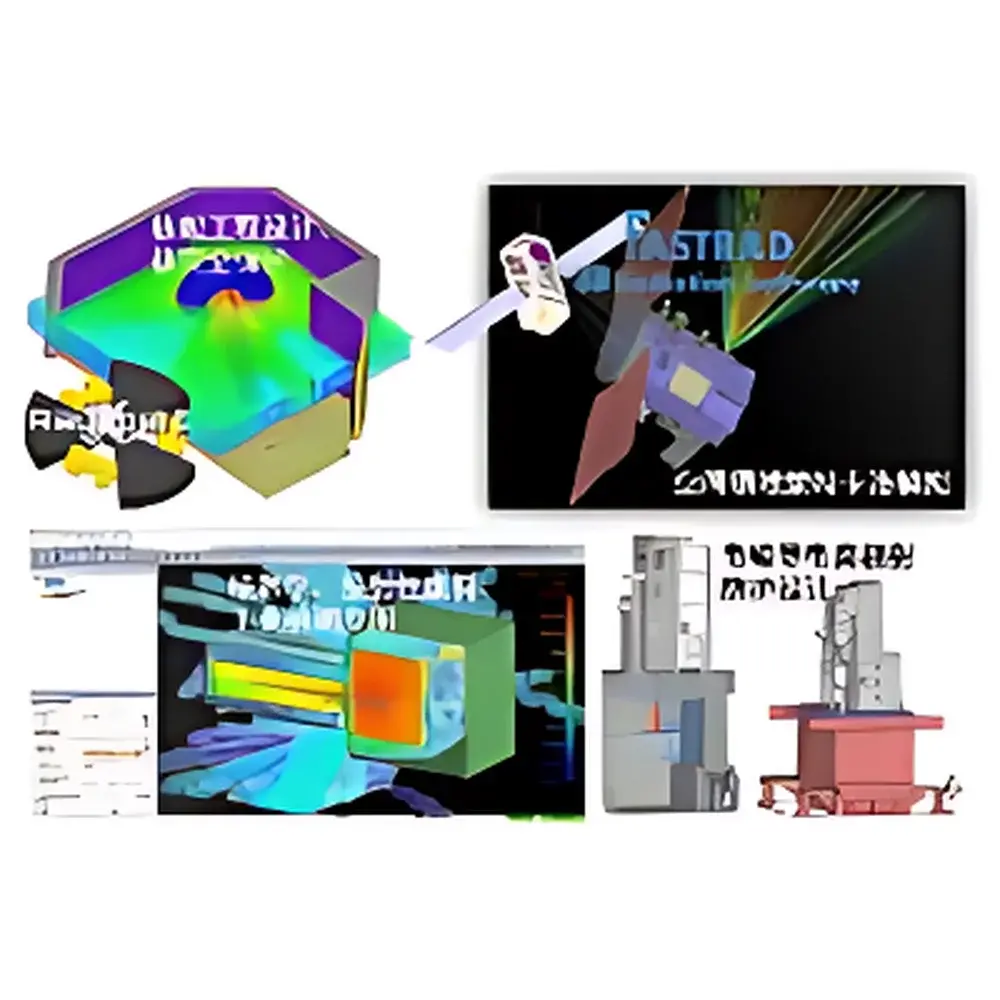
TRAD RayXpert 2.0 Radiation Simulation & Modeling Software
| Brand | TRAD (Tests & Radiations) |
|---|---|
| Origin | France |
| Model | RayXpert 2.0 |
| Core Engine | Geant4 v11.2-based Monte Carlo simulation platform |
| Particle Support | γ, β⁻/β⁺, e⁻/e⁺, n, p, d, t, α, ³He, heavy ions |
| Source Types | Point, surface, volume, spectrum (user-defined or library-based), complex energy spectra |
| Geometry | Native 3D CAD modeling + STEP import (ISO 10303-21) |
| Material Definition | Custom elemental composition, density, mixture, isotopic enrichment |
| Output Metrics | Dose rate (Gy/h), absorbed dose (Gy), equivalent dose (Sv), fluence, particle tracks, path-integrated dose |
| Analysis Tools | Isodose contours, cross-sectional dose profiles, detector response simulation, multi-source/spectrum superposition, variance-reduced convergence monitoring (FOM) |
| Compliance Framework | Supports GLP-aligned audit trails, input/output logging, parameter versioning |
| Automation | Python API, CLI mode, JSON export for materials/sources, scriptable input generation |
| Licensing | Modular (SILVER/GOLD/PLATINUM), floating network license available |
| OS | Windows 10/11 (64-bit) |
Overview
TRAD RayXpert 2.0 is a professional-grade, Geant4 v11.2–based Monte Carlo radiation transport simulation software engineered for high-fidelity 3D modeling of ionizing radiation environments. Developed by TRAD (Tests & Radiations), a French engineering firm headquartered in Toulouse with over three decades of expertise in space radiation effects and nuclear instrumentation, RayXpert 2.0 implements first-principles physics to simulate particle interactions—including electromagnetic (γ, X-ray, e⁻/e⁺), hadronic (n, p, d, t, α, ³He, ions), and mixed-field scenarios—across arbitrarily complex geometries. Unlike empirical or simplified analytical tools, RayXpert 2.0 solves the Boltzmann transport equation stochastically, enabling rigorous prediction of spatially resolved absorbed dose, ambient dose equivalent, fluence distributions, and detector response under realistic shielding, source, and material configurations. Its primary application domain spans radiation protection engineering, spacecraft shielding design, medical physics (radiotherapy and brachytherapy planning), nuclear facility safety analysis, and accelerator-based industrial inspection systems.
Key Features
- Multi-Physics Particle Transport: Full support for electromagnetic, hadronic, and decay processes per Geant4 v11.2, including updated nuclear data libraries (JEFF-3.3, ENDF/B-VIII.0, TENDL-2024) for accurate neutron cross-sections and high-energy hadron interactions above 20 MeV.
- Integrated 3D Modeling Environment: Native parametric CAD builder with hierarchical object management, automatic geometry validation (overlap, vacuum leak detection), and repair capabilities—complementing STEP AP214 import for mechanical integration with engineering workflows.
- Advanced Variance Reduction: Built-in implementation of splitting, Russian roulette, exponential transform, and importance mapping—enabling order-of-magnitude acceleration in convergence without biasing statistical uncertainty estimates.
- Quantitative Dose Visualization: Real-time rendering of isodose surfaces, planar dose cross-sections, path-integrated dose along user-defined trajectories (Path Dose Viewer), and spectral decomposition of contributions from individual particles or source components.
- Extensible Material & Source Libraries: Fully customizable material definitions (elemental composition, density, isotopic fractions) and source configuration (discrete energy lines, continuous spectra, time-dependent emission profiles) with JSON export and Python-accessible metadata.
- Automation & Interoperability: Command-line interface (CLI) for batch simulation orchestration, Python bindings for workflow integration, and structured output formats compatible with MATLAB, Excel, and custom post-processing pipelines.
Sample Compatibility & Compliance
RayXpert 2.0 does not interface with physical detectors or field instruments; it operates as a pure computational modeling environment for virtual radiation experiments. Input geometry may originate from native modeling or imported STEP files conforming to ISO 10303-21. Material definitions align with ICRU/ICRP reference compositions and permit user-specified isotopic enrichment—critical for simulating irradiated fuel or activated components. The software supports traceable simulation auditing through comprehensive logging of input parameters, random seed states, and intermediate tally outputs. While not certified as a standalone regulatory tool, RayXpert 2.0 workflows are routinely employed in contexts requiring compliance with ISO 4037 (X/γ reference radiations), IEC 61558 (radiation protection instrumentation), and ESA ECSS-E-ST-10-04C (space radiation environment modeling standards). Its deterministic logging architecture facilitates GLP/GMP-aligned validation protocols when deployed within controlled QA/QC environments.
Software & Data Management
RayXpert 2.0 employs a modular licensing structure—SILVER (γ/X-ray only), GOLD (adds electrons and neutrons), and PLATINUM (full hadronic physics, Python API, and automation)—with optional floating network licenses for enterprise deployment. All versions run natively on Windows 10/11 (64-bit) and store project data in encrypted, versioned binary containers. Input configurations—including geometry, materials, sources, and physics lists—are fully exportable as human-readable JSON for archival, peer review, or third-party verification. Simulation logs capture runtime statistics (particles processed, variance reduction factors applied, FOM values), enabling reproducibility assessment across compute platforms. Integration with external tools is supported via CSV/TSV exports of dose maps, tally histograms, and particle spectra—ensuring compatibility with institutional data governance policies and long-term digital preservation requirements.
Applications
- Radiation Protection Engineering: Optimization of shielding thickness and material selection for radiotherapy bunkers, nuclear waste transport casks, and spent fuel pool configurations—validated against IAEA Safety Standards Series No. SSG-30.
- Spacecraft Systems Design: Prediction of total ionizing dose (TID) and displacement damage dose (DDD) in onboard electronics, using mission-specific solar particle event (SPE) and galactic cosmic ray (GCR) spectra per ESA SPENVIS-compatible inputs.
- Medical Physics: Commissioning support for proton therapy nozzles, Monte Carlo-based treatment plan verification, and brachytherapy source calibration—aligning with AAPM TG-105 and ICRU Report 90 recommendations.
- Nuclear Facility Safety: Criticality safety assessments for fissile material handling, neutron streaming analysis through penetrations, and activation product inventory estimation using time-dependent decay chains.
- Industrial NDT & Security: Simulation of X-ray and neutron radiography systems—including scatter contribution, beam hardening, and detector efficiency corrections—for non-destructive evaluation of aerospace composites or cargo screening systems.
FAQ
Does RayXpert 2.0 require a hardware dongle or cloud activation?
No. License enforcement is performed via node-locked or floating network tokens managed through TRAD’s secure licensing server; offline operation is supported with periodic revalidation windows.
Can RayXpert 2.0 import CAD files from SolidWorks or CATIA directly?
Yes—via standardized STEP AP214 format. Native support for Parasolid or ACIS kernels is not included, but most major CAD platforms export STEP compliant with ISO 10303-21.
Is GPU acceleration supported for Monte Carlo calculations?
Not in the current release. RayXpert 2.0 leverages multi-threaded CPU execution (OpenMP) and optimized Geant4 kernel scheduling; GPU offloading remains under evaluation for future versions.
How does RayXpert 2.0 handle radioactive decay chains and time-dependent sources?
It integrates GEANT4’s Radioactive Decay module, supporting full decay trees, branching ratios, and delayed particle emission—including beta-delayed neutrons and gamma cascades—with user-defined initial nuclide inventories.
Are validation benchmarks included with the software distribution?
Yes—each installation includes a suite of IAEA- and NIST-traceable benchmark problems (e.g., CASK-1, PWR pressure vessel neutron fluence, ICRU sphere depth-dose curves) with reference solutions for regression testing and user verification.
Related Products







