
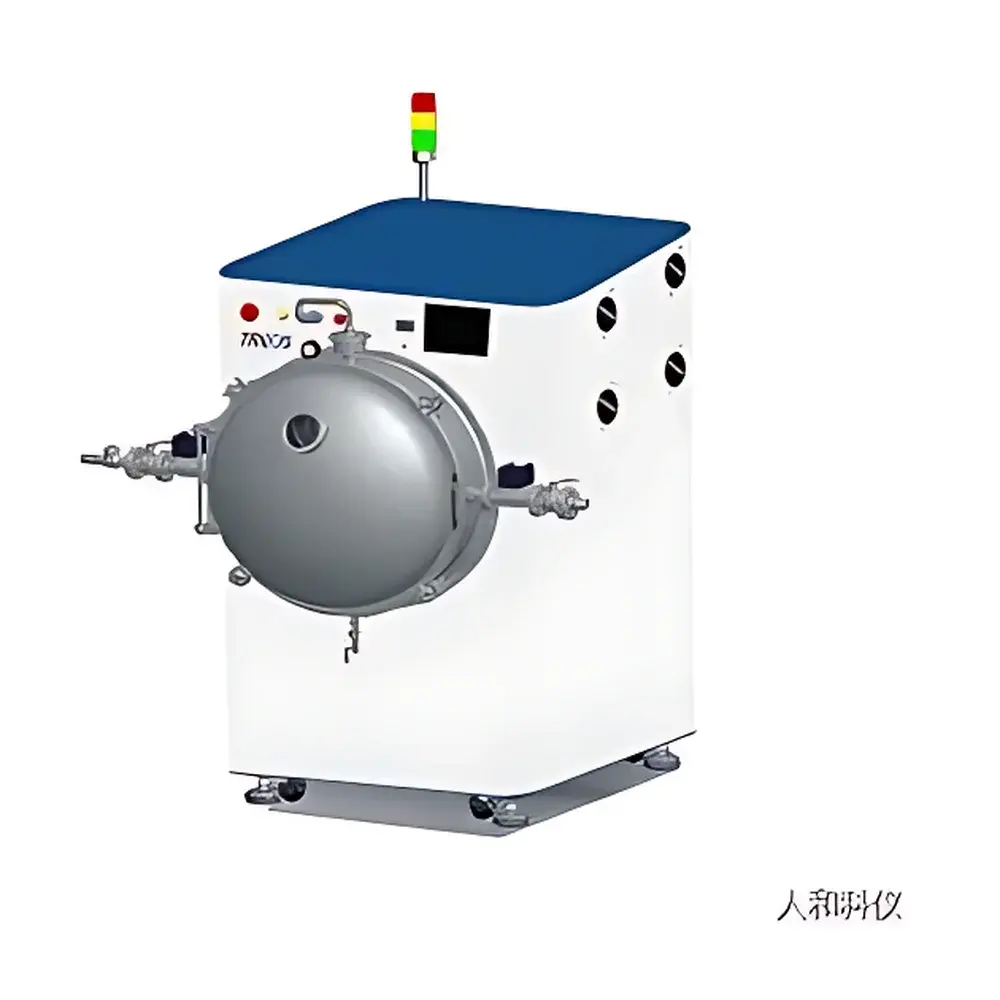
TRILOS Inline Vacuum Deaerator
| Brand | TRILOS |
|---|---|
| Origin | USA |
| Manufacturer Type | Authorized Distributor |
| Origin Category | Imported |
| Model | VTR-Series |
| Price | Upon Request |
| Dimensions (L×W×H) | 1620 × 1393 × 1717 mm (2295 mm with exhaust stack) |
| Net Weight | 860 kg |
| Operating Vacuum Range | 6 mbar to atmospheric pressure |
| Power Supply | AC 380 V ±10%, 50–60 Hz, 3-phase |
| Rated Power | 2.5 kW |
| Throughput Capacity | 200–2000 L/h (viscosity-dependent) |
| Wetted Materials | SUS304 stainless steel, perfluoroelastomer (FFKM), PTFE |
Overview
The TRILOS Inline Vacuum Deaerator is an engineered solution for continuous, high-efficiency removal of entrained and dispersed microbubbles from viscous fluid systems—specifically designed to meet the stringent requirements of precision coating, thin-film casting, and high-value slurry processing. Unlike batch vacuum chambers or static degassing tanks, this system operates on the validated VTR principle: Vacuum–Thin-film–Rotation. In this process, feed material is drawn under controlled sub-atmospheric pressure into a rotating chamber where it forms a uniform, shear-stabilized film across the inner surface of a high-precision rotor disk. Under combined centrifugal force and sustained low-pressure exposure (6 mbar minimum), dissolved gases and occluded air nucleate, coalesce, and migrate to the vapor phase, which is continuously extracted via a dedicated vacuum manifold. The deaerated fluid exits radially through a non-pulsating discharge port—without reintroduction of shear-induced re-entrainment or pump-induced re-aeration. This architecture ensures consistent bubble removal across viscosities ranging from 50,000 mPa·s (e.g., cathode/anode battery slurries, conductive pastes), without requiring surfactant additives or thermal destabilization.
Key Features
- VTR-based continuous deaeration: Eliminates dependency on dwell time, enabling real-time integration into inline coating and dispensing lines.
- Low-vacuum operation (6–1000 mbar range): Minimizes solvent volatilization and preserves formulation integrity—critical for solvent-based binders and thermally sensitive actives.
- No re-foaming post-treatment: Discharge occurs via gravity-assisted, pump-free flow path; no mechanical pumping stage prevents reintroduction of air.
- Material compatibility: Wetted components constructed from electropolished SUS304 stainless steel, FFKM seals, and PTFE-lined surfaces ensure chemical resistance and compliance with USP Class VI and FDA 21 CFR Part 117 (food contact) and ISO 13485 (medical device manufacturing) requirements.
- Residence time control: Integrated precision check valve allows fine adjustment of material dwell time within the deaeration chamber (typically 2–15 seconds), optimizing gas release kinetics without over-processing.
- Modular footprint: Compact vertical configuration (1620 × 1393 × 1717 mm, 2295 mm with exhaust extension) supports retrofitting into existing cleanroom or production line layouts.
Sample Compatibility & Compliance
The TRILOS Inline Vacuum Deaerator accommodates Newtonian and non-Newtonian fluids—including shear-thinning, thixotropic, and yield-stress materials—commonly processed in lithium-ion battery electrode manufacturing (NMC, LFP slurries), proton exchange membrane (PEM) fuel cell catalyst inks, conductive silver/gold pastes, UV-curable coatings, cosmetic emulsions (e.g., hand creams, lipsticks), pharmaceutical ointments, food-grade suspensions (mayonnaise, sauces), and agrochemical formulations. Its design conforms to ISO 8502-2 for surface cleanliness validation, ASTM D2755 for foam stability assessment, and supports GLP/GMP audit readiness through traceable operational parameters (vacuum setpoint, throughput rate, temperature monitoring points optional). All wetted materials comply with EC 1935/2004 (food contact), REACH SVHC screening, and USP plastic component standards.
Software & Data Management
While the base model operates via analog vacuum regulators and manual flow control valves, optional digital instrumentation packages include programmable logic controller (PLC)-based HMI interfaces with Modbus TCP/RTU support for integration into MES/SCADA environments. Real-time logging of vacuum level, inlet/outlet pressure differentials, and cumulative throughput volume is available with timestamped CSV export. Optional 21 CFR Part 11-compliant software modules provide electronic signatures, audit trails, user access levels, and data integrity safeguards—enabling full traceability for regulated industries including medical device coating, biopharmaceutical excipient processing, and automotive battery qualification.
Applications
This system is deployed in R&D laboratories and pilot-scale production facilities where bubble-induced defects directly impact functional performance: pinholes in battery electrode films leading to dendrite propagation; voids in PEM catalyst layers reducing proton conductivity; micro-blisters in optical adhesive coatings compromising light transmission; or inconsistent particle dispersion in conductive inks causing sheet resistance variation. It is routinely specified by Tier-1 EV battery manufacturers, display panel suppliers, contract development and manufacturing organizations (CDMOs), and food-grade coating formulators seeking reproducible, scalable deaeration without formulation compromise.
FAQ
Can the system handle shear-sensitive biological suspensions without denaturation?
Yes—the VTR process applies controlled rotational shear only during thin-film formation; residence time is short (<15 s), and no high-shear impellers or rotor-stator geometries are involved.
Is validation documentation available for GMP environments?
Yes—IQ/OQ protocols, material certificates of conformance (CoC), and 3.1 mill test reports for SUS304 components are provided upon order.
What maintenance intervals are recommended?
Vacuum pump oil change every 2000 operating hours; FFKM seal inspection annually or after 500 cycles; rotor surface cleaning with ethanol or IPA after each product changeover.
Does throughput vary linearly with viscosity?
No—throughput decreases non-linearly above ~10,000 mPa·s due to film adhesion effects; empirical calibration curves are supplied for common slurry families (e.g., PVDF/NMP, CMC/SBR/water).
Can the unit be integrated with upstream mixing or downstream slot-die coaters?
Yes—standardized 1.5″ sanitary clamp (ISO 2852) and tri-clamp flange interfaces enable direct piping integration; custom manifolds and pressure-compensated feed pumps are available as accessories.
Related Products



