
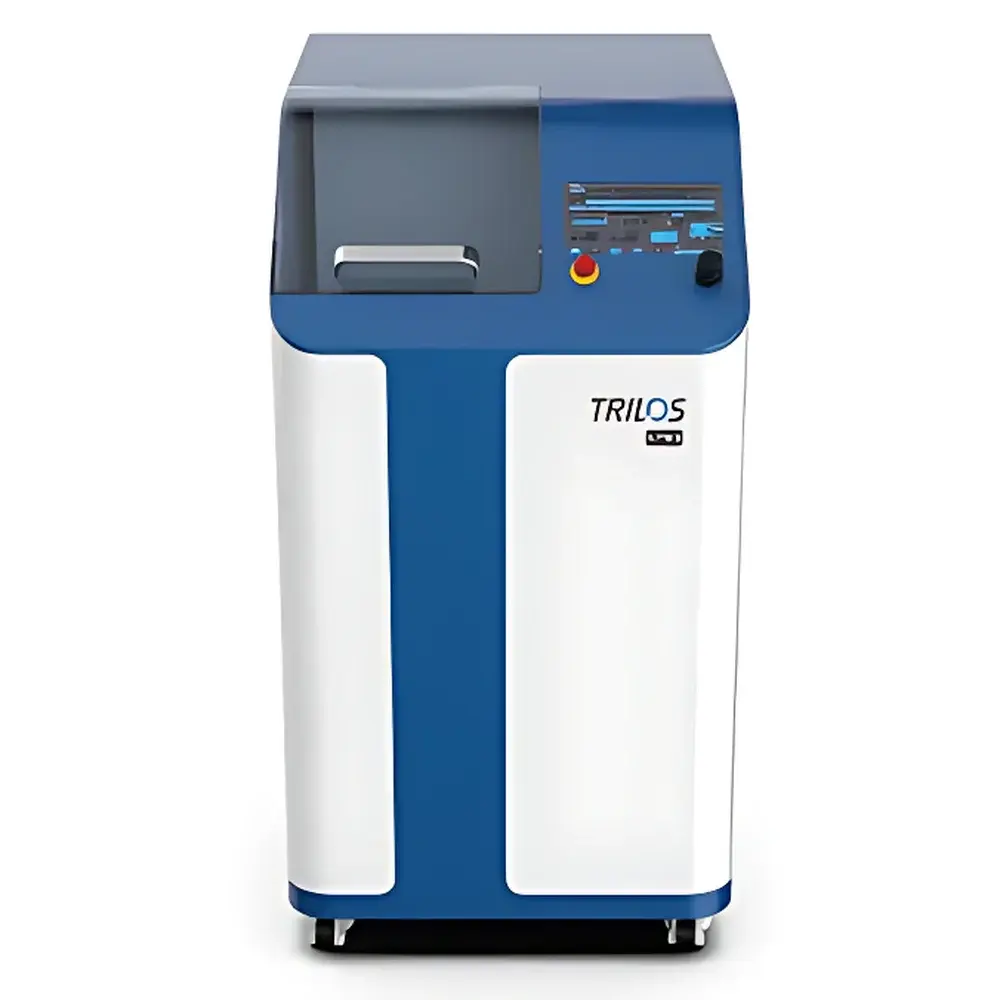
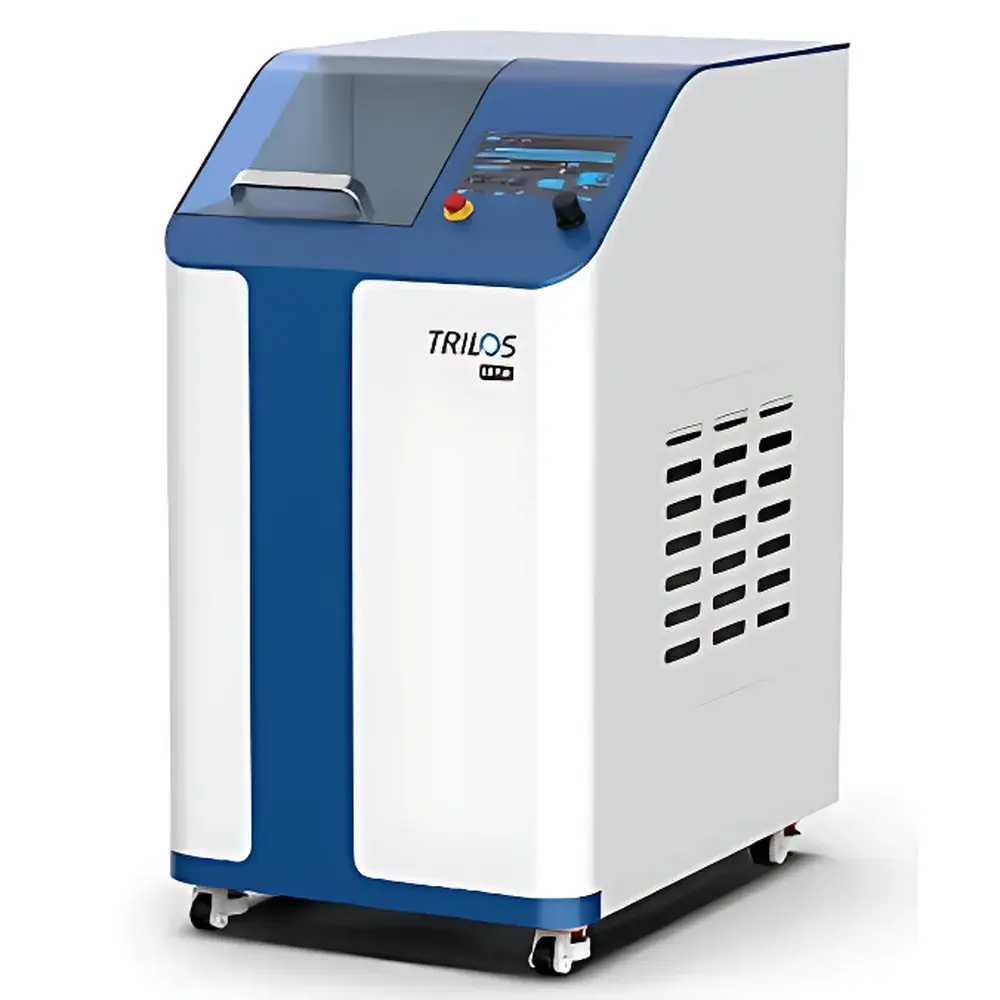
TRILOS ND500 Ultra-High-Pressure Microfluidic Nanohomogenizer
| Brand | TRILOS |
|---|---|
| Origin | USA |
| Model | ND500 |
| Instrument Type | High-Pressure Microfluidic Homogenizer |
| Dimensions (W×D×H) | 850 × 680 × 1050 mm |
| Processing Capacity | <1000 mL per batch |
| Throughput | 30 L/h |
| Maximum Operating Pressure | 2000 bar (200 MPa) |
| Inlet Temperature Range | Up to 90 °C |
| Online Temperature Control Range | 10–90 °C |
| Minimum Batch Volume | 1000 mL |
| Homogenization Stage | Single-stage |
| Cleaning Water Consumption | 30 L/h |
| CIP Cycle Time | 30 min |
| Max. CIP Temperature | <90 °C |
| Ambient Operating Conditions | 3–40 °C, ≤90% RH |
Overview
The TRILOS ND500 Ultra-High-Pressure Microfluidic Nanohomogenizer is an engineered solution for scalable nanoscale dispersion, cell disruption, and formulation homogenization in regulated laboratory and pilot-scale environments. It operates on the principle of microfluidic interaction—where process fluid is pressurized to up to 2000 bar and forced through precisely engineered Z-type or Y-type interaction chambers. Within these geometrically optimized microchannels, the fluid undergoes simultaneous high-velocity shear, turbulent eddy formation, cavitation-induced mechanical stress, and interparticle collision at supersonic relative velocities. This multi-mechanism energy transfer enables consistent sub-200 nm particle size reduction, narrow polydispersity index (PDI), and reproducible nanostructure formation without thermal degradation or chemical additives. Unlike conventional valve-based homogenizers, the ND500 employs a fixed-geometry interaction chamber—eliminating wear-related pressure drift and ensuring long-term calibration stability. Its architecture supports both batch and semi-continuous operation, bridging the gap between R&D screening and GMP-aligned process development.
Key Features
- Microfluidic interaction chamber with Z- and Y-configuration options for tunable shear/cavitation balance
- Stainless-steel hygienic construction compliant with ASME BPE and ISO 20000-1 surface finish standards (Ra ≤ 0.4 µm)
- Integrated PLC-based touchscreen HMI with recipe management, real-time pressure/temperature logging, and alarm history
- Dual sanitary-grade ceramic-coated plungers with automatic lubrication-free operation and extended service life
- Active online temperature control (10–90 °C) via jacketed chamber and external chiller interface
- CE-certified mechanical safety system including dual redundant pressure relief valves, emergency stop circuitry, and ISO 13857-compliant guarding
- IoT-ready architecture with Modbus TCP and OPC UA support for remote monitoring, predictive maintenance alerts, and integration into MES/LIMS platforms
- Tri-Clamp (ISO 2852) inlet/outlet ports enabling rapid disassembly, cleaning-in-place (CIP), and sterile transfer compatibility
Sample Compatibility & Compliance
The ND500 accommodates a broad range of viscoelastic and particulate feedstocks—including liposomal suspensions (≤10,000 cP), biopolymer gels, ceramic slurries (SiO₂, ZrO₂, Al₂O₃), conductive pastes, and mammalian/bacterial cell lysates. Feed solids are limited to ≤500 µm to prevent chamber clogging; inlet temperature must remain below 90 °C to maintain seal integrity and polymer compatibility. The system meets CE Machinery Directive 2006/42/EC and conforms to ISO 14155:2020 (for biomedical material processing validation). While not inherently 21 CFR Part 11-compliant, its audit trail-capable HMI supports configuration for FDA-regulated workflows when deployed with validated electronic signature modules and time-stamped event logs. It is routinely employed in laboratories adhering to USP , ISO 13320 (laser diffraction), and ASTM E2456 (nanoparticle characterization) protocols.
Software & Data Management
The embedded control software provides deterministic real-time regulation of pressure, flow rate, and temperature with ≤±0.5% full-scale accuracy. All operational parameters—including chamber inlet pressure, outlet temperature, total runtime, and cycle count—are timestamped and stored locally on industrial-grade SD card (16 GB, write-protected mode). Data export is supported via USB 2.0 or Ethernet in CSV/Excel-compatible format. Optional firmware upgrade enables secure TLS 1.2 communication for cloud-based data aggregation and AI-driven performance analytics. Audit trails include operator ID, parameter changes, and system fault codes—all retained for ≥12 months as required under GLP and GMP Annex 11 expectations. No proprietary file formats are used; raw sensor outputs align with IEEE 1451.2 transducer electronic data sheet (TEDS) conventions.
Applications
- Pharmaceutical nanomedicine: Preparation of lipid nanoparticles (LNPs), solid lipid nanoparticles (SLNs), nanoemulsions, and microcapsules for parenteral delivery
- Bioprocessing: Disruption of Gram-negative bacteria, yeast, and mammalian cells for recombinant protein extraction and organelle isolation
- Advanced materials: Exfoliation of graphene, dispersion of quantum dots, and stabilization of conductive ink formulations (Ag, Cu, CNT)
- Food science: Production of cold-sterilized dairy emulsions, plant-based protein micelles, and bioactive ingredient nanoencapsulation
- Cosmeceuticals: Generation of transparent, non-settling pigment dispersions and sustained-release fragrance carriers
FAQ
What is the maximum allowable feed viscosity for stable ND500 operation?
Viscosity must not exceed 10,000 cP at processing temperature; higher viscosities require pre-shearing or dilution to avoid plunger stall or pressure instability.
Can the ND500 be validated for GMP manufacturing use?
Yes—when operated with documented IQ/OQ/PQ protocols, calibrated pressure transducers traceable to NIST standards, and configured with electronic audit trail functionality, it supports Phase I–III clinical material production.
Is the interaction chamber replaceable, and what is its service life?
Chambers are field-replaceable consumables; typical lifetime exceeds 500 hours at 1500 bar with aqueous buffers, and is reduced proportionally with abrasive or high-solids feeds.
Does the system support automated cleaning cycles?
It supports fully programmable CIP sequences with temperature ramping, flow rate modulation, and timed detergent dwell—compatible with standard pharmaceutical cleaning agents (e.g., NaOH, Citrox, Tergazyme).
How is process repeatability ensured across batches?
By maintaining constant pressure setpoint, temperature setpoint, and total processed volume per cycle—combined with chamber geometry consistency and closed-loop PID control of hydraulic actuation.



