
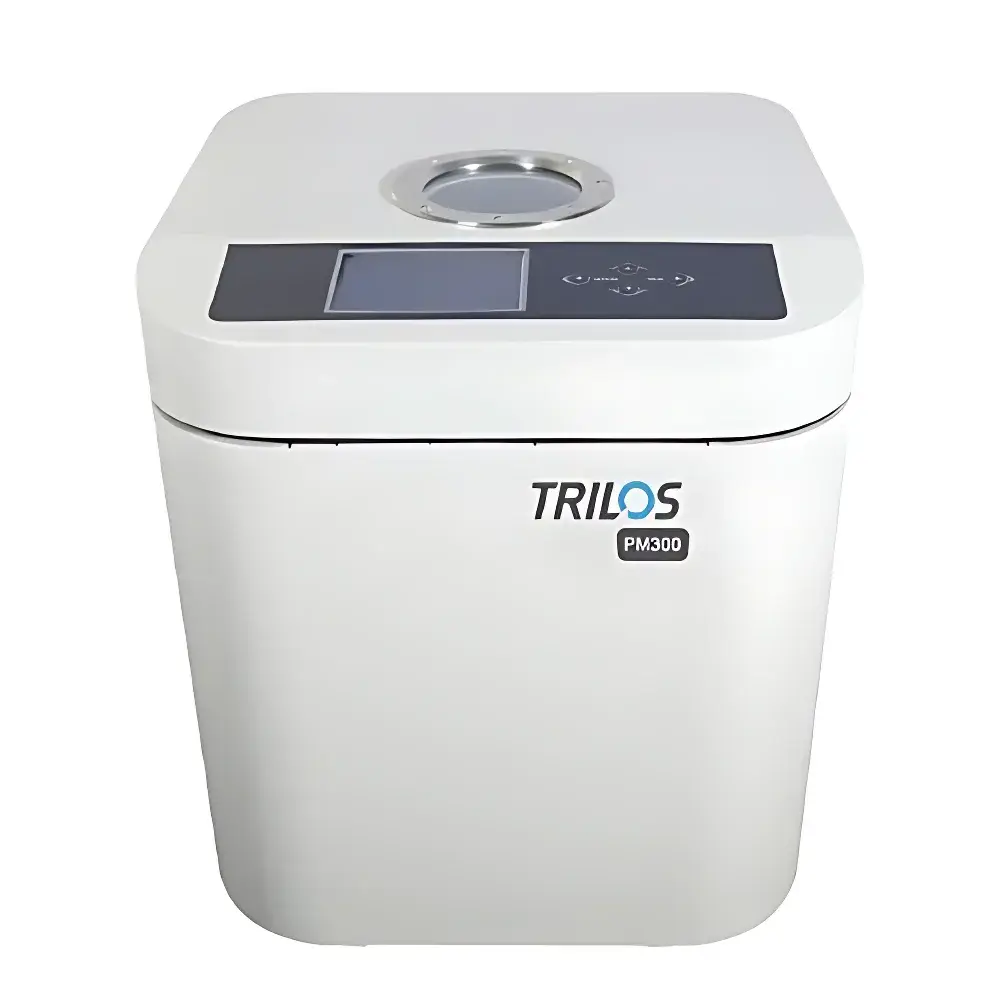
TRILOS PM300 Planetary Mixer-Deaerator
| Brand | TRILOS |
|---|---|
| Model | PM300 |
| Type | Planetary Dual-Axis Mixer & Vacuum Deaerator |
| Origin | USA |
| Max Capacity | 300 g / 300 mL (dual-cup configuration) |
| Max Orbital Speed | 1500 rpm |
| Max Rotational Speed | 1500 rpm |
| Power Supply | 220 V, 1.5 kW |
| Dimensions | 400 × 500 × 400 mm (W × D × H) |
| Weight | 39 kg |
| Compliance | CE-marked |
Overview
The TRILOS PM300 Planetary Mixer-Deaerator is an engineered solution for high-shear, vacuum-assisted mixing and degassing of viscous and thixotropic materials in laboratory-scale R&D and pilot production. Operating on the principle of planetary motion—where mixing tools simultaneously rotate about their own axis (rotation) and revolve around a central axis (orbital motion)—the PM300 generates controlled, multi-directional shear fields and intense centrifugal forces. This dual-axis kinematics enables homogeneous dispersion, particle deagglomeration, and efficient air/void removal without mechanical stirring blades or impellers. Unlike conventional mixers, the PM300 eliminates dead zones and achieves uniform energy input across the entire sample volume—even for non-Newtonian fluids with viscosities exceeding 10⁶ mPa·s. Its integrated vacuum chamber (optional or standard depending on configuration) supports pressure reduction down to ≤10 mbar, facilitating rapid deaeration of pastes, slurries, and膏-like formulations prior to casting, coating, or characterization.
Key Features
- Dual independent motor drives enabling precise, programmable control of orbital (0–1500 rpm) and rotational (0–1500 rpm) speeds—enabling fine-tuned shear profile optimization for sensitive or highly viscous systems.
- Robust stainless-steel vacuum chamber with reinforced borosilicate glass lid and pneumatic sealing mechanism, rated for continuous operation under vacuum conditions.
- Interlocked safety system compliant with IEC 61000-6-2/6-4 and EN 61000-6-3, including automatic motor shutdown upon lid opening or vacuum loss.
- Intuitive touchscreen interface with up to 20 customizable process recipes, each storing speed ramping profiles, dwell times, vacuum setpoints, and sequence logic.
- Modular tooling platform supporting interchangeable mixing blades, spatula-type scrapers, and dual-cup fixtures—compatible with standard 50–150 mL cylindrical containers (e.g., DIN 55350-compliant jars).
- Low-vibration base design with elastomeric damping mounts, minimizing transmission to adjacent instrumentation and meeting ISO 20816-1 vibration severity Class A requirements for laboratory environments.
Sample Compatibility & Compliance
The PM300 accommodates a broad spectrum of material classes—including conductive pastes (e.g., Ag, Cu, Ni-based electrode inks), thermal interface materials (TIMs), UV-curable adhesives, silicone sealants, pharmaceutical ointments, battery slurry precursors (NMC, LFP, Si-anode composites), and nanostructured polymer dispersions. It handles fillers with D₉₀ < 50 µm and solids loading up to 85 wt%. All wetted parts are electropolished 316L stainless steel or PTFE-coated, ensuring compatibility with acidic, alkaline, and solvent-based chemistries (e.g., NMP, DMF, IPA, ethyl acetate). The system conforms to ISO 17025 documentation standards for method validation and supports audit-ready electronic records per FDA 21 CFR Part 11 when paired with TRILOS LabLink software (v3.2+).
Software & Data Management
TRILOS LabLink software provides full remote operation, real-time torque and vacuum monitoring, and automated data logging at user-defined intervals (100 ms resolution). Process logs include timestamped RPM, vacuum level, motor current draw, and thermal sensor readings from the chamber base—enabling correlation of rheological behavior with operational parameters. Export formats include CSV, PDF reports, and XML metadata compatible with LIMS integration (e.g., Thermo Fisher SampleManager, LabVantage). Audit trails record all user actions, parameter changes, and system events with digital signature support. Firmware updates are delivered via secure HTTPS and validated using SHA-256 checksums.
Applications
- R&D formulation development for solid-state battery cathode/anode slurries requiring void-free microstructure prior to doctor-blading or slot-die coating.
- Preparation of medical-grade silicone sealants meeting USP and biocompatibility testing prerequisites.
- Dispersion of carbon nanotubes and graphene flakes in epoxy matrices for aerospace composite prototyping.
- Homogenization of UV-curable acrylic adhesives used in optoelectronic assembly—ensuring absence of micro-bubbles that cause delamination under thermal cycling.
- Batch-wise mixing of conductive silver pastes for printed electronics, where particle alignment and interfacial wetting directly impact sheet resistance and solder joint reliability.
- Pharmaceutical semi-solid dosage form development (e.g., transdermal gels), where air entrapment compromises stability and dose uniformity per USP .
FAQ
What vacuum level can the PM300 achieve, and is a vacuum pump included?
The PM300 is configured for operation with an external two-stage rotary vane pump (not supplied). When paired with a certified pump (e.g., Edwards RV8), it consistently reaches ≤10 mbar absolute pressure within 90 seconds for a 300 mL load.
Can the PM300 process materials above 1,000,000 mPa·s viscosity?
Yes—its dual-axis torque delivery and low-speed high-torque motor architecture enable effective processing of materials up to ~5,000,000 mPa·s (measured per ASTM D1084 at 25 °C), provided appropriate tool geometry and ramping profiles are applied.
Is the system compliant with GMP/GLP documentation requirements?
The hardware and LabLink software support ALCOA+ principles: Attributable, Legible, Contemporaneous, Original, Accurate, Complete, Consistent, Enduring, and Available. Full electronic records, change control logs, and IQ/OQ documentation packages are available upon request.
What maintenance intervals are recommended for long-term reliability?
Motor brushes require inspection every 2,000 operating hours; vacuum seals should be replaced annually or after 500 cycles under ≤50 mbar; calibration of speed and vacuum sensors is advised every 12 months per ISO/IEC 17025-accredited service provider.



