
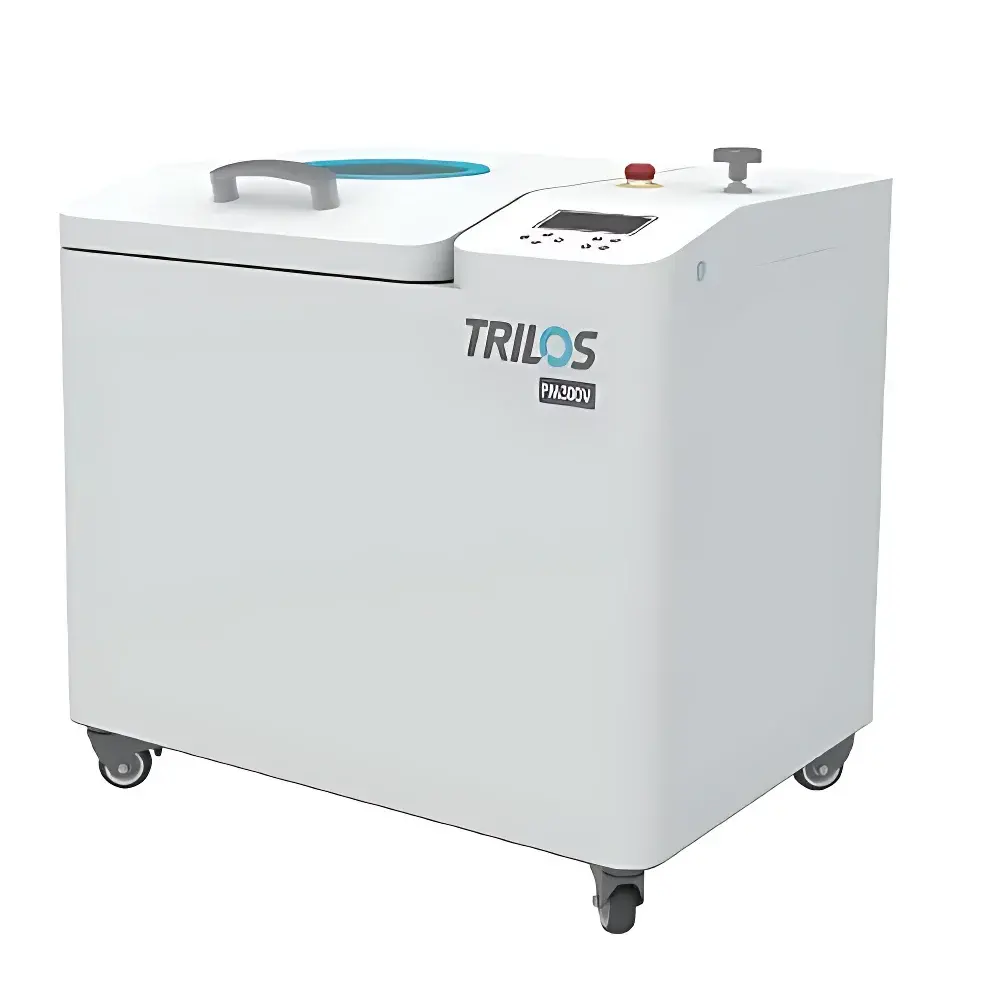
TRILOS PM300V Vacuum Deaeration Mixer with Dual-Axis Rotation
| Brand | TRILOS |
|---|---|
| Origin | USA |
| Model | PM300V |
| Max. Capacity | 300 g / 300 mL (dual-cup) |
| Max. Orbital Speed | 1500 rpm |
| Max. Rotational Speed | 1500 rpm |
| Power Supply | 220 V, 1.5 kW |
| Dimensions | 760 × 670 × 550 mm |
| Weight | 100 kg |
Overview
The TRILOS PM300V Vacuum Deaeration Mixer is an engineered dual-axis rotational mixing system designed for high-precision dispersion, homogenization, and vacuum-assisted deaeration of viscous and ultra-viscous materials in R&D and small-batch production environments. Operating on the principle of simultaneous orbital (planetary) and rotational motion under controlled vacuum, the PM300V generates intense shear, centrifugal force, and boundary-layer disruption—enabling efficient removal of sub-micron entrapped air and volatiles without mechanical agitation-induced degradation. Unlike conventional vacuum mixers relying solely on static vacuum or single-axis rotation, the PM300V’s synchronized dual-axis kinematics ensures uniform material displacement across the entire vessel wall, eliminating stagnant zones and promoting laminar yet thorough reorientation of viscous phases. This architecture is particularly critical for formulations where bubble-induced defects compromise structural integrity, electrical continuity, or optical homogeneity—such as conductive pastes, battery electrode slurries, and optically clear encapsulants.
Key Features
- Dual independent motor drives enabling precise, programmable control of orbital (0–1500 rpm) and rotational (0–1500 rpm) speeds—fully decoupled to support process optimization for diverse rheological profiles.
- Integrated high-vacuum system (≤10 mbar typical operating range) with pressure monitoring and automatic vacuum hold functionality to sustain deaeration throughout mixing cycles.
- Robust stainless-steel dual-cup holder accommodates two 150 mL vessels simultaneously, supporting parallel processing or comparative formulation studies with identical thermal and mechanical boundary conditions.
- Centrifugally stabilized mixing action ensures full wall adhesion and multi-directional layer inversion—even for materials exceeding 1,000,000 mPa·s viscosity—without splashing, overflow, or vortex formation.
- Touchscreen HMI with preloaded recipe memory (≥50 protocols), real-time speed/pressure logging, and USB export capability for audit-ready process documentation.
- Structural frame engineered for vibration damping and long-term operational stability; CE-compliant safety interlocks including vacuum-loss shutdown and lid-position sensing.
Sample Compatibility & Compliance
The PM300V handles a broad spectrum of non-corrosive, non-explosive materials—including solvent-based and solvent-free systems—commonly encountered in advanced materials development. Compatible sample types include polymer melts, UV/thermal-curable resins, ceramic and metal pastes, lithium-ion cathode/anode slurries, silicone sealants, pharmaceutical ointments, conductive silver/gold inks, and nano-dispersed functional coatings. The system supports compliance with laboratory quality frameworks: all operational parameters (speed, vacuum level, time) are digitally recorded and timestamped, facilitating adherence to GLP and internal SOP requirements. While not certified for GMP manufacturing, its data integrity features—including user-access logs and uneditable cycle reports—align with FDA 21 CFR Part 11 expectations for electronic records in regulated R&D settings.
Software & Data Management
The embedded control firmware provides deterministic sequence execution with up to 9-step programmable cycles per recipe, each configurable with ramp rates, dwell times, and vacuum setpoints. All process data—including actual vs. target rpm, vacuum decay curves, and total elapsed time—are stored internally with microsecond-level timestamp resolution. Export is supported via USB 2.0 in CSV format for integration into LIMS or statistical process control (SPC) platforms. No cloud connectivity or remote access is implemented, preserving data sovereignty and minimizing cybersecurity exposure—a design priority for corporate R&D labs handling proprietary formulations.
Applications
- Electrode slurry deaeration for Li-ion, solid-state, and sodium-ion battery prototyping.
- Void-free encapsulation of MEMS devices and optical sensors using low-outgassing silicones.
- Homogenization of high-solid-content nanocomposites (e.g., graphene, CNT, or MXene dispersions) without sonication-induced damage.
- Preparation of medical-grade hydrogels and transdermal patches requiring bubble-free matrix integrity.
- Rheological conditioning of solder pastes, underfill materials, and die-attach adhesives prior to dispensing or stencil printing.
- Accelerated aging studies of sealants and potting compounds under controlled vacuum-thermal stress.
FAQ
What vacuum level can the PM300V achieve, and how is it maintained during rotation?
The system achieves ≤10 mbar absolute pressure using a two-stage rotary vane pump (external, not included). A pressure-regulated feedback loop maintains setpoint vacuum within ±0.5 mbar tolerance during dynamic rotation via a sealed rotary vacuum feedthrough and PID-controlled throttle valve.
Can the PM300V process materials with fillers above 80 wt% loading?
Yes—its high-torque dual-drive architecture and wall-shear dominant kinematics enable effective deaeration of highly filled pastes (e.g., Ag-filled epoxy at 85 wt%) without phase separation or filler settling.
Is validation support available for IQ/OQ protocols?
TRILOS provides factory-verified performance qualification documents (including speed accuracy, vacuum stability, and temperature rise tests) and assists labs in developing site-specific installation and operational qualification templates aligned with ISO/IEC 17025 practices.



