
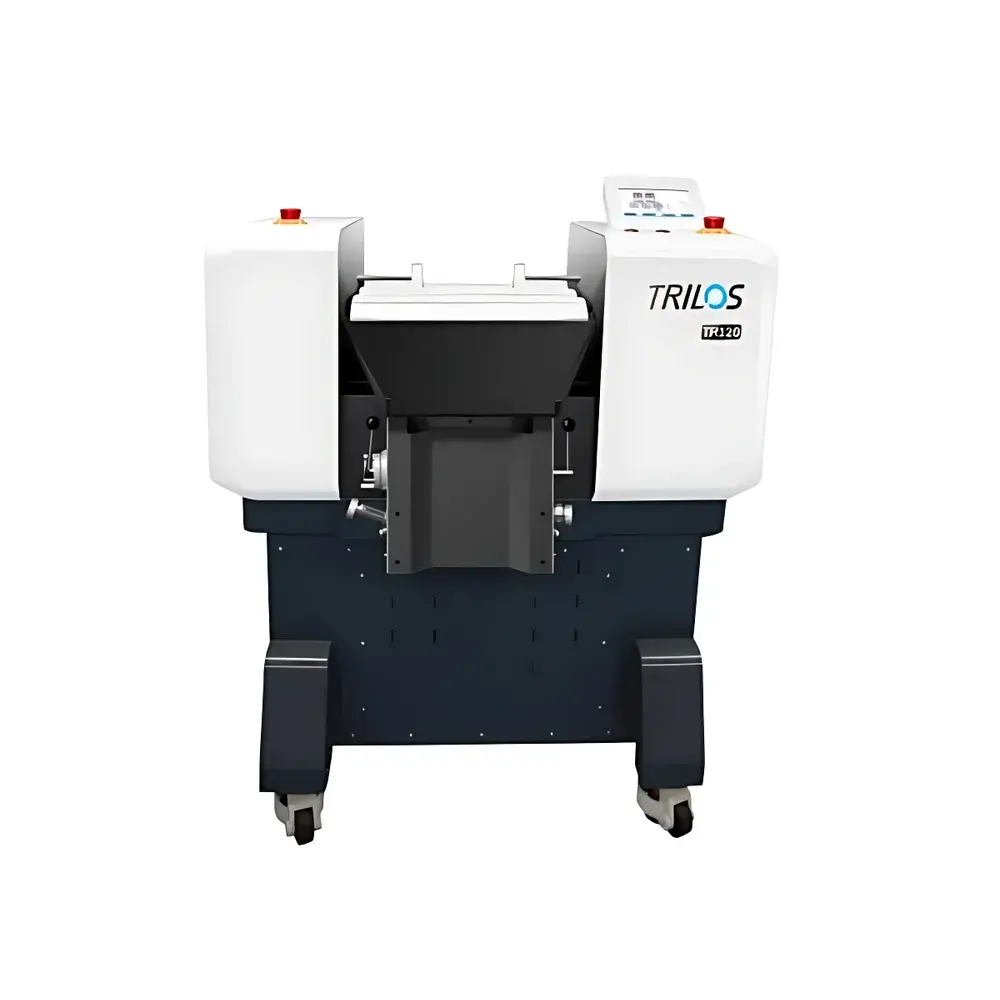
TRILOS TR120A Three-Roll Mill
| Brand | TRILOS |
|---|---|
| Origin | USA |
| Model | TR120A |
| Instrument Type | Three-Roll Mill |
| Sample Applicability | Soft and semi-viscous pastes, slurries, and dispersions |
| Final Particle Size | ≤0.01 mm (≤10 µm) |
| Feed Particle Size | >1 µm |
| Typical Output Particle Size | ~1 µm |
| Batch Processing Capacity | 0.5–60 L |
| Roll Diameter | 120 mm |
| Roll Length | 450 mm |
| Roll Speed Ratio | 1:3:9 |
| Roll Materials | Silicon Carbide (SiC), Alumina (Al₂O₃), Zirconia (ZrO₂), or Stainless Steel |
| Doctor Blade Materials | Al₂O₃, ZrO₂, Stainless Steel, or PVC |
| Motor Power | 3.5 kW |
| Dimensions (L×W×H) | 1150 × 660 × 1280 mm |
| Weight | 350 kg |
| Cooling System | Integrated recirculating coolant loop |
| Control Interface | Touchscreen HMI with programmable recipe management |
| Operational Modes | Gap Mode & Pressure Mode |
| Safety Features | Interlocked dust cover, emergency stop, roll gap limit sensors, thermal overload protection |
Overview
The TRILOS TR120A Three-Roll Mill is an industrial-grade dispersion and particle size reduction system engineered for high-precision processing of soft, viscous, and shear-sensitive materials. Operating on the principle of laminar shear deformation between three horizontally aligned, counter-rotating rolls—each driven at precisely controlled differential speeds (1:3:9 ratio)—the TR120A subjects material to progressive, calibrated mechanical stress across successive nip zones. This enables reproducible deagglomeration, wet grinding, and homogenization down to sub-micron particle distributions without thermal degradation or excessive attrition. Designed for laboratory-to-pilot-scale transition and small-batch production environments, the TR120A bridges the gap between R&D feasibility studies and scalable manufacturing processes in regulated and non-regulated sectors alike.
Key Features
- Precision-engineered roll geometry with ±1 µm axial runout tolerance and surface finish <0.2 µm Ra, ensuring uniform shear field distribution across the full 450 mm working length.
- Modular roll material selection—including silicon carbide (SiC), alumina (Al₂O₃), zirconia (ZrO₂), and electropolished stainless steel—optimized for chemical compatibility, wear resistance, and cleanability per application requirements.
- Electronically actuated, motorized roll gap adjustment with real-time digital readout (resolution: 1 µm), supporting both fixed-gap and dynamic pressure-controlled operation modes.
- Integrated closed-loop cooling system with temperature monitoring (±0.5 °C stability) to maintain consistent rheological behavior during extended runs—critical for heat-sensitive formulations such as lithium-ion battery cathode slurries or polymer nanocomposites.
- 10.1-inch industrial touchscreen HMI running embedded Linux OS, featuring recipe-based process control, audit-trail-capable parameter logging, and password-protected user access levels (Operator / Technician / Administrator).
- Self-aligning doctor blade assembly with adaptive contact force compensation, minimizing streaking and improving edge-to-edge coating uniformity on final dispersions.
- Comprehensive safety architecture compliant with ISO 13857 and ANSI B11.19: interlocked dust enclosure, dual-channel E-stop circuitry, roll rotation direction verification, and automatic motor shutdown upon abnormal thermal or torque deviation.
Sample Compatibility & Compliance
The TR120A accommodates a broad spectrum of soft-phase, high-solids-content systems including conductive pastes (e.g., Ag, Cu, CNT, graphene), UV-curable inks, dental composites, cosmetic emulsions, pharmaceutical ointments, and functional ceramic slurries. Its design supports GMP-aligned workflows through traceable parameter recording, electronic signature support (per FDA 21 CFR Part 11 readiness), and optional IQ/OQ documentation packages. All wetted components meet USP Class VI biocompatibility standards where applicable; surface finishes comply with ASME BPE 2023 hygienic design guidelines for pharmaceutical and food-contact applications.
Software & Data Management
The onboard control software provides synchronized acquisition of roll speed (RPM), applied load (N), gap position (µm), coolant inlet/outlet temperatures (°C), and motor current draw (A). Exportable CSV logs include timestamps with millisecond resolution and are compatible with LIMS integration via Modbus TCP or OPC UA protocols. Firmware updates are performed via secure USB or Ethernet connection, with version rollback capability and SHA-256 integrity verification. Audit trails retain all parameter changes, user logins, and alarm events for ≥12 months—fully configurable to align with internal SOPs and external regulatory review cycles.
Applications
- Battery electrode manufacturing: Dispersion of NMC/LFP active materials, conductive carbon, and PVDF binders into homogeneous, low-viscosity slurries suitable for slot-die coating.
- Advanced packaging inks: Stabilization of pigment nanoparticles in solvent- or water-based vehicles while preserving color strength and rheological profile.
- Dental restorative materials: Controlled breakdown of glass-ceramic fillers within methacrylate matrices to achieve optimal polishability and fracture toughness.
- Nanocomposite masterbatches: Exfoliation and distribution of 2D materials (MoS₂, h-BN) or metal-organic frameworks (MOFs) in thermoplastic carriers.
- Topical pharmaceutical formulations: Uniform incorporation of micronized APIs into hydrophilic gels or oleaginous bases without crystal growth or phase separation.
FAQ
What is the minimum achievable particle size with the TR120A?
Under optimal conditions—using SiC rolls, stabilized coolant, and feed material pre-screened to <5 µm—the TR120A consistently achieves D90 values ≤10 µm, with median sizes (D50) frequently reaching 0.8–1.2 µm for well-wetted, non-agglomerating systems.
Can the TR120A be integrated into an automated production line?
Yes. It features standard 24 VDC I/O terminals, analog 0–10 V/4–20 mA signal interfaces, and EtherNet/IP connectivity for PLC-level coordination with upstream feeding and downstream drying or coating stations.
Is validation support available for regulated industries?
TRILOS provides factory-verified IQ/OQ protocols, calibration certificates traceable to NIST standards, and URS alignment documentation upon request—facilitating compliance with ISO 13485, ICH Q5, and EU Annex 15 requirements.
How often does the roll surface require re-polishing?
With proper maintenance and use of chemically compatible materials, SiC and ZrO₂ rolls retain functional surface integrity for >5,000 operational hours; stainless steel rolls may require re-polishing every 1,500–2,000 hours depending on abrasive loading.
Does the system support ATEX-certified configurations for solvent-based processing?
ATEX Zone 2 / Class I Div 2 configurations are available as custom-engineered variants, including explosion-proof motors, intrinsically safe sensors, and static-dissipative roll coatings—subject to detailed hazard assessment and regional certification oversight.



