
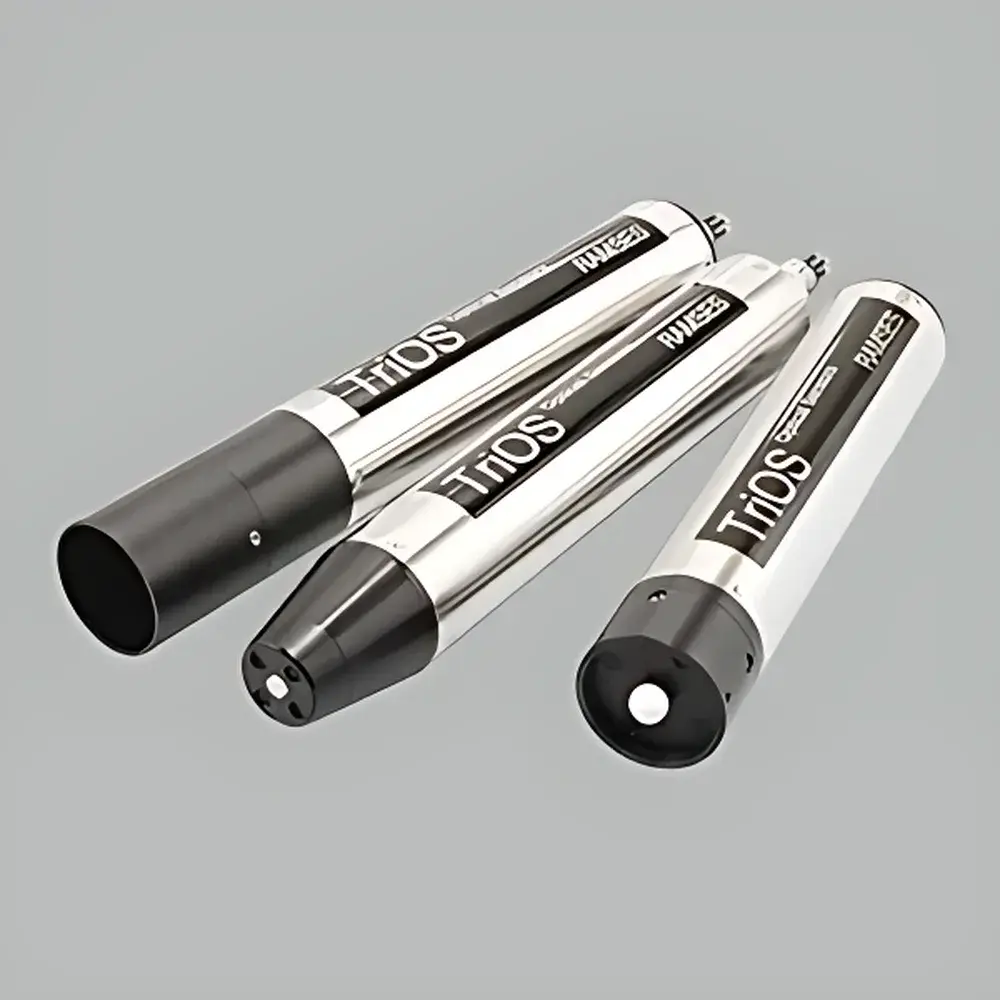
TriOS RAMSES G2 Autonomous High-Spectral Radiometer
| Brand | TriOS |
|---|---|
| Origin | Germany |
| Model | RAMSES G2 |
| Detector | 256-channel silicon photodiode array |
| Spectral Range | ACC-UV (280–500 nm), ACC-VIS/ARC-VIS/ASC-VIS (320–950 nm), ARC-UV/VIS (280–720 nm) |
| Optical Resolution | 2.2–3.3 nm/pixel |
| Spectral Accuracy | ±0.2–±0.3 nm |
| Irradiance Sensitivity (NEI) | 0.4–0.85 µW·m⁻²·nm⁻¹ (8 s integration) |
| Radiance Sensitivity (NEI) | 0.25–0.8 µW·m⁻²·nm⁻¹·sr⁻¹ (8 s integration) |
| Typical Saturation (4 ms IT) | 1–20 W·m⁻²·nm⁻¹ (irradiance), 1–14 W·m⁻²·nm⁻¹·sr⁻¹ (radiance) |
| Cosine Error | <6–10% (wavelength-dependent) |
| Response Time (pulse mode) | ≤24 s |
| Measurement Interval (pulse mode) | ≤12 s |
| Housing Material | Stainless steel 1.4571/1.4404 or Ti alloy 3.7035 + POM |
| Dimensions (ACC, w/o IP module) | 260 × 48 mm |
| Weight (stainless steel) | 1.25 kg |
| Operating Temperature | +2 to +40 °C |
| Storage Temperature | −20 to +80 °C |
| Pressure Rating | 30 bar (standard SubConn), 100 bar (deep-sea version) |
| Ingress Protection | IP68 |
| Flow Rate Tolerance | 0.1–10 m/s |
| Power Supply | 9–24 VDC (±10 %) |
| Power Consumption | 1 W (typ.) |
| Memory | 2 GB internal data logger |
| Digital Interfaces | RS-485 (Modbus RTU), Ethernet (TCP/IP) |
| Calibration Interval | 24 months |
| Maintenance Frequency | ≤0.5 h/month |
Overview
The TriOS RAMSES G2 Autonomous High-Spectral Radiometer is a field-deployable, self-contained optical sensor engineered for precise, high-resolution spectral measurement of irradiance, radiance, and scalar irradiance across ultraviolet (UV), visible (VIS), and combined UV/VIS spectral domains. Based on advanced miniature spectrometer architecture with 256-channel silicon photodiode arrays, the RAMSES G2 employs calibrated diffraction-grating optics and thermally stabilized detection electronics to deliver traceable, laboratory-grade spectral data under demanding environmental conditions. Its core measurement principle relies on absolute radiometric calibration against NIST-traceable standards, with spectral responsivity characterized per ISO 17123-7 and ASTM E275 for radiometric instrumentation. Designed for unattended operation in remote or resource-constrained settings—including autonomous underwater vehicles (AUVs), moored buoys, polar observatories, and handheld survey platforms—the system integrates full spectral acquisition, onboard processing, non-volatile storage, and dual-protocol digital interfacing without requiring external controllers.
Key Features
- Autonomous operation enabled by integrated 2 GB flash memory and low-power (1 W typical) architecture—supports continuous profiling for weeks on battery or solar-hybrid power systems.
- G2 web-based configuration interface: Access real-time status, adjust integration time (4 ms–8 s), set sampling intervals, and manage calibration coefficients via any standard web browser over Ethernet or RS-485.
- Modbus RTU support simplifies integration into industrial SCADA, PLC, and legacy oceanographic data acquisition networks—eliminating custom driver development.
- Modular mechanical design accommodates three optical configurations: ACC (cosine-corrected irradiance), ARC (narrow-field radiance), and ASC (4π scalar irradiance), each optimized for specific radiometric quantities and angular response requirements.
- Ruggedized housing options include marine-grade stainless steel (1.4571/1.4404) or titanium alloy (3.7035), rated to 30 bar (standard) or 100 bar (deep-sea variant), with IP68 ingress protection and operational stability at flow velocities up to 10 m/s.
- Optional auxiliary sensors—including tilt, pressure, and temperature—enable synchronized environmental context tagging for post-processing correction and QA/QC validation.
Sample Compatibility & Compliance
The RAMSES G2 is compatible with diverse aquatic and atmospheric media, including seawater, freshwater, glacial meltwater, and clear-air column measurements. Its cosine error remains within ±6–10% across specified wavelength bands—validated per ISO 9060:2018 (spectroradiometers) and aligned with protocols for satellite vicarious calibration (e.g., NASA SeaBASS, ESA MERIS validation). The instrument meets CE marking requirements for electromagnetic compatibility (EMC Directive 2014/30/EU) and low-voltage safety (LVD Directive 2014/35/EU). Data integrity complies with GLP principles through timestamped, write-once logging; audit trails are preserved during firmware updates and configuration changes. While not FDA 21 CFR Part 11-certified out-of-the-box, raw binary logs and metadata structures support validated archive workflows in regulated water quality laboratories.
Software & Data Management
TriOS provides the free RAMSES Control Center (RCC) desktop application for Windows/macOS/Linux, supporting spectral visualization, batch calibration application, unit conversion (e.g., W·m⁻²·nm⁻¹ → µmol·m⁻²·s⁻¹ for PAR), and export to CSV, NetCDF, or HDF5. All G2 devices expose a RESTful API over Ethernet, enabling scripted control via Python, MATLAB, or LabVIEW. Raw spectra are stored in vendor-neutral binary format with embedded calibration matrices, dark current offsets, and temperature-compensation coefficients. Internal clock synchronization supports GPS-disciplined timekeeping when paired with external PPS inputs. Firmware updates preserve user-defined configurations and historical calibration history.
Applications
- Water Quality Monitoring: Quantification of CDOM absorption, chlorophyll-a fluorescence excitation signatures, and turbidity-related scattering in compliance with ISO 10264 and EN 15206-1.
- Satellite Validation: In situ reference measurements for atmospheric correction and product validation of Sentinel-3 OLCI, Landsat OLI, and MODIS Aqua/Terra missions.
- Photosynthetic Active Radiation (PAR) Studies: High-resolution scalar irradiance (ASC) profiles for phytoplankton productivity modeling and benthic light climate assessment.
- Polar & Remote Field Campaigns: Battery-operated deployments on ice-tethered profilers, autonomous surface vehicles (ASVs), and fixed stations where maintenance access is limited to biannual service windows.
- Optical Oceanography Research: Multi-sensor radiometric profiling for inherent optical property (IOP) inversion using Hydrolight or Eco2Sim forward models.
- UV-B Exposure Assessment: Spectrally resolved erythemal dose rate calculation per CIE S 019/E:2006 for ecological stress studies in high-altitude or ozone-depleted regions.
FAQ
What spectral calibration standards are used for factory calibration?
All RAMSES G2 units undergo absolute radiometric calibration using NIST-traceable tungsten halogen lamps and deuterium lamps, with spectral irradiance transfer certified per ISO/IEC 17025:2017 by an accredited metrology laboratory.
Can the RAMSES G2 operate submerged continuously for extended periods?
Yes—when equipped with the deep-sea housing option (100 bar rating) and properly sealed SubConn connectors, the device supports long-term moored deployment in coastal and continental shelf environments, with pressure-compensated thermal management ensuring detector stability.
Is post-deployment recalibration required before each field season?
TriOS recommends verification against a stable reference source (e.g., quartz-halogen lamp with known output) prior to critical campaigns; full recalibration is advised every 24 months or after exposure to mechanical shock, extreme thermal cycling, or biofouling events.
How is cosine response error corrected in data processing?
The instrument’s angular responsivity profile is characterized during calibration and embedded in the spectral correction matrix; RCC software applies wavelength-specific cosine error compensation during radiometric unit conversion.
Does the G2 support real-time telemetry via satellite or cellular modems?
While the RAMSES G2 itself does not include RF transceivers, its Modbus RTU and TCP/IP interfaces enable seamless integration with third-party telemetry gateways (e.g., Campbell Scientific CR6 + RF451, or Sierra Wireless AirLink RV50) for near-real-time spectral data transmission.
Related Products







