
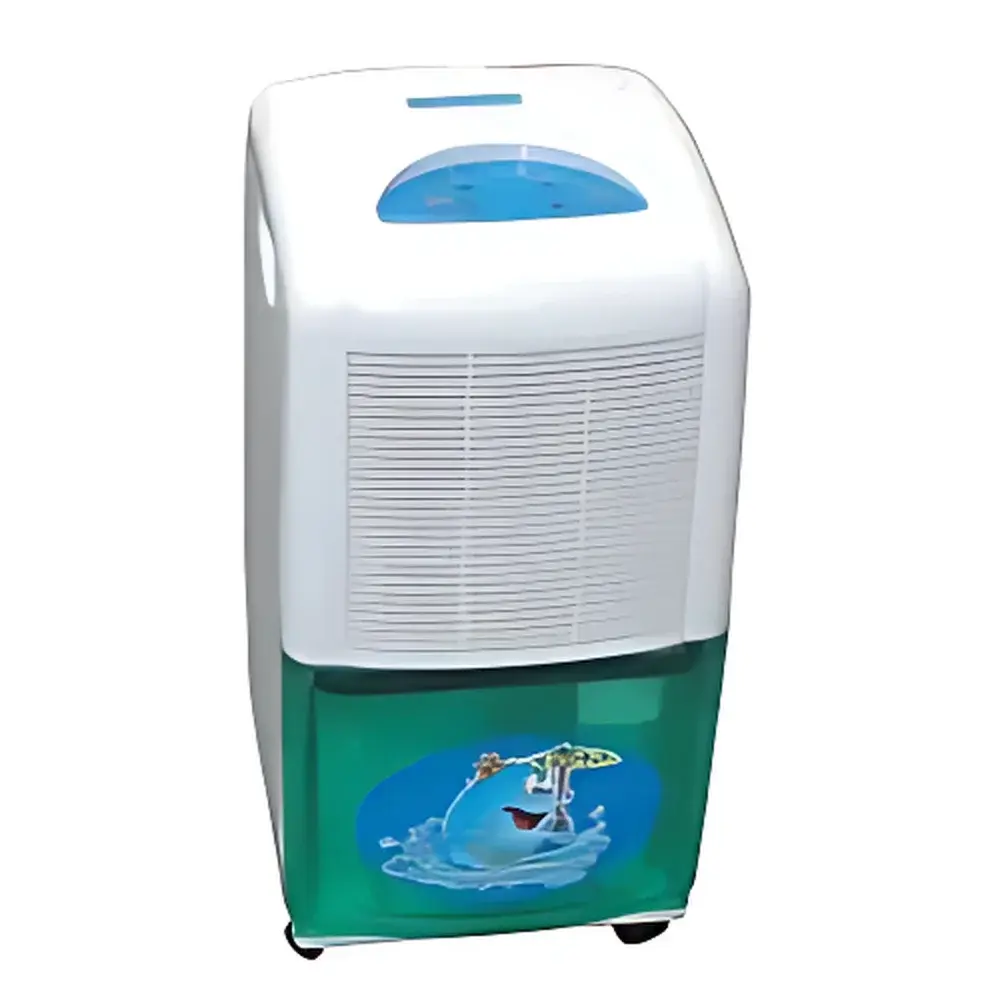
Truelab 820B Compact Compressor-Based Dehumidifier for Precision Laboratory Instrument Rooms
| Brand | Truelab |
|---|---|
| Origin | Shanghai, China |
| Model | 820B |
| Type | Compressor-based dehumidifier |
| Application | Industrial-grade laboratory environmental control |
| Dimensions (L×W×H) | 400 × 345 × 640 mm |
| Operating Temperature Range | up to 40°C |
| Recommended Coverage Area | 20–35 m² (at 2.6 m ceiling height) |
| Dehumidification Capacity | 20 L/day (at 30°C, 80% RH) |
| Air Circulation Rate | 20 m³/h |
| Water Tank Capacity | 4 L |
| Input Power | 390 W |
| Net Weight | 17 kg |
| Power Supply | 220 V / 50 Hz |
| Control Interface | Digital humidity display with auto-defrost function |
| Mobility | Equipped with four swivel casters |
Overview
The Truelab 820B is a compact, compressor-driven dehumidifier engineered specifically for controlled environments in scientific laboratories—particularly instrument rooms housing hygroscopic or humidity-sensitive analytical equipment such as FTIR spectrometers, precision balances, X-ray diffractometers, and optical interferometers. Unlike general-purpose residential units, the 820B integrates thermodynamic stability and operational reliability into a footprint-optimized chassis designed for integration within constrained lab layouts. Its core operation follows refrigerant-based condensation principle: ambient air is drawn across a cooled evaporator coil where moisture condenses and collects in the internal reservoir; the dried air is then reheated via the condenser and discharged upward through an axial outlet. This up-blow configuration minimizes floor-level airflow turbulence—critical near vibration-sensitive instruments—and avoids direct impingement on benchtop apparatus.
Key Features
- Compact form factor (400 × 345 × 640 mm) optimized for placement beneath fume hoods, beside analytical workstations, or inside enclosed instrument cabinets.
- Digital LED hygrometer with ±3% RH accuracy and adjustable setpoint control (30–80% RH range), enabling precise maintenance of ISO 14644-1 Class 7/8 cleanroom-adjacent humidity conditions.
- Auto-defrost cycle triggered by evaporator coil temperature sensors, ensuring uninterrupted operation during extended low-temperature or high-humidity exposure typical in coastal or monsoon-affected lab regions.
- Upward-directed airflow design mitigates dust resuspension and eliminates lateral drafts that could destabilize microbalance readings or thermal equilibrium in calorimetric systems.
- Four dual-locking swivel casters (two with brakes) support smooth repositioning without tools—essential for periodic calibration alignment or emergency equipment relocation per ISO/IEC 17025 clause 6.4.2.
- Rotary compressor with sealed R134a refrigerant circuit delivers stable dehumidification performance across ambient temperatures from 5°C to 40°C, meeting ASTM D2247 requirements for continuous environmental conditioning.
Sample Compatibility & Compliance
The 820B is compatible with standard laboratory infrastructure including grounded 220 V / 50 Hz power circuits and non-corrosive indoor atmospheres (non-explosive, non-acidic). It complies with GB 4706.32–2012 (Chinese national safety standard for household and similar electrical appliances – Particular requirements for dehumidifiers) and meets electromagnetic compatibility (EMC) requirements per GB 4343.1–2018. While not certified to UL 1995 or IEC 60335-2-40 for North American markets, its mechanical and electrical architecture aligns with GLP-compliant environmental monitoring practices when deployed as part of a documented lab environmental control system (per FDA 21 CFR Part 11 Annex 11 data integrity expectations for auxiliary equipment logs).
Software & Data Management
The 820B operates as a standalone analog-digital hybrid unit with no embedded firmware, cloud connectivity, or remote interface. All operational parameters—including current RH reading, target setpoint, and compressor runtime status—are displayed locally on the front-panel LED screen. For regulatory traceability, users are advised to integrate the unit into facility-wide environmental monitoring systems (EMS) via external calibrated hygrometer logging (e.g., Vaisala HMP7 or Rotronic HygroLog NT) paired with audit-trail-capable software (such as DeltaTrak Validator or Siemens Desigo CC). No proprietary drivers or vendor-specific software dependencies are required.
Applications
- Stabilization of relative humidity in analytical instrument enclosures to prevent lens fogging, detector drift, or sample hydration artifacts in spectroscopy and microscopy workflows.
- Maintenance of ≤50% RH in storage cabinets for desiccant-sensitive reference standards (e.g., USP , EP 2.1.12), calibration weights, and hygroscopic reagents.
- Supplemental moisture control in gloveboxes, dry rooms, and nitrogen-purged enclosures where residual ingress must be actively scavenged.
- Preventive mitigation of condensation-induced corrosion on stainless steel optical tables, laser mounts, and high-vacuum feedthroughs during seasonal humidity fluctuations.
- Supporting ISO/IEC 17025 Clause 6.3.1 requirements for “suitable environmental conditions” in testing laboratories performing gravimetric, titrimetric, or chromatographic analyses.
FAQ
What is the maximum recommended room volume this unit can effectively condition?
For optimal performance at 30°C and 80% RH, the 820B is validated for spaces up to 35 m² with ceiling height ≤2.6 m (≈91 m³ total volume). Performance diminishes above 32°C or below 15°C ambient due to compressor efficiency limits.
Does the unit support continuous drainage via external hose?
No—the 820B lacks a gravity-drain port or pump option. It relies solely on its 4 L internal tank, requiring manual emptying approximately every 12–18 hours under rated load conditions.
Can it be operated unattended overnight in a secured lab?
Yes—built-in auto-shutoff activates when the tank is full or if internal temperature exceeds safe thresholds. However, unattended operation requires prior validation against local fire safety codes (e.g., NFPA 45) and integration with building alarm systems for overflow detection.
Is the compressor oil-lubricated or oil-free?
It employs a sealed rotary compressor with mineral oil lubrication; no user-serviceable oil ports exist. Service intervals follow manufacturer-recommended 3-year or 5,000-hour operational life guidelines.
How does the up-blow airflow affect thermal stratification in tall instrument racks?
The vertical discharge promotes gentle convection without disrupting laminar flow zones. When positioned at floor level adjacent to rack bases, it supports uniform RH distribution without inducing localized cooling that could trigger thermal expansion errors in metrology-grade fixtures.
Related Products



