
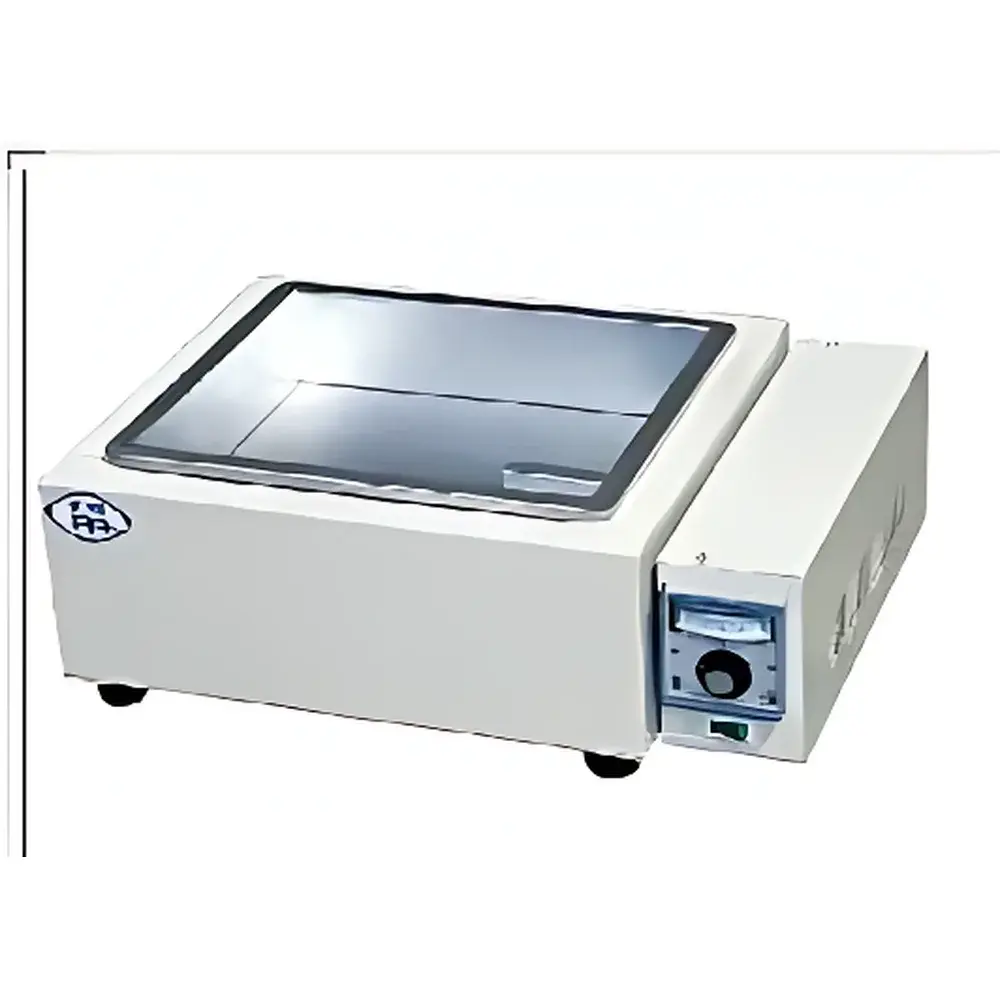
Truelab DK-2 Sand Bath Heater
| Brand | Truelab |
|---|---|
| Model | DK-2 |
| Power Rating | 2 kW |
| Internal Chamber Dimensions | 450 × 350 × 70 mm |
| Construction | Stainless Steel Inner Bath & Lid, Electrostatically Powder-Coated Exterior |
| Internal Recirculation | None (Dry Heat Transfer via Sand Medium) |
| Compliance | Designed for General Laboratory Use per GB/T 28961–2012 (Laboratory Equipment — Safety Requirements) |
Overview
The Truelab DK-2 Sand Bath Heater is a robust, dry-heating thermal platform engineered for uniform, contamination-free temperature control in applications where direct flame or liquid bath media are unsuitable. Unlike water or oil baths, the DK-2 utilizes granular silica sand as an inert, high-thermal-mass heat transfer medium—enabling stable, non-oxidizing heating environments ideal for glassware with irregular geometries, sealed vessels, or samples sensitive to moisture, vapor condensation, or oil migration. Its operation relies on resistive heating elements embedded beneath a stainless steel bath plate, transferring thermal energy conductively through the sand bed. Temperature uniformity across the working surface is achieved via optimized sand depth (70 mm), lateral heat diffusion, and low-thermal-conductivity insulation beneath the chamber. The unit is designed for continuous-duty laboratory operation at ambient-to-moderate elevated temperatures, supporting ISO/IEC 17025-aligned sample preparation workflows requiring traceable, repeatable dry-heat conditioning.
Key Features
- Stainless steel inner bath and lid (AISI 304 grade) ensure long-term corrosion resistance against alkalis, salts, and organic residues commonly encountered during evaporation or drying protocols.
- Electrostatic powder-coated carbon steel housing provides mechanical durability and chemical resistance while minimizing surface static accumulation in cleanroom-adjacent environments.
- Fixed-power 2 kW heating system delivers rapid thermal ramp-up and sustained thermal output without active cooling or refrigeration circuitry—optimized for energy-efficient, single-direction thermal control.
- Rectangular bath cavity (450 × 350 × 70 mm) accommodates multiple standard-sized flasks, beakers, or custom reaction vessels simultaneously, supporting parallel processing in QA/QC and R&D labs.
- No fluid reservoir or pump mechanism eliminates risks associated with leakage, fluid degradation, or maintenance-intensive circulation systems—reducing total cost of ownership and downtime.
- Front-panel analog temperature indicator (calibrated scale, ±2 °C typical accuracy) enables immediate visual verification of operational status; compatible with external digital thermocouple probes for GLP-compliant temperature logging.
Sample Compatibility & Compliance
The DK-2 is validated for use with borosilicate glass (e.g., Pyrex®, Duran®), ceramic crucibles, stainless steel trays, and PTFE-coated containers. It is not intended for volatile solvent immersion or pressure-rated vessel heating. The absence of liquid media renders it inherently compliant with fire-safety requirements for organic solvent handling zones (per NFPA 45 and local lab safety codes). While not certified to UL 61010-1 or IEC 61010-1 as a standalone medical device, its construction adheres to general laboratory equipment safety principles outlined in GB/T 28961–2012 and aligns with risk-based assessment frameworks used in GMP-preparatory environments. No CE, UKCA, or FDA 510(k) designation applies, as it falls outside regulatory scope for in vitro diagnostic or therapeutic devices.
Software & Data Management
The DK-2 operates as a stand-alone analog thermal platform with no integrated microcontroller, firmware, or digital interface. Temperature monitoring and documentation must be performed externally using calibrated Class A or Class B platinum resistance thermometers (Pt100/Pt1000), thermocouples (Type K or T), or validated data loggers compliant with ASTM E74 or ISO/IEC 17025 calibration traceability. For regulated environments requiring audit trails, users may integrate third-party validation-ready loggers supporting 21 CFR Part 11 electronic signature and secure data export (CSV, PDF). No proprietary software or driver installation is required or supported.
Applications
- Controlled evaporation of aqueous or organic extracts under inert sand blanket conditions—minimizing splattering and oxidation of thermolabile compounds.
- Drying of filter papers, precipitates, or lyophilized intermediates where residual moisture must be removed without thermal shock or surface scorching.
- Constant-temperature preheating of reagent bottles, catalyst supports, or calibration standards prior to analytical injection or gravimetric analysis.
- Supporting ASTM D92 (Cleveland Open Cup), D1555 (hydrocarbon distillation), and USP environmental conditioning steps requiring dry, stable thermal platforms.
- Teaching laboratories performing basic thermodynamics experiments, including heat capacity estimation and Arrhenius kinetics studies under reproducible dry-heating conditions.
FAQ
Does the DK-2 include temperature control or only fixed heating?
The DK-2 is a heating-only unit with no adjustable thermostat or PID controller. It operates at full 2 kW power until manually switched off. External temperature regulation requires integration with a separate proportional controller and sensor.
Can the DK-2 be used with oil or water instead of sand?
No. The bath is mechanically and thermally designed exclusively for dry sand media. Introducing liquids will damage internal insulation, compromise electrical safety, and void warranty.
What sand specifications are recommended for optimal performance?
Use ASTM C778-grade silica sand (particle size 0.3–0.6 mm, low iron content, pre-dried at 105 °C). Avoid beach sand, masonry sand, or any material containing organics or soluble salts.
Is the DK-2 suitable for GLP-regulated stability studies?
It may serve as ancillary equipment in GLP workflows if paired with qualified external sensors, documented calibration records, and defined SOPs—but it does not provide automated data capture or audit-trail functionality natively.
What maintenance is required?
Periodic inspection of sand bed integrity, removal of carbonized residue from vessel bases, and verification of grounding continuity per IEC 60364. No lubrication, fluid replacement, or firmware updates are necessary.



