
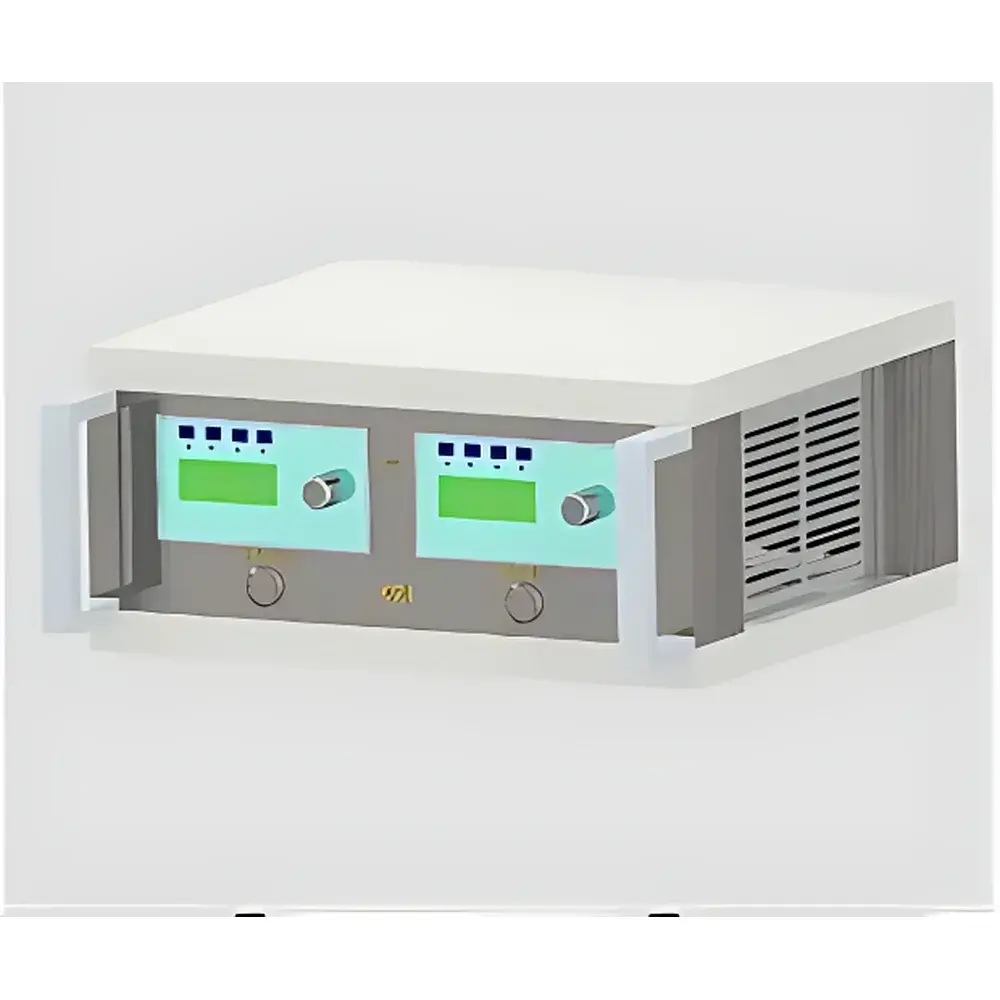
Truelab K21 Dual-Channel Electrospinning Controller for Rotary Collector and Reciprocating Nozzle Stage
| Brand | Truelab |
|---|---|
| Origin | Tianjin, China |
| Manufacturer Type | Authorized Distributor |
| Country of Origin | China |
| Model | K21 |
| Power Supply | AC 220 V, 50 Hz |
| Dimensions (W×D×H) | 275 × 250 × 110 mm |
| Weight | 4.5 kg |
| Rotary Collector Speed Range | 0–1000 rpm (resolution: 1 rpm |
| accuracy | ±0.1 rpm ≤300 rpm, ±1 rpm <1000 rpm) |
| Reciprocating Stage Speed Range | 0–1000 mm/min (resolution: 1 mm/min |
| accuracy | ±0.1 mm/min ≤300 mm/min, ±1 mm/min <1000 mm/min) |
| Direction Toggle Switch | Yes |
| Emergency Stop Button | Integrated |
Overview
The Truelab K21 Dual-Channel Electrospinning Controller is an engineered interface module designed for precise, synchronized motion control in laboratory-scale electrospinning systems. It functions as a dedicated motion management unit that independently regulates two critical mechanical subsystems: (1) a rotary collector—typically a motorized drum or mandrel used to gather nanofibrous mats—and (2) a linear reciprocating stage that carries the spinneret needle assembly. Unlike generic motor drivers, the K21 implements dual-channel open-loop step-pulse control based on standard stepper motor protocols (e.g., pulse/direction signaling), enabling deterministic positioning and velocity profiling without feedback sensors. Its architecture supports real-time speed ramping, direction reversal, and independent parameter setting per channel—essential for optimizing fiber alignment, deposition uniformity, and process repeatability in nanofiber fabrication workflows.
Key Features
- Dual independent control channels: one for rotary collector (0–1000 rpm), one for linear reciprocating stage (0–1000 mm/min)
- High-resolution speed adjustment: 1 rpm and 1 mm/min resolution across full range; calibrated accuracy of ±0.1 rpm (≤300 rpm) and ±1 rpm (<1000 rpm); ±0.1 mm/min (≤300 mm/min) and ±1 mm/min (<1000 mm/min)
- Integrated mechanical emergency stop button compliant with IEC 60204-1 safety standards for immediate power cutoff
- Dedicated direction toggle switch per channel for rapid polarity reversal without software reconfiguration
- Compact industrial enclosure (275 × 250 × 110 mm) with aluminum alloy chassis and EMI-shielded internal layout for stable operation in shared lab environments
- AC 220 V / 50 Hz input with built-in overvoltage and thermal protection circuits
Sample Compatibility & Compliance
The K21 controller is compatible with NEMA 17 and NEMA 23 stepper motors commonly integrated into electrospinning hardware platforms—including rotating drum collectors (diameters 50–200 mm), thin-rod collectors, and XY or linear translation stages with belt- or lead-screw-driven nozzles. It does not include motor drivers but interfaces directly with external stepper driver modules (e.g., DM542, TB6600) via industry-standard STEP/DIR/EN signal lines. The device complies with CE marking requirements for low-voltage equipment (LVD Directive 2014/35/EU) and electromagnetic compatibility (EMC Directive 2014/30/EU). While not certified for GMP or ISO 13485 environments, its design supports traceable operation under GLP-aligned lab practices when paired with validated electrospinning systems.
Software & Data Management
The K21 operates as a standalone hardware controller with no embedded firmware or USB/serial communication interface. All parameter configuration—including speed setpoints, acceleration profiles, and direction states—is performed locally via front-panel rotary encoders and tactile push buttons. No proprietary software, drivers, or cloud connectivity are required. This analog-digital hybrid interface ensures deterministic response times and eliminates latency or protocol stack dependencies common in PC-based controllers. For laboratories requiring audit trails, manual logbooks or external data acquisition systems (e.g., LabVIEW or Python-controlled DAQ) may be used to record operational timestamps and parameter settings in accordance with 21 CFR Part 11–aligned documentation practices.
Applications
- Controlled alignment of polymeric nanofibers via synchronized drum rotation and nozzle oscillation
- Multi-layer scaffold fabrication with alternating collection geometry (e.g., parallel vs. perpendicular fiber orientation)
- Process development studies evaluating rotational speed vs. fiber diameter distribution (via SEM correlation)
- Reproducible preparation of wound dressing membranes, filtration media, and battery separator prototypes
- Integration into custom-built electrospinning rigs where modular, deterministic motion control is prioritized over programmable automation
FAQ
Does the K21 include built-in stepper motor drivers?
No—the K21 provides only logic-level STEP/DIR/EN signals and requires external stepper drivers rated for your motor’s voltage and current specifications.
Can the two channels operate at different speeds simultaneously?
Yes—each channel is fully independent; rotary speed and linear stage speed may be set and adjusted without mutual interference.
Is there an option for analog voltage input or external trigger synchronization?
No—the K21 accepts only manual front-panel input; it does not support 0–10 V, PWM, or TTL trigger inputs.
What maintenance is required?
None beyond periodic visual inspection of connectors and cleaning of ventilation slots; the unit contains no consumables or field-replaceable parts.
Is technical documentation available in English?
Yes—user manual, wiring diagrams, and pinout specifications are provided in English upon request from authorized Truelab distributors.



