
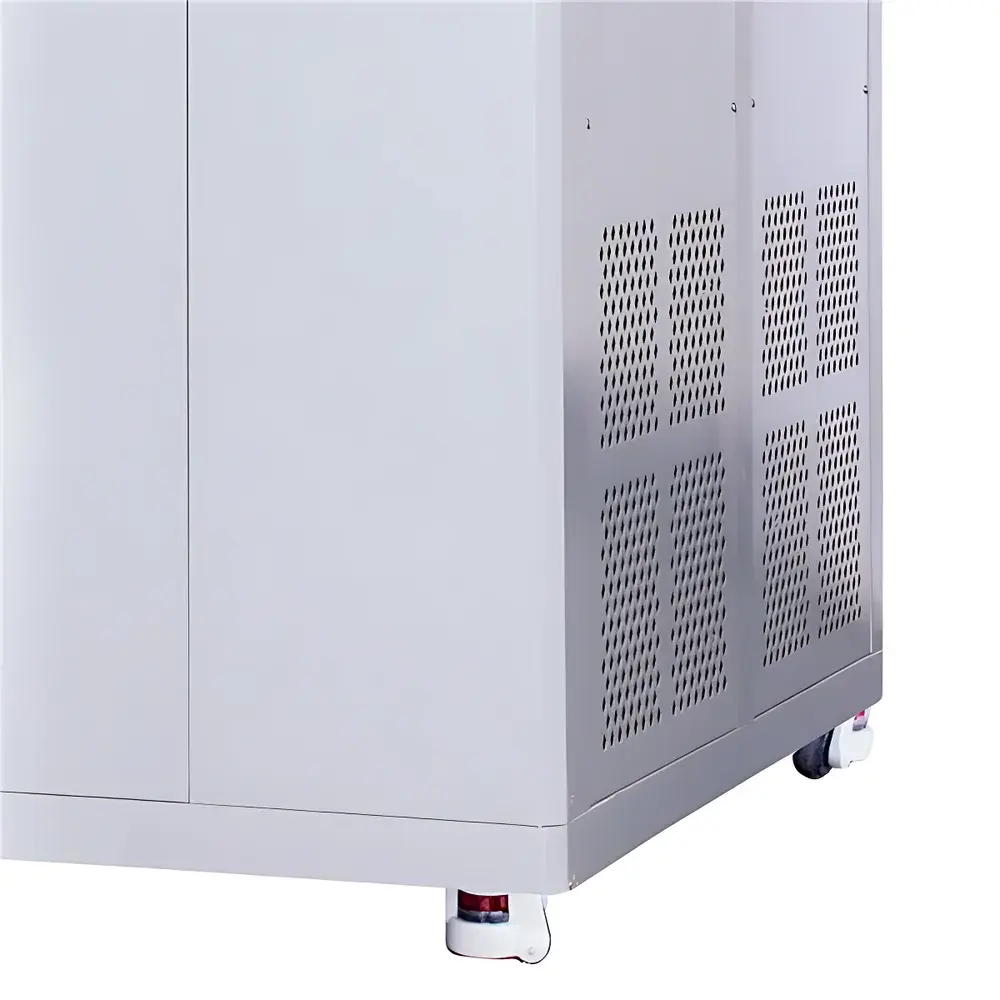
OK-TS-13 Three-Chamber Thermal Shock Test Chamber
| Brand | OK Instruments |
|---|---|
| Origin | Guangdong, China |
| Manufacturer Type | Direct Manufacturer |
| Product Origin | Domestic (China) |
| Model | OK-TS-13 |
| Price | USD 11,200 (FOB Guangdong) |
| High-Temperature Range (°C) | +150 |
| Low-Temperature Range (°C) | −50 |
| Thermal Shock Range (°C) | −50 to +150 |
| Temperature Stability (°C) | ±2 |
| Heating Rate (°C/min) | ≥10 |
| Cooling Rate (°C/min) | ≥10 |
Overview
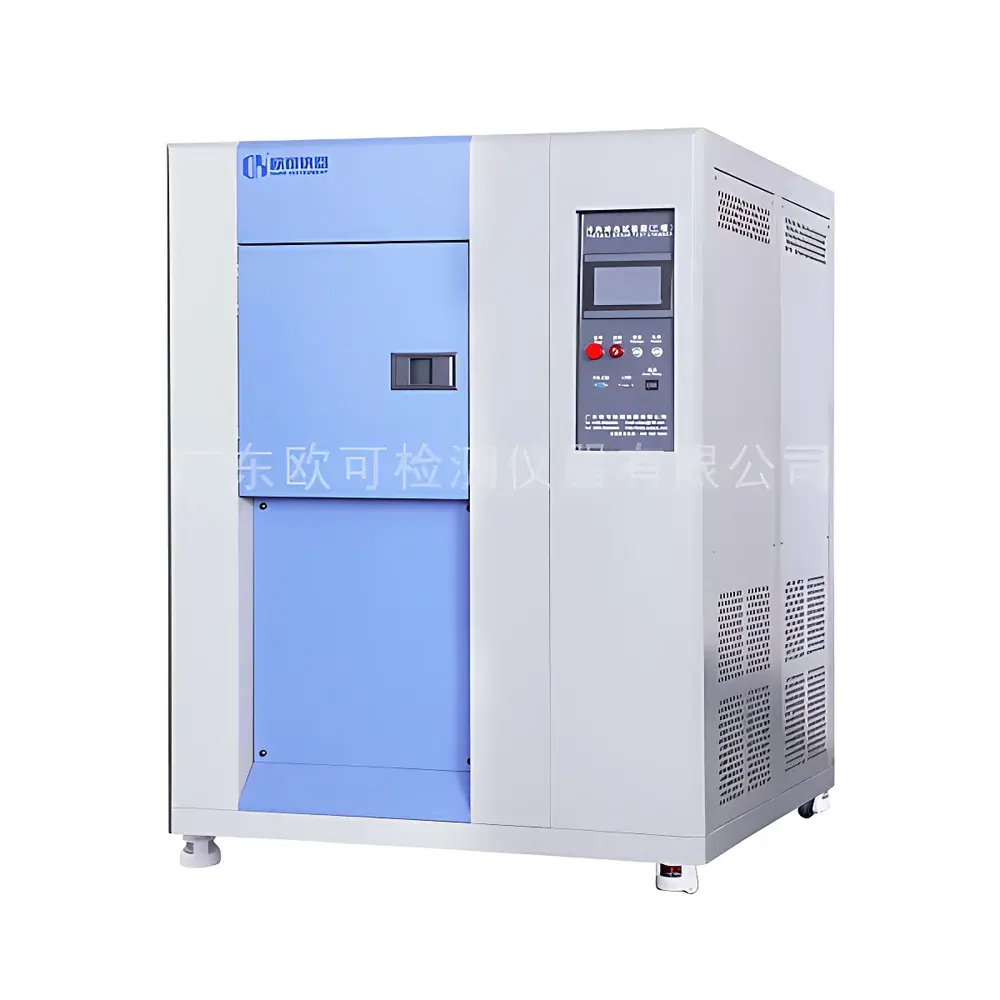
The OK-TS-13 Three-Chamber Thermal Shock Test Chamber is an engineered environmental test system designed for rapid, repeatable, and high-fidelity thermal shock evaluation of electronic components, automotive modules, aerospace assemblies, and advanced material specimens. Unlike two-chamber shuttle-type systems, the OK-TS-13 employs a three-compartment architecture—comprising independent hot soak, cold soak, and test chambers—enabling true static sample positioning during transitions. This configuration eliminates mechanical stress from basket movement, ensures zero vibration transfer to the DUT (Device Under Test), and delivers superior temperature uniformity and reproducibility across IEC 60068-2-14 (Test N), MIL-STD-810H Method 503.5, and GJB 150.5A-2009. The chamber operates on a dual-stage cascade refrigeration principle, integrating a high-temperature R404A loop and low-temperature R23 loop, thermally coupled via an evaporative condenser. This design achieves stable −50 °C to +150 °C shock profiles with ≤2 °C chamber stability under load, meeting stringent requirements for qualification testing in ISO/IEC 17025-accredited laboratories.
Key Features
- Three-chamber static configuration: separate hot chamber (+150 °C), cold chamber (−50 °C), and insulated test chamber—no moving parts or shuttle mechanisms affecting specimen integrity
- Cascade refrigeration system with imported semi-hermetic compressors (Germany-sourced), optimized for rapid thermal transition (≥10 °C/min heating/cooling rates under standard load conditions)
- Water-cooled condensing unit requiring external cooling tower (10 m³/h capacity); enables sustained operation at extreme temperature setpoints without compressor overload
- Energy modulation control logic dynamically adjusts refrigerant flow and heater duty cycle to maintain target ramp rates while minimizing power consumption and thermal overshoot
- Double-wall vacuum-insulated construction with polyurethane foam (≥150 mm thickness) and stainless-steel inner chamber (SUS304) for long-term corrosion resistance and thermal inertia reduction
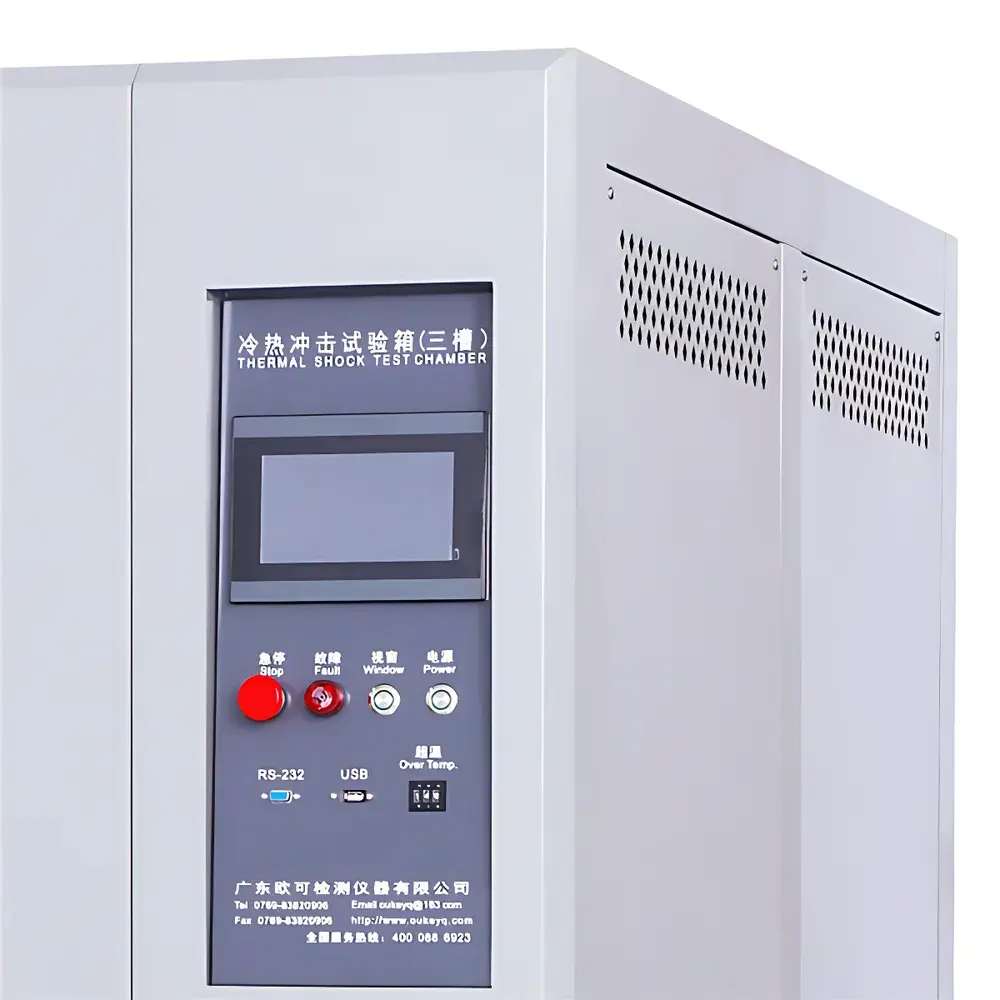
- Integrated safety interlocks including over-temperature cutoff, refrigerant pressure monitoring, door safety switch, and emergency stop per EN 61000-6-2 and EN 61000-6-4
Sample Compatibility & Compliance
The OK-TS-13 accommodates test specimens up to 500 mm × 500 mm × 500 mm (W×D×H) with maximum mass loading of 30 kg. Its static test chamber supports fixtures for PCBs, sensor housings, battery packs, optical lenses, and encapsulated semiconductor packages. The system complies with multiple international and defense standards, including but not limited to: IEC 60068-2-14 (Test N: Change of Temperature), MIL-STD-810H Method 503.5 (Temperature Shock), GJB 150.5A-2009 (Military Standard – Temperature Shock), GB/T 2423.22-2012 (Environmental Testing – Temperature Change), and QC/T 17-2019 (Automotive Component Environmental Resistance). All thermal profiles are traceable to NIST-calibrated reference sensors (Class A PT100), and the chamber is suitable for GLP/GMP-aligned validation protocols when paired with IQ/OQ documentation packages.
Software & Data Management
Equipped with OK-TCM v3.2 embedded controller running on a real-time Linux kernel, the OK-TS-13 provides full-cycle programmability—including multi-step shock sequences, dwell time definition (1 min to 999 h), rate-controlled ramps, and automatic cycling. Data logging records temperature at 1-second intervals from up to six user-placed thermocouples (Type K, Class 1), stored internally (32 GB SSD) and exportable via USB or Ethernet (Modbus TCP, optional OPC UA). Audit trails comply with FDA 21 CFR Part 11 requirements when configured with user role-based access control, electronic signatures, and immutable log archiving. Calibration certificates (including as-found/as-left data) are generated per ISO/IEC 17025 Annex A.3 guidelines.
Applications
- Qualification testing of avionics modules per DO-160 Section 4 (Temperature Shock)
- Reliability screening of solder joints and underfill adhesion in high-density PCBAs
- Validation of thermal expansion coefficient (CTE) mismatch in multi-material packaging (e.g., SiC MOSFET modules)
- Accelerated aging of polymer seals, gaskets, and conformal coatings used in EV battery enclosures
- Pre-compliance stress screening for automotive ECUs prior to ISO 16750-4 environmental validation
- Material phase-transition analysis for shape-memory alloys and piezoelectric ceramics
FAQ
What distinguishes the three-chamber design from two-chamber thermal shock systems?
The OK-TS-13 isolates thermal mass in dedicated hot and cold reservoirs, enabling near-instantaneous transfer of the test chamber air volume between extremes—without moving the specimen. This eliminates mechanical wear, vibration artifacts, and positional uncertainty inherent in shuttle-basket designs.
Is external cooling infrastructure mandatory?
Yes. The cascade refrigeration system requires a dedicated water-cooled condenser connected to an industrial cooling tower rated at ≥10 m³/h flow capacity. Air-cooled alternatives are not supported due to thermal load constraints at −50 °C operation.
Can the chamber be validated for ISO/IEC 17025 accreditation?
Yes. The system includes factory-installed calibrated sensors, documented uncertainty budgets, and supports third-party verification using accredited dry-well calibrators (e.g., Fluke 9143) per ISO/IEC 17025 Clause 6.5.2.
What is the typical lead time for IQ/OQ documentation?
Standard IQ/OQ protocol templates are provided with shipment. Fully executed, site-specific qualification packages (including witness testing) are available as a value-added service with 10–12 business days lead time post-installation.
Does the controller support remote monitoring via LAN or cloud?
Local Ethernet (10/100BASE-T) is standard; secure remote access requires integration into the customer’s existing IT infrastructure with firewall-configured port forwarding. Cloud connectivity is not natively implemented to maintain data sovereignty and compliance with industrial cybersecurity policies (e.g., IEC 62443-3-3).



