
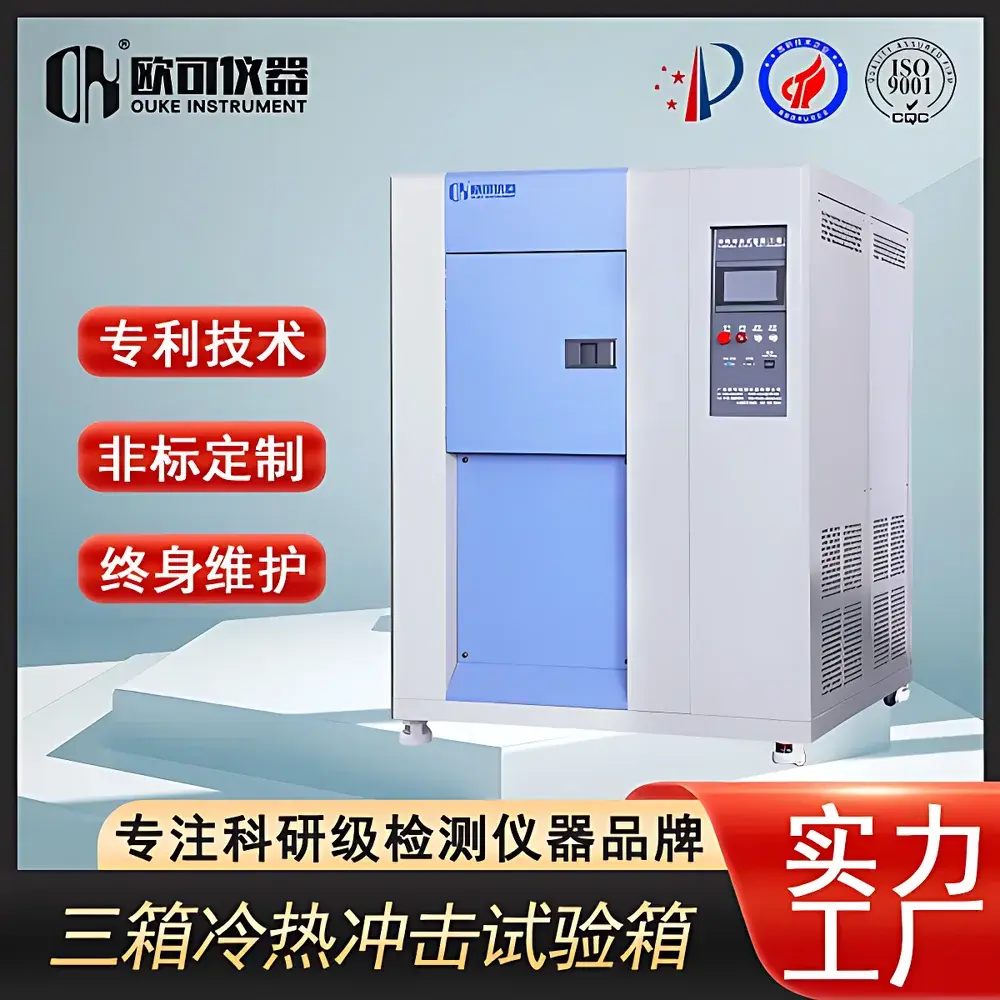
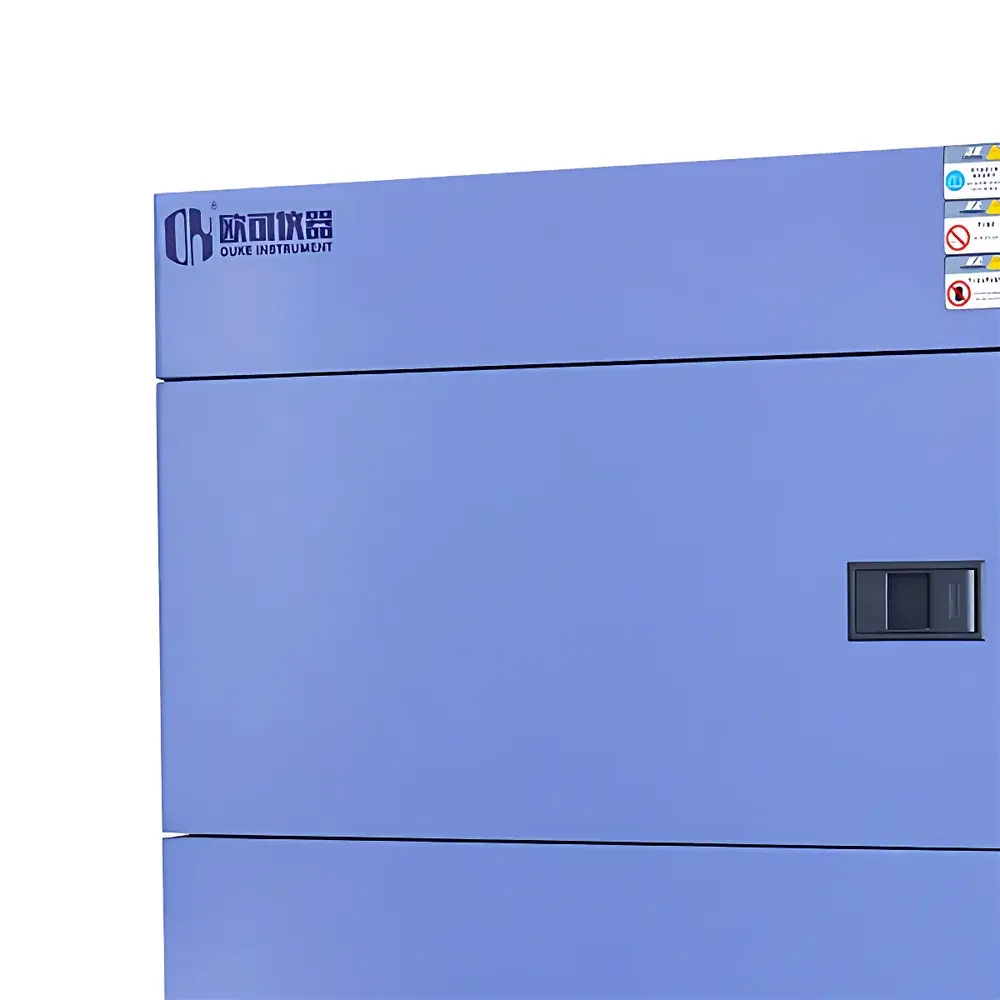
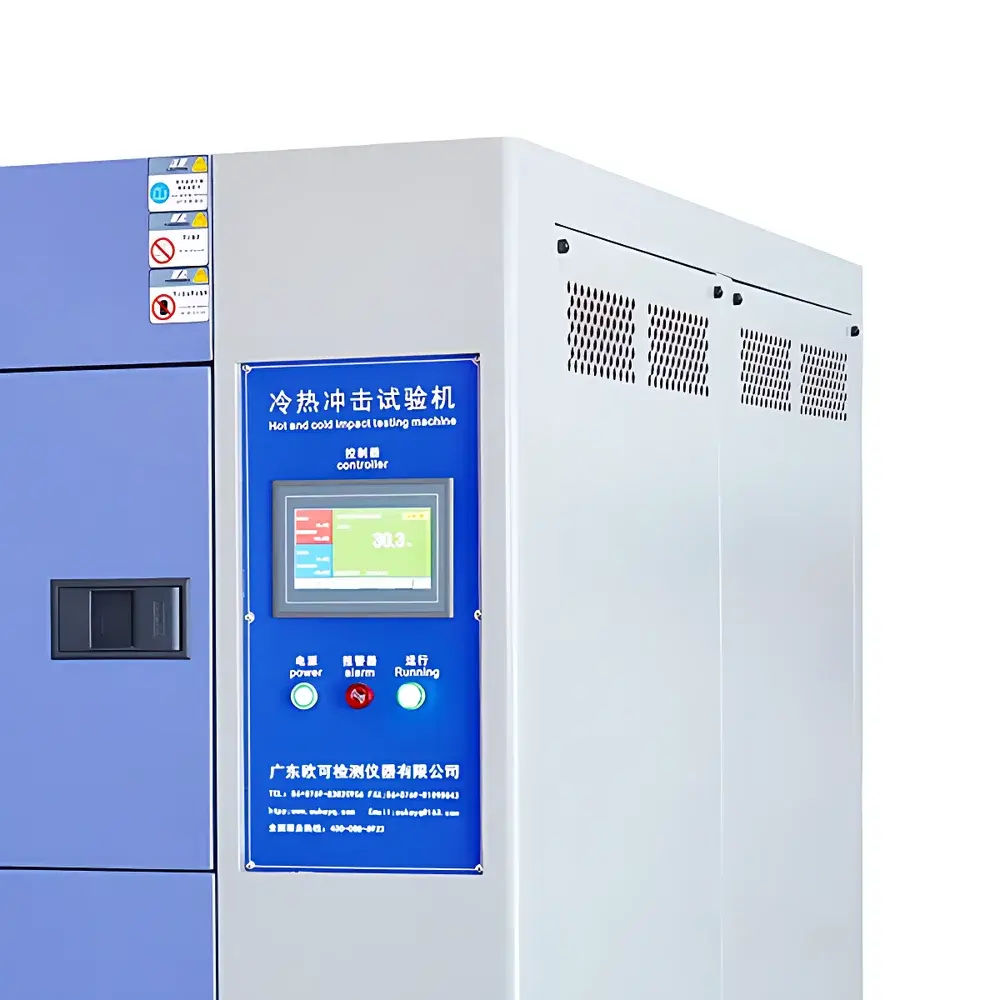
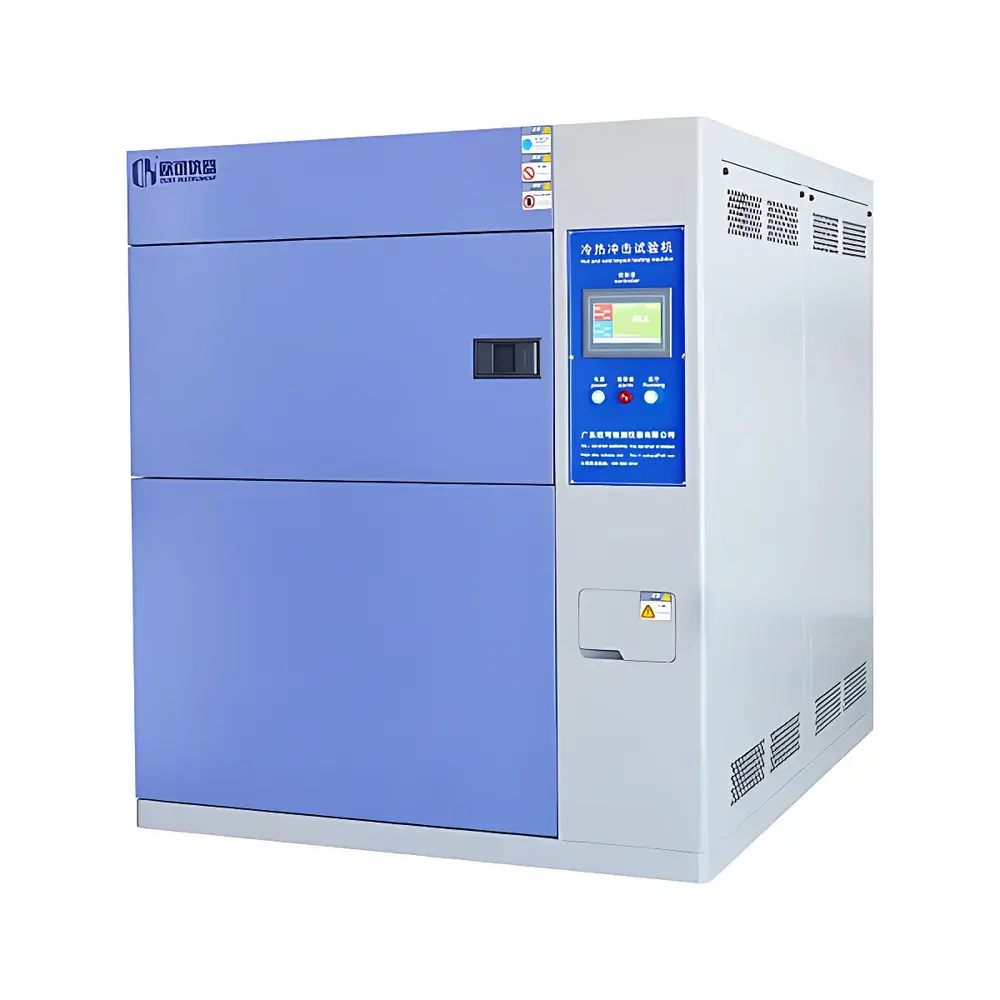
OK-TS-49.8 Thermal Shock Test Chamber
| Brand | OK Instruments |
|---|---|
| Origin | Guangdong, China |
| Manufacturer Type | Direct Manufacturer |
| Product Category | Domestic |
| Model | OK-TS-49.8 |
| High Temperature Range | +150 °C |
| Low Temperature Range | −55 °C |
| Thermal Shock Range | −55 °C to +150 °C |
| Temperature Stability | ±2 °C |
| Transfer Time (Hot ↔ Cold) | ≤10 s |
| Transfer Time (Cold ↔ Hot) | ≤10 s |
Overview
The OK-TS-49.8 Thermal Shock Test Chamber is a dual-chamber (hot/cold) mechanical thermal shock system engineered for rapid, repeatable, and standards-compliant thermal stress testing of electronic components, PCB assemblies, aerospace hardware, and advanced packaging materials. It operates on the principle of physical thermal shock—defined by IEC 60068-2-14 and MIL-STD-883 Method 1010—as a discontinuous, step-function temperature transition between two thermally isolated zones. Unlike temperature cycling chambers that rely on ramped air temperature gradients, the OK-TS-49.8 achieves true thermal shock by physically relocating test specimens via a motorized lift basket between independently stabilized high-temperature (+150 °C) and low-temperature (−55 °C) chambers. This architecture ensures minimal thermal inertia, enabling transfer times ≤10 seconds—meeting the critical “transfer time” requirement specified in GJB 150.5A, JESD22-A106, and IPC-9701 for accelerated reliability screening.
Key Features
- Dual-zone stainless-steel chamber design with independent PID-controlled heating (electric) and refrigeration (cascade two-stage compressor) systems
- Motorized lift basket mechanism with position feedback sensors and fail-safe mechanical limit switches
- Temperature stability maintained at ±2 °C across both chambers under steady-state conditions (per IEC 60068-3-5)
- Transfer time verified per ASTM E1545 and IEC 60068-2-14 Annex A: ≤10 s hot-to-cold and cold-to-hot transitions
- Integrated real-time chamber monitoring with dual-channel Pt100 RTD sensors and data logging at 1 Hz resolution
- Front-access observation window with anti-fog heated glass and internal LED illumination for visual inspection during operation
- Compliance-ready safety architecture: over-temperature cut-off, refrigerant pressure monitoring, door interlock, and emergency stop circuit
Sample Compatibility & Compliance
The OK-TS-49.8 accommodates samples up to 400 mm × 400 mm × 400 mm (L×W×H) and 25 kg maximum load. Its chamber geometry supports standard JEDEC trays, DIP/PGA packages, bare die carriers, and small subsystems requiring powered-in or unpowered thermal shock exposure. The system conforms to the environmental stress screening (ESS) requirements of MIL-STD-810H Section 503.6 and supports validation against GJB 150.5A (China’s military standard for thermal shock), IEC 60068-2-14 (basic test method for thermal shock), and JESD22-A106B (JEDEC solid-state technology association standard). Optional configuration includes RS-485 Modbus RTU interface for integration into GLP/GMP audit trails and FDA 21 CFR Part 11–compliant electronic records when paired with validated third-party software platforms.
Software & Data Management
Control and monitoring are executed via an embedded 7-inch capacitive touchscreen HMI running OK’s proprietary TS-Control v3.2 firmware. The interface supports user-defined shock profiles—including dwell time (1 min to 999 min), cycle count (1 to 9999), and sequence logic (e.g., 3× hot dwell → transfer → 3× cold dwell → transfer). All operational parameters—including chamber setpoints, actual temperatures, basket position status, and transfer timestamps—are logged internally with UTC timestamping and exportable via USB 2.0 to CSV format. For enterprise-level traceability, optional Ethernet/IP connectivity enables OPC UA server integration and remote supervision via SCADA or LIMS environments. Audit trail functionality records operator login/logout events, parameter changes, and alarm acknowledgments—supporting ISO/IEC 17025 and ISO 9001 calibration documentation workflows.
Applications
- Qualification testing of solder joint integrity in lead-free BGA and QFN packages per IPC-J-STD-020
- Reliability assessment of MEMS devices, optical sensors, and hermetic ceramic packages subjected to rapid ambient shifts
- Failure mode analysis of conformal-coated PCBs under extreme thermal transients
- Pre-screening of avionics modules prior to HALT/HASS execution
- Material compatibility evaluation for encapsulants, adhesives, and underfill compounds used in automotive ECUs
- Validation of thermal interface material (TIM) bond strength after repeated shock exposure
FAQ
What is the difference between thermal shock and temperature cycling?
Thermal shock involves instantaneous transfer between two stable temperature extremes (e.g., −55 °C ↔ +150 °C), inducing high-magnitude transient stresses. Temperature cycling uses continuous ramping within a single chamber and targets cumulative fatigue mechanisms.
Does the OK-TS-49.8 meet MIL-STD-883 Method 1010?
Yes—the system satisfies the transfer time, temperature range, and dwell stability criteria defined in MIL-STD-883H Method 1010.11 for thermal shock qualification of microelectronic devices.
Can the chamber accommodate powered devices during testing?
Yes—optional feedthrough ports (up to 12 channels, 300 V AC/DC rated) support live electrical monitoring of DUTs during shock transitions.
Is calibration certification included with shipment?
Each unit ships with a factory-as-tested report including chamber uniformity mapping and transfer time verification. NIST-traceable calibration certificates are available as a configurable option.
What maintenance intervals are recommended?
Compressor oil and filter replacement every 2,000 operating hours; chamber seal inspection quarterly; full system performance verification annually per ISO/IEC 17025 Clause 6.4.6.
Related Products



