
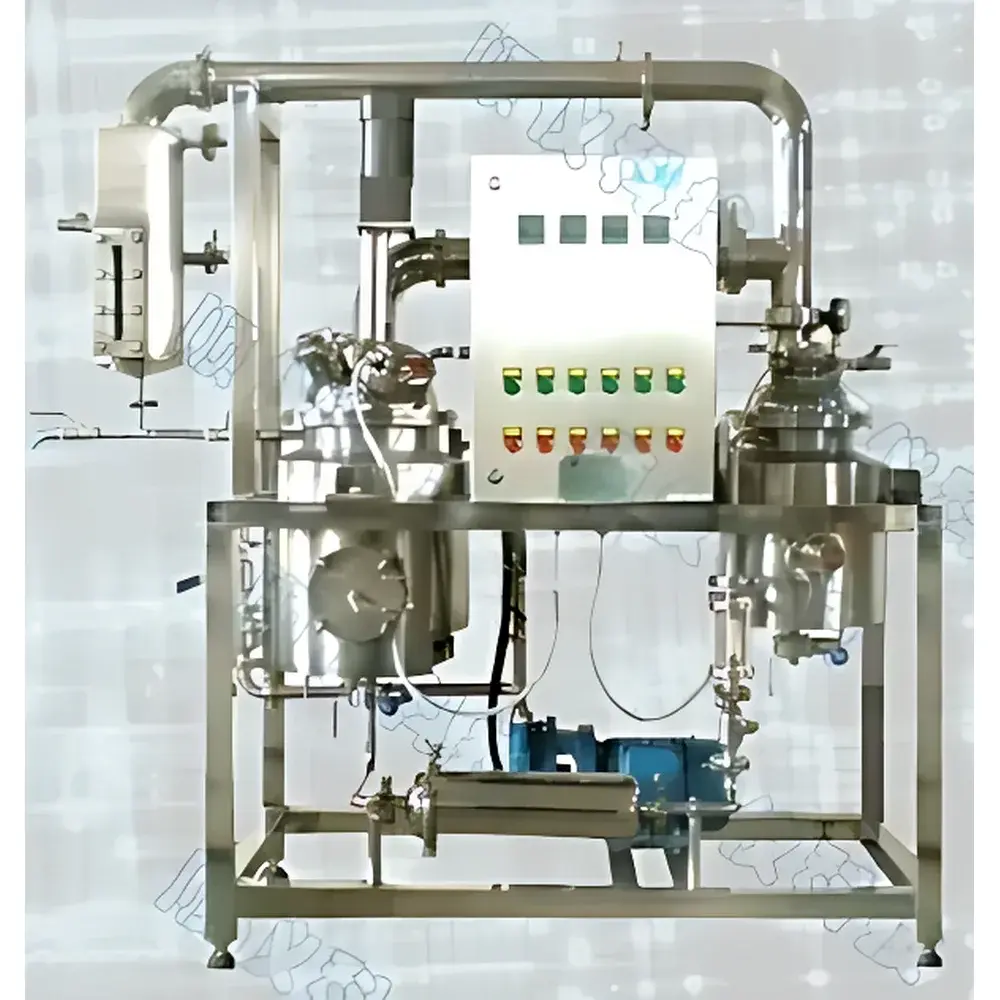
TS-NS Series Laboratory-Scale Extraction and Concentration Unit
| Origin | Shanghai, China |
|---|---|
| Manufacturer Type | Authorized Distributor |
| Origin Category | Domestic (China) |
| Model | TS-NS |
| Capacity Options | 5 L, 10 L, 20 L, 30 L, 50 L, 100 L |
| Heating Power | 5–20 kW |
| Jacket Pressure | 0.3–0.4 MPa |
| Internal Vessel Pressure | 0.09 MPa |
| Extraction Temperature | Up to 100 °C |
| Concentration Temperature Range | 40–80 °C |
| Stirring Motor Power | 0.09–0.40 kW |
| Condensing Area | 0.20–0.95 m² |
| Heating Surface Area | 0.20–0.95 m² |
| Vacuum Pump Power | 0.75–2.25 kW |
| Ultimate Vacuum | −0.05 to −0.08 MPa |
| Dimensions (L×W×H mm) | 1500×1200×550 to 2200×1550×660 |
| Construction Material | SUS304 stainless steel, internal/external welds polished to 300-grit finish |
| Insulation | Triple-layer thermal insulation |
| CIP System | Integrated Clean-in-Place |
| Heating Method | Electric jacketed heating |
| Optional Ultrasound Frequencies | 15, 20, 28, 30, 35, 40, 50, 60 kHz |
| Compliance | Designed per GMP principles for pharmaceutical R&D environments |
Overview
The TS-NS Series Laboratory-Scale Extraction and Concentration Unit is an integrated, thermally coupled system engineered for precise, scalable solvent-based separation and concentration processes in research and development laboratories. It operates on the principle of heat reflux extraction—where solvent is continuously boiled, vaporized, condensed, and returned to the extraction vessel—combined with vacuum-assisted low-temperature concentration. This dual-mode architecture enables simultaneous or sequential execution of dynamic solid–liquid extraction (e.g., herbal decoction, maceration, forced-circulation percolation) and post-extraction solvent recovery or active constituent enrichment. The unit supports both atmospheric and controlled-pressure operation, with built-in temperature regulation across all process zones (extraction jacket, condenser, concentrator), ensuring reproducible thermal profiles critical for phytochemical stability and yield optimization. Its modular footprint and open-frame design facilitate integration into GLP-compliant lab workflows, particularly where space-constrained benchtop scalability and regulatory traceability are required.
Key Features
- Compact, open-structure configuration requiring only standard electrical supply (380 V, 50 Hz) and cooling water—no steam boiler or external chiller needed.
- Centralized PLC-based control panel with real-time digital display of extraction temperature, jacket pressure, vacuum level, stirring speed, and condensate flow status.
- SUS304 stainless steel construction throughout; interior and exterior welds electropolished to Ra ≤ 0.8 µm (300-grit equivalent) to prevent microbial adhesion and ensure cleanability.
- Triple-layer thermal insulation minimizes ambient heat loss and improves energy efficiency during prolonged operation.
- Integrated CIP (Clean-in-Place) system with spray ball and validated rinse cycles compliant with ISO 14644-1 Class 7 cleanroom maintenance protocols.
- Optional ultrasonic enhancement module featuring focused transducer arrays (15–60 kHz selectable) and frame-type agitator—designed to maximize cavitation density within large-volume botanical matrices without hot-spot formation.
- Full-radius internal geometry eliminates dead zones during heating, extraction, and discharge—enabling >99.8% material evacuation and reducing cross-batch carryover risk.
Sample Compatibility & Compliance
The TS-NS unit accommodates heterogeneous natural matrices including dried herbs, granulated botanicals, algal biomass, food-grade raw materials, and polymer-bound resins. It supports aqueous, hydroalcoholic, and low-boiling organic solvents (e.g., ethanol, acetone, ethyl acetate) under vacuum or atmospheric conditions. All wetted surfaces meet USP Class VI and FDA 21 CFR Part 11 requirements for electronic record integrity when paired with optional audit-trail-enabled software. The mechanical design adheres to ASME BPVC Section VIII Div. 1 for pressure-retaining components and complies with IEC 61000-6-2/6-4 electromagnetic compatibility standards. Documentation packages include Factory Acceptance Test (FAT) reports, material certifications (EN 10204 3.1), and GMP-aligned operational qualification (OQ) templates for laboratory validation.
Software & Data Management
The embedded controller logs timestamped process variables at 1-second intervals and exports CSV-formatted datasets via USB or Ethernet. Optional HMI upgrade enables remote monitoring through secure HTTPS interface, supporting role-based user access (operator, supervisor, QA reviewer). Data files include automatic metadata tagging (batch ID, operator ID, SOP version, equipment ID) to satisfy ALCOA+ data integrity criteria. Audit trails capture all parameter modifications, start/stop events, and alarm acknowledgments with immutable timestamps—fully compatible with laboratory information management systems (LIMS) and electronic lab notebooks (ELN) via ASTM E2500-14-defined APIs.
Applications
- Phytochemical R&D: Standardized extraction of alkaloids, flavonoids, saponins, and polysaccharides from Salvia miltiorrhiza, Ginkgo biloba, and Withania somnifera under pharmacopeial conditions (ChP, EP, USP).
- Nutraceutical pilot studies: Optimization of anthocyanin yield from berry pomace using temperature-gradient reflux and fractional vacuum concentration.
- Fragrance & flavor isolation: Steam-distillation–compatible aromatic oil recovery from citrus peels and mint leaves with inline condensate phase separation.
- Chemical process screening: Solvent selection trials for API intermediate purification under varying reflux ratios and hold times.
- Teaching laboratories: Hands-on demonstration of mass transfer kinetics, Raoult’s law deviations, and Fickian diffusion modeling in plant tissue systems.
FAQ
What regulatory standards does the TS-NS unit support for pharmaceutical development?
It is designed to align with EU GMP Annex 15, WHO TRS 986, and ICH Q5C guidelines for equipment qualification in early-phase process development. Full documentation support is provided for IQ/OQ/PQ execution.
Can the ultrasonic module be retrofitted to existing units?
Yes—ultrasonic transducers and matching generator cabinets are available as field-installable kits with mechanical mounting interfaces and calibrated power coupling verification.
Is vacuum distillation supported for heat-labile compounds?
Absolutely—the unit achieves stable vacuum levels down to −0.08 MPa, enabling boiling point depression to <40 °C for terpenoids, lactones, and volatile oils while maintaining condenser subcooling margins ≥15 K.
How is cleaning validation performed?
The CIP system includes conductivity-based endpoint detection, rinse water sampling ports, and residue swab locations mapped per PDA Technical Report No. 29. Validation protocols follow ASTM E3083-17.
What is the typical lead time for custom configuration (e.g., explosion-proof rating, Hastelloy cladding)?
Standard delivery is 12–14 weeks from order confirmation; custom engineering add-ons extend lead time by 4–6 weeks depending on component sourcing and third-party certification requirements.



