
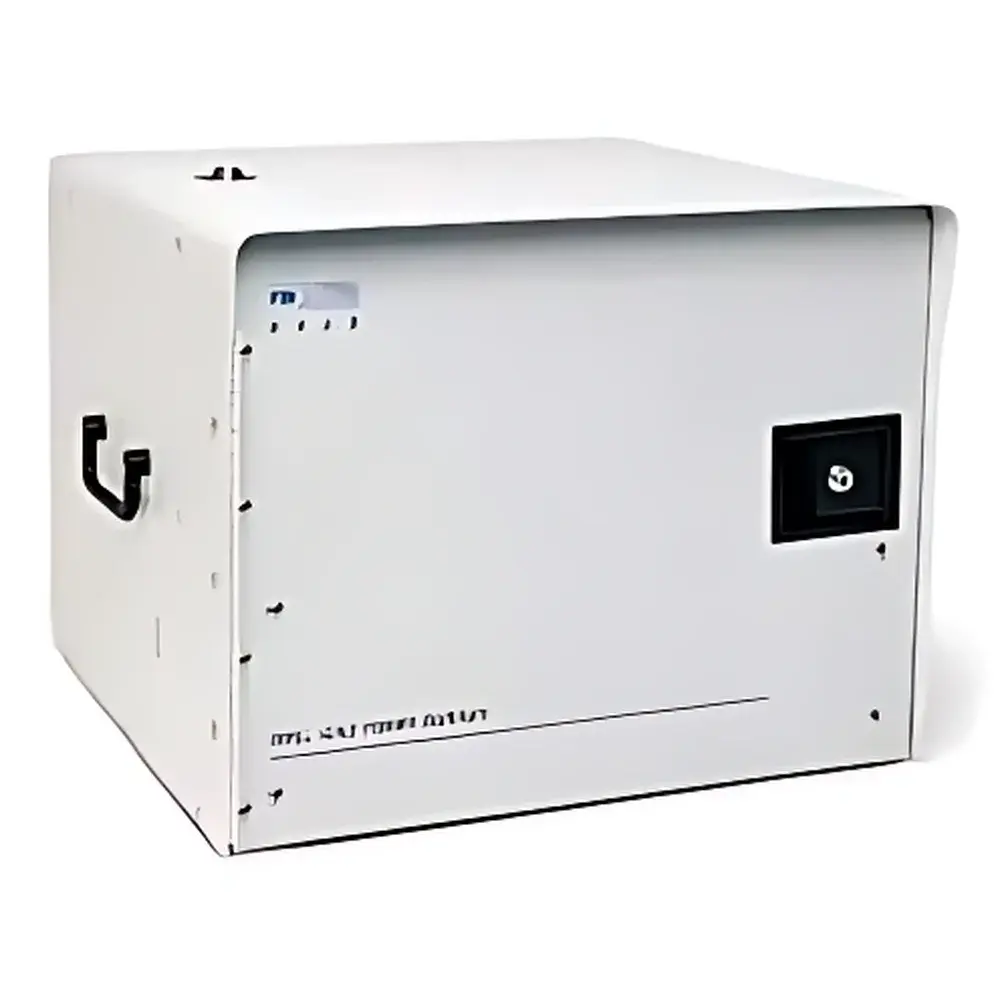
TSI 3433-SSPD Small-Scale Powder Dispenser
| Origin | USA |
|---|---|
| Manufacturer Type | Authorized Distributor |
| Origin Category | Imported |
| Model | 3433 |
| Pricing | Available Upon Request |
| Particle Size Range | 0.5–50 µm |
| Output Aerosol Concentration | 0.3–4 mg/m³ (standard motor) / 3–40 mg/m³ (optional motor) |
| Powder Feed Rate | 3–90 mg/hr |
| Compressed Air Requirement | 12–21 L/min at 138 kPa |
| Turntable Rotation Speed | 0.25–3.3 rev/hr (standard motor) / 2.5–33.3 rev/hr (optional motor) |
Overview
The TSI 3433-SSPD Small-Scale Powder Dispenser is a precision-engineered aerosol generation system designed for controlled, reproducible dispersion of dry powdered materials into stable, monodisperse or polydisperse aerosol streams. Based on the rotating drum (turntable) principle with pneumatic shearing and fluidization, the 3433-SSPD utilizes compressed air to lift and entrain particles from a rotating powder bed—enabling quantitative delivery of sub-milligram quantities of material without thermal degradation or solvent contamination. This mechanism ensures minimal sample waste and high fidelity in particle size distribution preservation—critical when handling expensive reference standards (e.g., PSL spheres), toxic compounds, or limited-volume environmental filter extracts. The instrument is purpose-built for laboratory-scale calibration, method validation, and controlled exposure studies within ISO 17025-accredited testing facilities and GLP-compliant aerosol research environments.
Key Features
- Micro-dosing capability: Accurately dispenses powders in the 0.5–50 µm aerodynamic diameter range with gravimetric feed rates controllable between 3 and 90 mg/hr.
- Dual-motor configuration: Standard motor supports low-concentration, high-stability generation (0.3–4 mg/m³); optional high-speed motor enables elevated output (3–40 mg/m³) for rapid challenge testing or instrument saturation protocols.
- Turntable-driven dispersion: Precision-machined stainless-steel drum rotates at adjustable speeds (0.25–33.3 rev/hr), ensuring consistent powder layer renewal and minimizing agglomeration or static buildup.
- Compressed-air optimized design: Operates reliably with clean, oil-free air at 138 kPa (20 psi) and 12–21 L/min flow—compatible with standard lab-grade air compressors and inline filtration systems meeting ISO 8573-1 Class 2:2:2 requirements.
- Modular integration: Designed for direct coupling to downstream instrumentation including TSI APS 3321 Aerodynamic Particle Sizers, PSD 3603 Particle Sizing Detectors, and cascade impactors per ISO 14644-3 and ASTM D6604.
Sample Compatibility & Compliance
The 3433-SSPD accommodates a broad spectrum of dry, free-flowing powders—including polystyrene latex (PSL) microspheres, sodium chloride, lactose, silica, and ambient particulate matter collected on 25 mm or 37 mm diameter membrane filters (e.g., PVC, PTFE, or mixed cellulose ester). Its non-contact, room-temperature dispersion avoids chemical alteration or phase change—ensuring integrity of hygroscopic, thermolabile, or electrostatically sensitive samples. The system complies with key regulatory and metrological frameworks: it supports traceable calibration workflows aligned with ISO/IEC 17025, facilitates audit-ready documentation for FDA 21 CFR Part 11–enabled software integrations, and meets functional requirements outlined in ISO 16000-9 (indoor air—particulate matter determination) and EPA Method IO-3.1 (aerosol generation for respirator filter testing).
Software & Data Management
While the 3433-SSPD operates as a stand-alone hardware module, its performance parameters are fully compatible with TSI’s Instrument Manager™ and Aerosol Instrument Manager™ (AIM) software suites. These platforms enable synchronized logging of dispersion duration, motor speed, air pressure, and real-time mass concentration estimates (when paired with a calibrated TSI DustTrak DRX or FM-1000 sensor). All operational logs support CSV export, time-stamped metadata embedding, and configurable alarm thresholds—meeting GLP/GMP data integrity criteria including ALCOA+ principles (Attributable, Legible, Contemporaneous, Original, Accurate, Complete, Consistent, Enduring, Available). Audit trails and electronic signatures are available when deployed with validated AIM installations under 21 CFR Part 11 configurations.
Applications
- Calibration of optical particle counters, aerodynamic particle sizers, and condensation particle counters using NIST-traceable PSL standards.
- Re-aerosolization of filter-collected ambient or occupational aerosols for compositional analysis via SEM-EDS, XRF, or ICP-MS.
- Generation of challenge aerosols for HEPA/ULPA filter efficiency testing per ISO 29463 and EN 1822.
- Controlled inhalation exposure studies in inhalation toxicology labs, supporting OECD Test Guidelines 412 and 413.
- Method development for PM2.5/PM10 reference material preparation and inter-laboratory comparison exercises.
FAQ
Can the 3433-SSPD disperse cohesive or hygroscopic powders?
Yes—when used with appropriate pre-conditioning (e.g., desiccation, surface treatment) and optimized air flow settings; however, material-specific validation is recommended prior to routine use.
Is the unit compatible with nitrogen or other inert carrier gases?
Yes—provided gas purity meets ISO 8573-1 Class 1:2:1 specifications and pressure/flow parameters remain within stated operating limits.
Does TSI provide NIST-traceable calibration certificates for the 3433-SSPD?
No—the 3433-SSPD is a generator, not a measuring device; however, TSI offers application-specific validation protocols and supports third-party metrological verification against ISO 27891-compliant aerosol measurement standards.
What maintenance intervals are recommended?
Daily visual inspection of drum surface and feed port; monthly cleaning with isopropyl alcohol and lint-free swabs; annual verification of motor torque and air flow calibration using a certified rotameter or mass flow meter.
Can the 3433-SSPD be integrated into automated test sequences?
Yes—via TTL trigger input/output ports and RS-232/USB interface, enabling synchronization with programmable logic controllers (PLCs) or LabVIEW-based test automation frameworks.







