
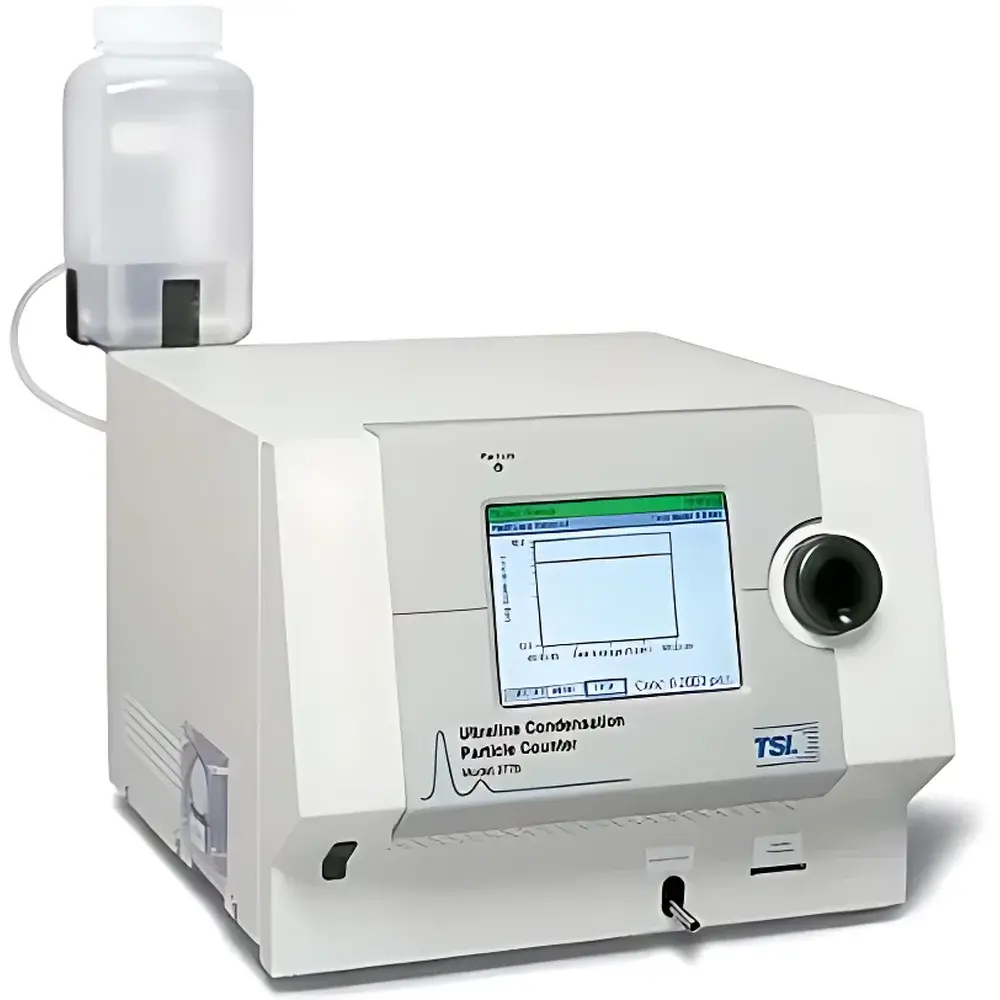
TSI 3776-CPC Condensation Particle Counter
| Origin | USA |
|---|---|
| Manufacturer Type | Authorized Distributor |
| Origin Category | Imported |
| Model | 3776-CPC |
| Pricing | Available Upon Request |
| Particle Size Range | 3 nm – 5 µm |
| Maximum Concentration | 1 × 10⁵ #/cm³ |
| Response Time | ≤1 s |
| Background Noise | <0.01 #/cm³ |
| Signal-to-Noise Ratio | 25:1 |
| Operating Temperature | 10–37 °C |
| Relative Humidity | 0–90 % RH (non-condensing) |
Overview
The TSI 3776-CPC Condensation Particle Counter is a high-sensitivity, research-grade instrument engineered for real-time detection and quantification of ultrafine aerosol particles down to 3 nanometers in mobility diameter. Utilizing a patented steam-based condensation growth mechanism, the 3776-CPC operates on the principle of controlled supersaturation within a laminar, coaxial sheath flow—ensuring uniform activation and growth of sub-3 nm nuclei across the entire sample stream. This design eliminates radial diffusion losses and minimizes residence time variability, enabling robust counting efficiency above 50% at 3 nm and approaching unity (>99%) above 10 nm. Unlike conventional butanol-based CPCs, the 3776-CPC employs purified water vapor as the working fluid, eliminating solvent handling, reducing maintenance intervals, and ensuring long-term stability under continuous operation. Its architecture supports integration into mobile platforms, cleanroom monitoring networks, and atmospheric science field deployments where low detection limits, rapid temporal resolution, and metrological traceability are critical.
Key Features
- Sub-3 nm lower detection limit—validated per ISO 27891 and TSI internal calibration protocols using certified monodisperse nanoparticles generated via electrospray and DMA classification
- Steam-sheath flow geometry that centers aerosol stream within a saturated vapor envelope, delivering exceptional counting reproducibility (CV < 2% at 100 #/cm³)
- Real-time response time ≤1 second—optimized for capturing transient events such as engine exhaust plumes, nanoparticle synthesis bursts, or indoor ventilation transients
- Ultra-low background noise (<0.01 #/cm³), achieved through multi-stage thermal and electrostatic filtration of make-up air and rigorous internal surface passivation
- Integrated temperature and humidity sensors with active compensation algorithms—ensuring stable performance across ambient conditions (10–37 °C, 0–90 % RH non-condensing)
- Ruggedized chassis with IP20-rated enclosure, CE-marked for EMC and safety compliance, and designed for 24/7 unattended operation in laboratory and outdoor enclosures
Sample Compatibility & Compliance
The 3776-CPC accepts standard ¼-inch OD stainless steel or conductive PTFE sampling lines and interfaces seamlessly with common aerosol conditioning systems—including impactors, cyclones, diluters, and differential mobility analyzers (DMAs). It is compatible with both laminar and turbulent inlet configurations when paired with appropriate isokinetic sampling probes. The instrument meets key regulatory and methodological frameworks including EPA Method PS-1 (for reference aerosol instrumentation), ISO 27891:2016 (specifications for ultrafine particle counters), and ASTM D8196-22 (standard practice for nanoparticle concentration measurement). For GLP/GMP environments, optional firmware enables audit-trail logging and user-access controls compliant with FDA 21 CFR Part 11 requirements when integrated with TSI’s TrakPro™ Software Suite.
Software & Data Management
Data acquisition and system control are managed via TSI’s TrakPro™ v6.0 software (Windows-based), supporting real-time plotting, configurable averaging windows (1 s to 1 hr), and automated export to CSV, HDF5, or SQL databases. The 3776-CPC communicates over USB-CDC or Ethernet (TCP/IP) with full Modbus TCP support for SCADA integration. Firmware updates are delivered via signed binary packages with SHA-256 verification. Raw count data includes timestamp (NTP-synchronized), internal sensor diagnostics (sheath flow rate, saturator temperature, condenser temperature), and status flags (e.g., “low signal”, “saturation warning”, “flow fault”). All metadata adhere to the Aerosol Measurement Standards (AMS) metadata schema v2.1 for interoperability with FAIR-compliant data repositories.
Applications
- Atmospheric science: Nucleation mode particle formation studies, urban background monitoring, and new particle formation (NPF) event characterization
- Indoor air quality (IAQ): Real-time tracking of ultrafine emissions from cooking, laser printers, and 3D printing operations
- Occupational health: Exposure assessment during nanomaterial handling, welding fume analysis, and pharmaceutical dry powder inhaler development
- Engine and combustion research: Exhaust particulate number (PN) measurement per UN GTR No. 15 and Euro 7 regulatory proposals
- Filter testing: Challenge aerosol monitoring for HEPA/ULPA filter certification per ISO 14644-3 and EN 1822
- Instrument intercomparison: Serving as a transfer standard in international round-robin exercises coordinated by ILAC and EURAMET
FAQ
What is the minimum detectable particle size, and how is it verified?
The 3776-CPC achieves a 50% counting efficiency at 3 nm, verified using traceable, NIST-traceable electrospray-generated nanoparticles classified by a high-resolution DMA and measured against reference instruments in accordance with ISO 27891 Annex B.
Does the instrument require consumables or routine solvent replacement?
No. The 3776-CPC uses deionized water as its condensing fluid; no organic solvents (e.g., butanol) are required. Water reservoirs are refillable and typically last ≥7 days under continuous operation.
Can the 3776-CPC be operated remotely or integrated into an existing monitoring network?
Yes. It supports Ethernet-based remote configuration, live data streaming, and alarm-triggered actions via configurable digital I/O ports and MQTT/HTTP API endpoints.
Is calibration traceable to national standards?
Yes. Factory calibration is performed using TSI’s primary aerosol calibration facility, accredited to ISO/IEC 17025:2017, with direct linkage to NIST SRM 1963 and PTB reference aerosols.
What maintenance intervals are recommended for field deployment?
Routine maintenance includes quarterly inspection of the water reservoir, inlet filter, and exhaust filter; annual verification of temperature and flow sensors is advised for ISO 17025-compliant use.







