
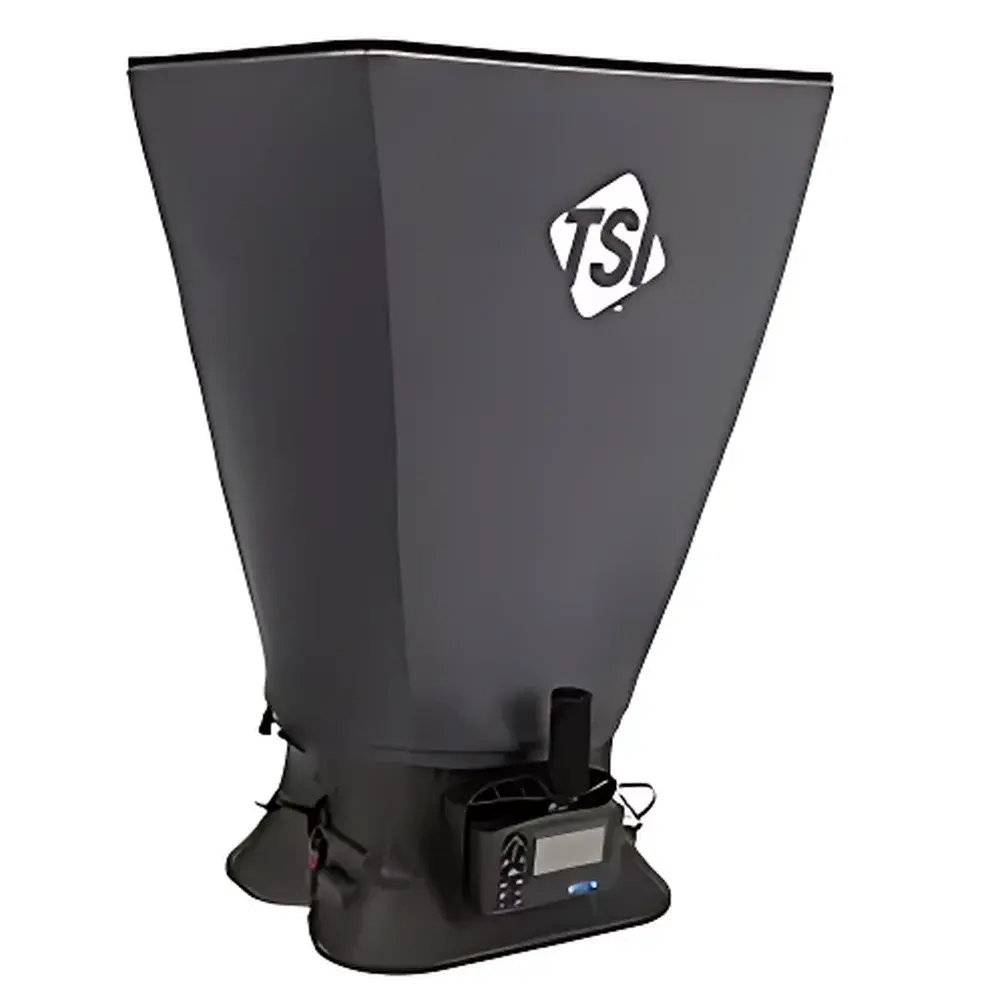
TSI AccuBalance Digital Air Flow Hood Model 8380
| Brand | TSI |
|---|---|
| Origin | USA |
| Model | 8380 |
| Hood Size | 2 ft × 2 ft (610 mm × 610 mm) |
| Pressure Measurement Range | ±250 Pa |
| Accuracy | ±3% of reading (typical for air flow measurement per ISO 16813 and ASHRAE Guideline 1) |
| Weight | <2.7 kg (6 lbs) |
| Battery | Rechargeable NiMH AA × 4 |
| Data Interface | USB + Bluetooth |
| Compliance | NIST-traceable calibration certificate included |
| Operating Temperature | 10–40 °C |
| Relative Humidity Limit | ≤90% RH non-condensing |
Overview
The TSI AccuBalance Digital Air Flow Hood Model 8380 is a precision-engineered, handheld air balancing instrument designed for quantitative volumetric airflow measurement at supply and return registers, diffusers, grilles, and other terminal air devices in HVAC systems. It operates on the principle of integrated differential pressure sensing across a calibrated laminar flow element — combined with real-time temperature and barometric pressure compensation — to compute volumetric flow rate (CFM or L/s) with high reproducibility. Unlike basic anemometers or pitot-static traverses, the AccuBalance 8380 eliminates spatial averaging errors by capturing total face velocity distribution across its standardized hood aperture, applying Log-Tchebycheff traverse logic internally to ensure compliance with ASHRAE Standard 111 and ISO 16813 requirements for air system commissioning and verification. Its modular architecture supports field reconfiguration for diverse duct geometries and regulatory contexts, making it suitable for both routine HVAC balancing and critical environment validation.
Key Features
- Detachable digital micromanometer with auto-zeroing pressure sensor and automatic air density correction based on ambient temperature and local barometric pressure
- Ergonomic, lightweight hood assembly (under 6 lbs / 2.7 kg) enabling single-operator use without ladders or auxiliary support
- Backpressure-compensated design ensures stable readings even under variable static pressure conditions typical in VAV and low-velocity systems
- Large backlit graphical display showing up to five simultaneous parameters: CFM/L/s, velocity (fpm/m/s), static pressure (Pa/in. w.g.), temperature (°C/°F), and relative humidity (%)
- Multi-language interface (English, Spanish, French, German, Chinese) with context-sensitive on-screen prompts and guided setup workflows
- Bluetooth 4.0 and USB 2.0 connectivity for real-time data streaming, remote monitoring, and post-processing via TSI’s TrakPro™ Lite software
- NIST-traceable calibration certificate supplied with each unit; optional annual recalibration services available through TSI-accredited labs
Sample Compatibility & Compliance
The AccuBalance 8380 is validated for use with standard rectangular and round supply/return openings ranging from 300 mm × 300 mm to 1,200 mm × 1,200 mm when paired with optional hood adapters (sold separately). Its measurement methodology conforms to key international standards including ASHRAE Guideline 1-2019 (HVAC Commissioning), ISO 16813:2021 (Indoor Air Quality – General Principles), and EN 13779:2007+A2:2012 (Ventilation for Non-Residential Buildings). For cleanroom applications, it supports ISO 14644-3:2019 Annex B protocols for airflow uniformity assessment. All firmware and data logging functions comply with GLP/GMP documentation integrity expectations, including audit-trail-capable timestamping and user-access-controlled data export.
Software & Data Management
TrakPro™ Lite software (included) enables configuration, live graphing, batch report generation (PDF/CSV), and traceable data archival. Each measurement record stores full metadata: operator ID, location tag, date/time stamp, environmental conditions, and instrument serial number. Data exports meet FDA 21 CFR Part 11 readiness requirements when used with enabled user authentication and electronic signature modules. Firmware updates are delivered via secure HTTPS portal; version history and change logs are retained in device memory for audit review.
Applications
- HVAC system commissioning and TAB (Testing, Adjusting, Balancing) per NEBB and AABC standards
- Cleanroom ISO class verification and recertification (air change rate, uniformity, and directional airflow)
- Energy audit and retrocommissioning studies requiring accurate zone-level airflow quantification
- IAQ investigations involving ventilation rate validation against ASHRAE 62.1 minimum outdoor air requirements
- Fault isolation in VAV boxes, terminal units, and duct leakage diagnostics using comparative hood measurements
- Regulatory submissions for LEED EQ Credit 1 (Outdoor Air Delivery Monitoring) and WELL Building Standard v2 Air Concept
FAQ
Is the AccuBalance 8380 certified for use in regulated pharmaceutical or healthcare facilities?
Yes — when operated with documented procedures, NIST-traceable calibration, and appropriate SOPs, it meets baseline requirements for HVAC performance qualification under EU GMP Annex 1 and USP . Full 21 CFR Part 11 compliance requires optional TrakPro™ Secure Edition.
Can the instrument measure both supply and exhaust airflow automatically?
Yes — the device detects flow direction in real time using differential pressure polarity analysis and displays corresponding supply/exhaust mode with dedicated icons and unit labeling.
What accessories are required for measuring in ducts instead of registers?
A compatible pitot tube (e.g., TSI 1950 series), static pressure probe, and flexible tubing kit are needed; these connect directly to the detachable micromanometer port and are supported in TrakPro™ Lite duct traverse mode.
Does the battery support continuous operation during extended site surveys?
With fully charged NiMH batteries, typical runtime exceeds 8 hours under mixed-use conditions (display backlight on, Bluetooth active, moderate sampling frequency); external power via AC adapter is supported during lab-based analysis.
How often should recalibration be performed?
TSI recommends annual recalibration against primary standards; more frequent verification (e.g., pre- and post-job zero checks) is advised for critical applications or after mechanical shock or extreme environmental exposure.







