
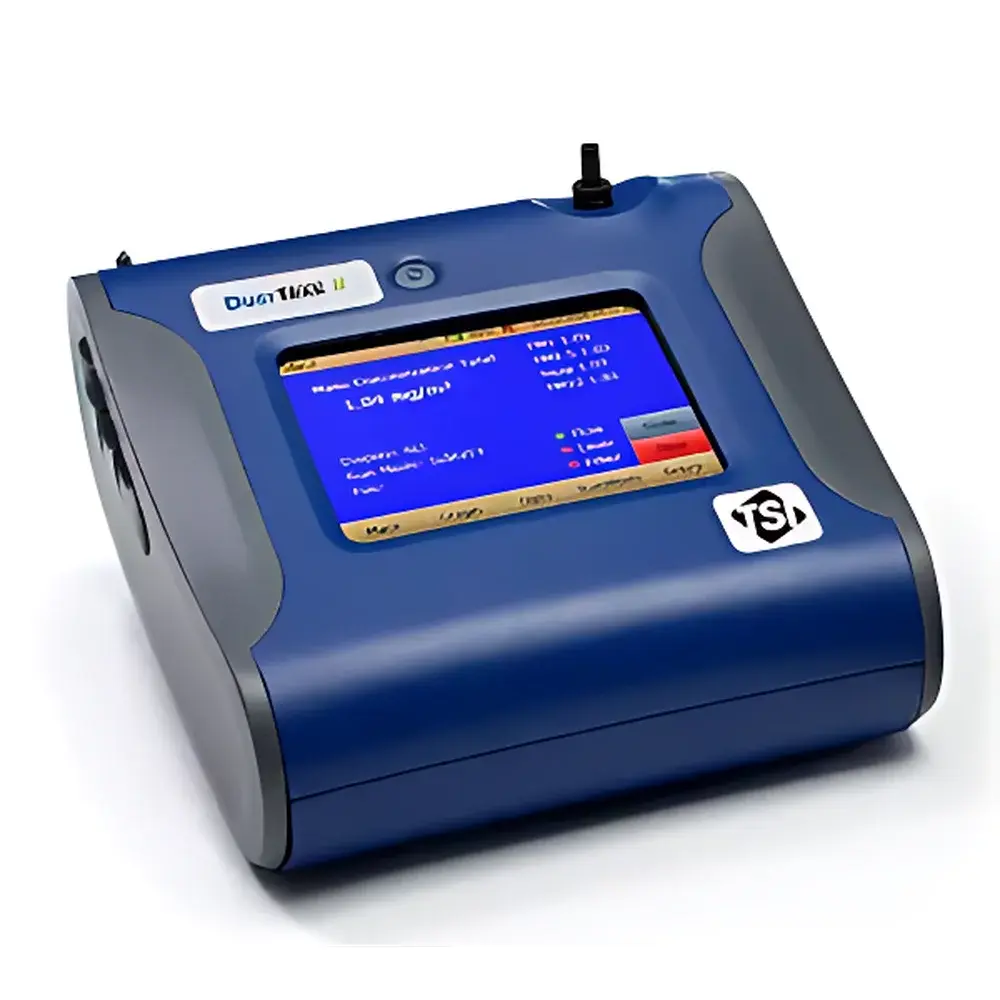
TSI DUSTTRAK™ II Model 8530 Respirable Dust Monitor
| Brand | TSI |
|---|---|
| Origin | USA |
| Model | DUSTTRAK™ II 8530 |
| Measurement Range | 0.001–400 mg/m³ |
| Resolution | Greater of 0.1% of reading or 0.001 mg/m³ |
| Sensor Principle | 90° Light Scattering |
| Flow Rate | 3.0 L/min (adjustable 1.4–3.0 L/min) |
| Particle Size Range | 0.1–15 µm |
| Data Memory | 5 MB (>60,000 points at 1-min interval) |
| Operating Temperature | 0–50 °C |
| Relative Humidity | 0–95% RH (non-condensing) |
| Display | 5.7″ VGA color touchscreen |
| Communication | USB, Ethernet, USB flash drive export |
| Analog Output | User-selectable 0–5 V or 4–20 mA |
| Alarm Output | Relay and/or audible buzzer |
| Filter Holder | Replaceable 37 mm cassette |
| Compliance | EN 61326-1:2006 (EMC immunity & emissions) |
Overview
The TSI DUSTTRAK™ II Model 8530 is a real-time, portable aerosol mass concentration monitor engineered for precision measurement of respirable and inhalable particulate matter in occupational, environmental, and industrial settings. Based on calibrated 90° light scattering photometry, the instrument provides continuous, direct-reading mass concentration data for PM₁, PM₂.₅, PM₁₀, respirable suspended particles (RSP), and total dust—without requiring gravimetric lab analysis. Its optical design is traceably calibrated against NIST-traceable PSL standards and validated per ISO 12103-1 A1 test dust, ensuring metrological consistency across field deployments. The device operates under EPA-recommended principles for direct-reading aerosol instrumentation (EPA/600/R-15/175), supporting both short-term exposure assessments and long-term trend monitoring in compliance with OSHA, NIOSH, and EU Directive 2008/50/EC ambient air quality requirements.
Key Features
- Real-time, simultaneous display of PM₁, PM₂.₅, PM₁₀, RSP, and total mass concentration (mg/m³) on a high-resolution 5.7″ VGA color touchscreen
- Factory-calibrated flow control system maintaining ±5% accuracy at 3.0 L/min; user-adjustable flow range (1.4–3.0 L/min) for optimized sampling across varying aerosol loadings
- Integrated 5 MB non-volatile memory storing >60,000 data points—configurable logging intervals from 1 second to 1 hour
- DUSTTRAK™ II EP variant available with external pump module for unattended, all-weather outdoor deployment (e.g., construction site perimeter monitoring, fugitive emission tracking)
- Replaceable 37 mm filter cassette support for concurrent gravimetric validation and field calibration verification per ISO 7708 and EN 481
- User-selectable analog output (0–5 V or 4–20 mA) with programmable scaling, plus relay-based alarm outputs for integration into SCADA or building management systems
- Robust thermal and humidity compensation: stable zero drift ≤±0.002 mg/m³ over 24 hours; operational within 0–50 °C and 0–95% RH (non-condensing)
Sample Compatibility & Compliance
The Model 8530 measures airborne particulates including mineral dusts, combustion soot, welding fume, cement dust, wood smoke, and process-generated mists and aerosols. It is validated for use with ISO-standardized test aerosols (A1, A2, A3, A4) and conforms to international regulatory frameworks including EU CE marking (EN 61326-1:2006 for EMC), OSHA Technical Manual Section II Chapter 2 (air contaminants), and NIOSH Manual of Analytical Methods (NMAM) Method 0600. While not a certified reference method per EPA PM₂.₅ FRM/FEM protocols, it serves as a quantitative screening tool aligned with ASTM D6245-22 (indoor air quality assessment) and supports GLP-compliant data integrity when used with TRAKPRO™ software audit trails.
Software & Data Management
TRAKPRO™ Data Analysis Software (v5.0+) enables full post-processing, statistical reporting, and regulatory-compliant documentation. Features include time-series visualization, custom averaging (TWA, STEL, ceiling), overlay of multiple instruments, and automated report generation (PDF/CSV/XLSX). All data files include embedded metadata: instrument ID, calibration date, flow rate, temperature/humidity logs, and operator notes. Software supports 21 CFR Part 11–compliant user authentication, electronic signatures, and immutable audit trails when deployed on validated Windows platforms—meeting GxP and ISO/IEC 17025 laboratory information management system (LIMS) integration requirements.
Applications
- Occupational hygiene surveys for compliance with OSHA PELs and ACGIH TLVs®
- Indoor air quality (IAQ) diagnostics in offices, schools, hospitals, and cleanrooms
- Fugitive emission monitoring at construction sites, demolition zones, and aggregate handling facilities
- Baseline ambient PM characterization and long-term trend analysis for environmental impact assessments
- Evaluation of local exhaust ventilation (LEV) and enclosure effectiveness per HSG258 guidelines
- Process aerosol control optimization in pharmaceutical manufacturing, food processing, and metal fabrication
- Field validation of low-cost sensor networks via co-location studies
- Aerosol research involving particle generation, dispersion modeling, and filtration efficiency testing
FAQ
Is the DUSTTRAK™ II 8530 suitable for regulatory compliance reporting?
It is widely accepted for exposure screening and engineering control verification but does not replace federal reference or equivalent methods for official regulatory submissions (e.g., EPA PM₂.₅ compliance monitoring).
Can the instrument be used outdoors continuously?
Yes—the EP (External Pump) configuration supports unattended operation in ambient conditions; optional weatherproof enclosures and solar power kits are available for extended deployments.
How often does the unit require calibration?
TSI recommends annual factory recalibration; field zero checks and span verification using NIST-traceable challenge aerosols should be performed before each critical measurement campaign.
Does it measure particle number or only mass concentration?
It reports mass concentration (mg/m³) only; particle number concentration requires complementary instrumentation such as a CPC or SMPS.
What maintenance is required?
Routine cleaning of the inlet nozzle and optical chamber every 40–80 hours of operation; periodic replacement of desiccant cartridge (if installed) and flow sensor calibration verification.
Related Products







