
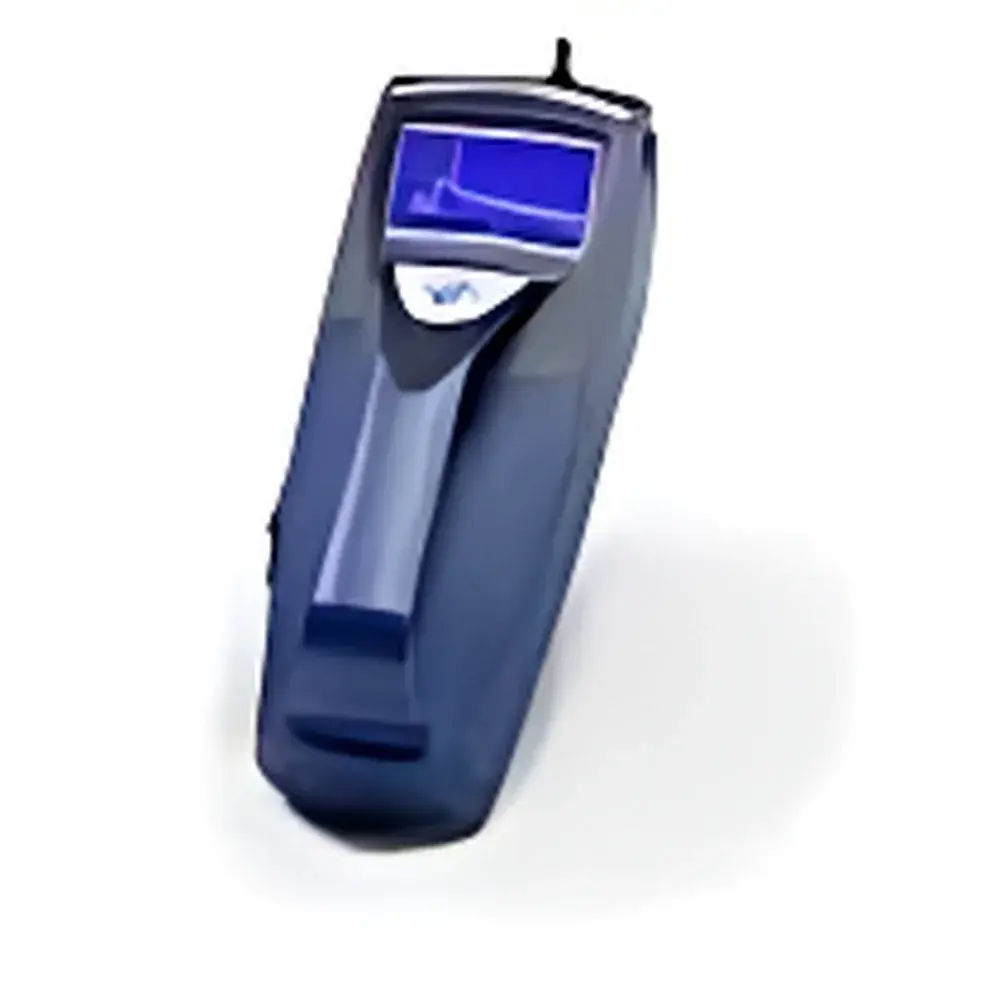
TSI DustTrak II Model 8532 Portable Aerosol Monitor
| Brand | TSI |
|---|---|
| Origin | USA |
| Model | DustTrak II 8532 |
| Measurement Principle | 90° Light Scattering |
| Particle Size Range | 0.1–10 µm |
| Mass Concentration Range | 0.001–150 mg/m³ |
| Resolution | ±0.1% of reading or 0.001 mg/m³ (whichever is greater) |
| Zero Stability | ±0.002 mg/m³ over 24 h (10-s averaging time) |
| Flow Rate | Factory-set at 3.0 L/min, user-adjustable from 1.40–3.0 L/min |
| Flow Accuracy | ±5% at factory-set point with internal flow control |
| Temperature Coefficient | +0.001 mg/m³/°C |
| Selectable Fractional Cuts | PM₁, PM₂.₅, PM₄, PM₁₀ (integrated sharp-cut cyclones) |
| Data Memory | 5 MB (>60,000 data points at 1-min interval |
| Recording Interval | 1 s–1 h, programmable |
| Time Constant | 1–60 s, user-selectable |
| Operating Humidity | 0–95% RH (non-condensing) |
| Storage Temperature | −20–60 °C |
| Dimensions (H×W×D) | 12.5 × 12.1 × 31.6 cm |
| Weight | 1.3 kg (bare), 1.5 kg (with Li-ion battery) |
| Display | 3.5″ VGA color touchscreen |
| Power | Rechargeable lithium-ion battery (internal/external charging) |
| Certifications | CPA certified (UK), CE compliant (EN 61326-1:2006 for immunity & emissions) |
| Alarm | Visual and audible (user-configurable setpoints, ±5% deadband) |
| Interface | USB port for data export |
Overview
The TSI DustTrak II Model 8532 is a portable, battery-powered aerosol mass concentration monitor engineered for real-time, gravimetrically correlated measurements of airborne particulate matter in occupational health, environmental monitoring, and industrial hygiene applications. Based on calibrated 90° light scattering photometry, the instrument provides continuous, quantitative readouts in mass concentration units (mg/m³) across four standardized inhalable fractions—PM₁, PM₂.₅, PM₄, and PM₁₀—using integrated, NIOSH- and ISO-compliant sharp-cut cyclone separators. Its optical design incorporates a sheath air system that isolates the sensing chamber from sampled aerosol, preventing lens contamination and ensuring long-term optical stability without routine cleaning. This architecture delivers high reproducibility (<±0.1% reading resolution), low zero drift (±0.002 mg/m³ over 24 h), and robust performance across diverse field conditions—from climate-controlled laboratories to high-dust construction sites and outdoor ambient networks.
Key Features
- Integrated fractional cyclone selection for PM₁, PM₂.₅, PM₄, and PM₁₀ with traceable calibration against reference gravimetric methods per ISO 7708 and EN 481
- Sheath-air-protected optical cavity enabling extended maintenance intervals and stable signal integrity under high-loading conditions
- 3.5″ VGA color touchscreen interface supporting both manual operation and fully programmable sampling protocols
- On-device statistical analysis—including real-time histograms, time-series plots, and summary metrics (mean, min/max, SD)—viewable during and post-sampling
- Configurable alarm logic with visual indicators and audible alerts (user-defined setpoints, ±5% hysteresis)
- Comprehensive status dashboard showing live diagnostics: pump flow rate, laser output, filter differential pressure, and sheath air integrity
- Preventive maintenance alerts including filter service indicators and automated zero-check prompts (optional zero module support)
- Internal 5 MB flash memory storing >60,000 data points at 1-minute intervals; exportable via USB to U-disk or PC
- Lithium-ion battery (1.5 kg total weight) supporting >8 hours of continuous operation; compatible with AC mains (115–240 VAC) and external DC sources
- CE-marked per EN 61326-1:2006 (electromagnetic compatibility) and UK CPA-certified for regulatory compliance in legally mandated monitoring contexts
Sample Compatibility & Compliance
The DustTrak II 8532 is validated for use with a broad spectrum of industrially relevant aerosols—including mineral dusts (e.g., silica, limestone), combustion-derived particulates (soot, fly ash), organic mists (oil, coolant), and ambient urban aerosols. Its PM₁₀ cyclone meets ISO 7708:1995 and EN 481:1993 specifications for inhalable fraction definition, while its PM₂.₅ cutpoint aligns with US EPA and EU PM₂.₅ regulatory criteria. The instrument supports isokinetic sampling via optional external probes and extension rods (up to 1.8 m), enabling access to ducts, ventilation grilles, and elevated work zones. All firmware and data logging routines comply with GLP-aligned audit trail requirements, and raw data files generated by TRAKPRO™ software include embedded timestamps, operator IDs, and configuration metadata—facilitating traceability in OSHA, MSHA, or EU REACH reporting frameworks.
Software & Data Management
Data acquisition, visualization, and reporting are managed through TSI’s TRAKPRO™ Desktop Software (v5.x or later), a Windows-based application qualified for FDA 21 CFR Part 11 compliance when deployed with appropriate organizational controls (electronic signatures, audit logs, role-based access). TRAKPRO™ enables batch processing of multi-instrument datasets, automatic application of user-defined calibration factors, and generation of PDF reports conforming to ISO/IEC 17025 documentation standards. Field data can be synchronized wirelessly via optional Bluetooth modules or transferred directly via USB. All stored records retain native precision (0.001 mg/m³ resolution), time-stamped to ±1 second, and tagged with instrument serial number, calibration date, and selected size fraction—ensuring full chain-of-custody integrity for third-party audits or regulatory submissions.
Applications
- Occupational exposure assessment per OSHA Method ID-253 and NIOSH Method 0600 for respirable and total dust
- Construction site dust management (PM₁₀ compliance monitoring near excavation, demolition, and paving operations)
- Indoor air quality (IAQ) surveys in offices, schools, and healthcare facilities using PM₂.₅ as a proxy for combustion-related pollutants
- Process validation and engineering controls verification in pharmaceutical cleanrooms and semiconductor fabrication environments
- Ambient air quality network supplementation where real-time, low-cost PM monitoring complements reference-grade beta attenuation monitors (BAMs)
- Emergency response deployment for rapid hazard mapping following wildfire smoke incursions or industrial particulate releases
FAQ
Does the DustTrak II 8532 require annual recalibration?
Yes. While the instrument maintains zero stability within ±0.002 mg/m³ over 24 hours, TSI recommends annual field calibration against NIST-traceable reference aerosols (e.g., Arizona Test Dust, PSL spheres) per ISO 17025-accredited procedures to ensure continued accuracy across the full 0.001–150 mg/m³ range.
Can it be used for regulatory compliance reporting in the EU?
The CPA certification (UK) and CE marking confirm conformity with applicable electromagnetic compatibility and safety directives. However, for legally binding ambient PM₁₀ or PM₂.₅ reporting under EU Directive 2008/50/EC, the instrument serves best as a screening tool; definitive compliance requires co-location with reference-grade FRM/FEM analyzers.
Is the data format compatible with LIMS integration?
TRAKPRO™ exports CSV and XML files containing all measured parameters, metadata, and QC flags. These formats are readily ingestible by most Laboratory Information Management Systems (LIMS) via standard import modules or custom API adapters.
What maintenance is required beyond filter replacement?
Routine maintenance includes quarterly inspection of the sheath air filter and main sample pump filter, biannual verification of flow rate with a primary calibrator (e.g., TSI 4045), and annual optical alignment check using TSI’s factory service protocol. No optical cleaning is needed under normal operating conditions due to the sheath air barrier.
How does the time constant setting affect measurement fidelity?
The user-selectable time constant (1–60 s) determines the exponential averaging window applied to raw scatter signals. Shorter constants improve responsiveness to transient spikes (e.g., welding fumes), while longer values suppress noise in stable environments—without altering the fundamental calibration relationship between scattered light intensity and mass concentration.







