
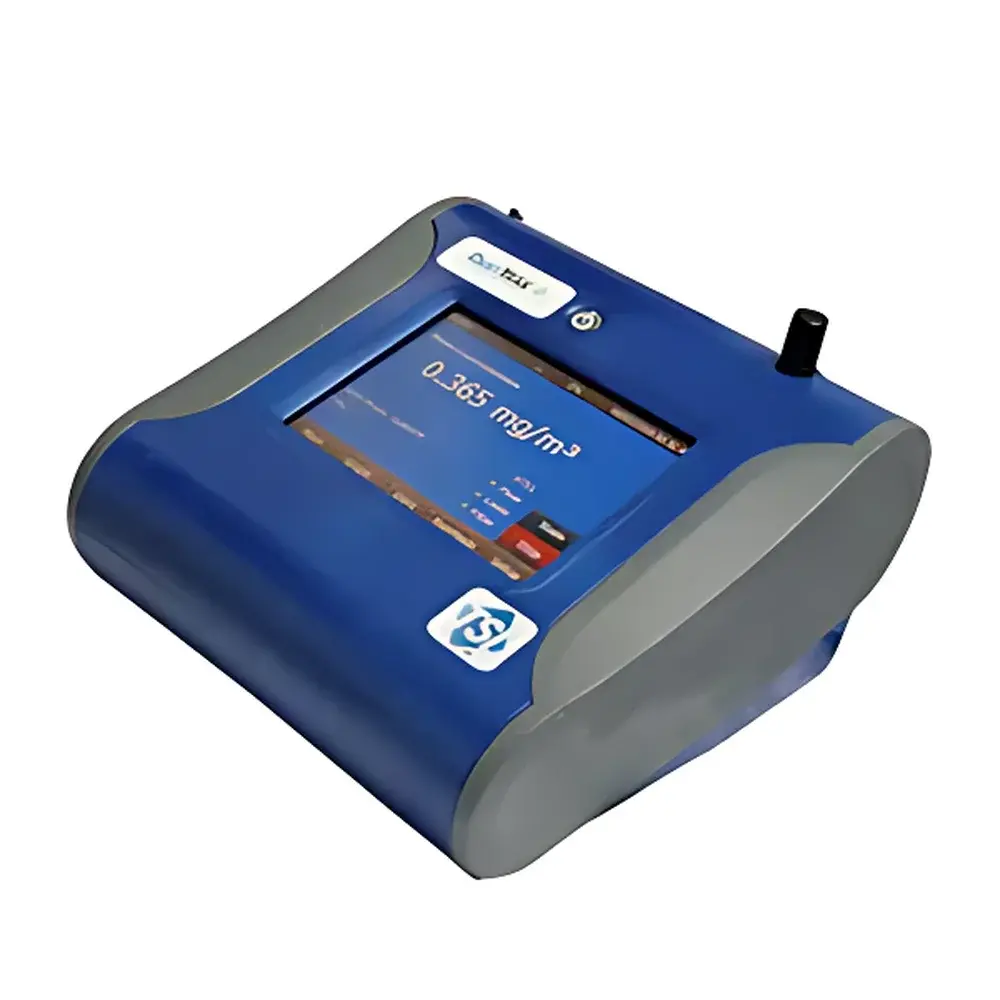
TSI Model 8533/8534 Real-Time Aerosol Monitor
| Brand | TSI |
|---|---|
| Origin | USA |
| Model | 8533/8534 |
| Measurement Principle | 90° Light Scattering (650 nm Laser Diode) |
| Safety Rating | Intrinsically Safe (Class I, Division 1, Groups A–D) |
| Concentration Range | 0.001–100 mg/m³ |
| Resolution | 0.001 mg/m³ |
| Accuracy | ±10% of reading (traceable to ISO 12103-1 A1 test dust) |
| Relative Error | ≤±2% |
| Particle Size Range | 0.1–10 µm |
| Flow Rate | Adjustable 0–1.8 L/min |
| Operating Temperature | 0–50 °C |
| Storage Temperature | −20–60 °C |
| Humidity Range | 0–95% RH (non-condensing) |
| Data Logging Capacity | ~80,000 points |
| Battery Life | >20 h @ 1.7 L/min with PM₂.₅ cyclone |
| Time Constant Options | 1, 5, 10, 15, 30 s |
| Alarm Outputs | Audible (95 dB), Visual (flashing red LED & OLED), Configurable Thresholds (0.001–999 mg/m³) |
Overview
The TSI Model 8533/8534 Real-Time Aerosol Monitor is an intrinsically safe, battery-powered instrument engineered for continuous, quantitative measurement of airborne particulate mass concentration across multiple aerodynamic size fractions. Based on calibrated 90° light scattering photometry using a 650 nm laser diode, the system delivers real-time, traceable mass concentration data—expressed in mg/m³—for respirable, thoracic, and inhalable aerosol fractions. Its core optical architecture employs a proprietary sheath-air isolation system that physically separates sampled aerosol from the optical detection chamber, preventing contamination of critical optical surfaces and ensuring long-term signal stability without routine lens cleaning. Designed for compliance with occupational hygiene standards—including OSHA PELs, ACGIH TLVs®, and ISO 7708 for particle-size-selective sampling—the 8533/8534 operates as both a personal exposure monitor and a fixed-area surveillance tool across industrial hygiene, construction safety, mining, manufacturing, and environmental field studies.
Key Features
- Intrinsically safe certification (UL/cUL Class I, Division 1, Groups A–D) for use in hazardous locations where flammable gases or vapors may be present
- Simultaneous real-time reporting of mass concentrations for five size-selective fractions: PM₁, PM₂.₅, inhalable, PM₁₀, and total PM (<15 µm)
- Integrated, user-replaceable size-selective inlets: PM₁.₀, PM₂.₅, PM₅.₀, and PM₁₀ cyclones; plus optional Dorr-Oliver (4 µm) and DPM (0.8 µm) cyclones for specialized respirable dust monitoring
- Graphical color touchscreen interface with intuitive navigation, on-device zero calibration (with optional Zero Module), and adjustable time constants (1–30 s) for dynamic environments
- High-fidelity data logging: up to 80,000 timestamped records with configurable intervals (1 s to 30 min); full traceability via TrakPro™ software
- Robust thermal and humidity compensation algorithms validated over 0–50 °C and 0–95% RH (non-condensing), minimizing drift under field conditions
- Auto-zero stabilization: ≤±0.001 mg/m³ drift over 24 h (10 s time constant); temperature coefficient: +0.0005 mg/m³/°C relative to last zero point
Sample Compatibility & Compliance
The 8533/8534 is validated for use with ambient and workplace aerosols including mineral dusts (e.g., silica, coal, limestone), metal fumes, welding smoke, biomass combustion particles, and industrial process mists. Calibration follows ISO 12103-1 using A1 test dust, with gravimetric reference methods applied for respirable fraction validation. The instrument supports compliance workflows aligned with OSHA Method ID-125G, NIOSH Method 0600, and EN 481. Its data output structure and audit trail capabilities—via TrakPro™ software—facilitate GLP/GMP-aligned recordkeeping and support FDA 21 CFR Part 11 requirements when deployed with appropriate electronic signature and access control configurations. All size-selective inlets are certified to meet ISO 13137 performance criteria for cyclone efficiency curves.
Software & Data Management
Data acquisition, configuration, and reporting are managed through TSI’s TrakPro™ v5 software (Windows® 7/8/10, 32-/64-bit). TrakPro enables full instrument setup—including alarm thresholds (configurable from 0.001–999 mg/m³), logging intervals, custom correction factors (5 user-defined sets), and label assignment. Raw and processed data export to CSV, Excel, and PDF formats includes metadata (instrument ID, operator, location, calibration date, inlet type). Audit logs capture all parameter changes, zero events, and alarm triggers with timestamps and user IDs. Software-generated reports conform to industrial hygiene reporting templates and support integration into enterprise EHS platforms via standardized data schemas.
Applications
- Occupational exposure assessment during sandblasting, grinding, demolition, and tunneling operations
- Real-time feedback for engineering controls validation (e.g., local exhaust ventilation efficacy)
- Indoor air quality surveys in schools, offices, and healthcare facilities
- Construction site dust monitoring per EPA and local regulatory action levels
- Respirable crystalline silica (RCS) monitoring in foundries, pottery, and stone fabrication
- Field validation of filter efficiency and containment integrity in pharmaceutical cleanrooms
- Long-term ambient particulate trend analysis in urban and peri-urban environments
FAQ
What size fractions does the 8533/8534 measure simultaneously?
It measures PM₁, PM₂.₅, inhalable, PM₁₀, and total PM (<15 µm) in real time—each using its respective certified size-selective inlet.
Is the instrument suitable for explosive atmospheres?
Yes. It carries UL/cUL intrinsic safety certification for Class I, Division 1, Groups A–D, permitting deployment in hydrocarbon processing, chemical plants, and grain handling facilities.
How is calibration traceability established?
Calibration is performed against ISO 12103-1 A1 test dust using gravimetric reference methods; factory calibration certificates include uncertainty budgets and NIST-traceable references.
Can data be exported for regulatory submission?
Yes. TrakPro generates audit-ready files with full metadata, change logs, and electronic signatures compliant with OSHA, MSHA, and EU REACH documentation requirements.
What maintenance is required for optical stability?
The sheath-air system eliminates optical fouling; only periodic inlet cleaning and annual verification of flow rate and zero stability are recommended per TSI’s PM-8533/8534 Maintenance Protocol.
Related Products







