
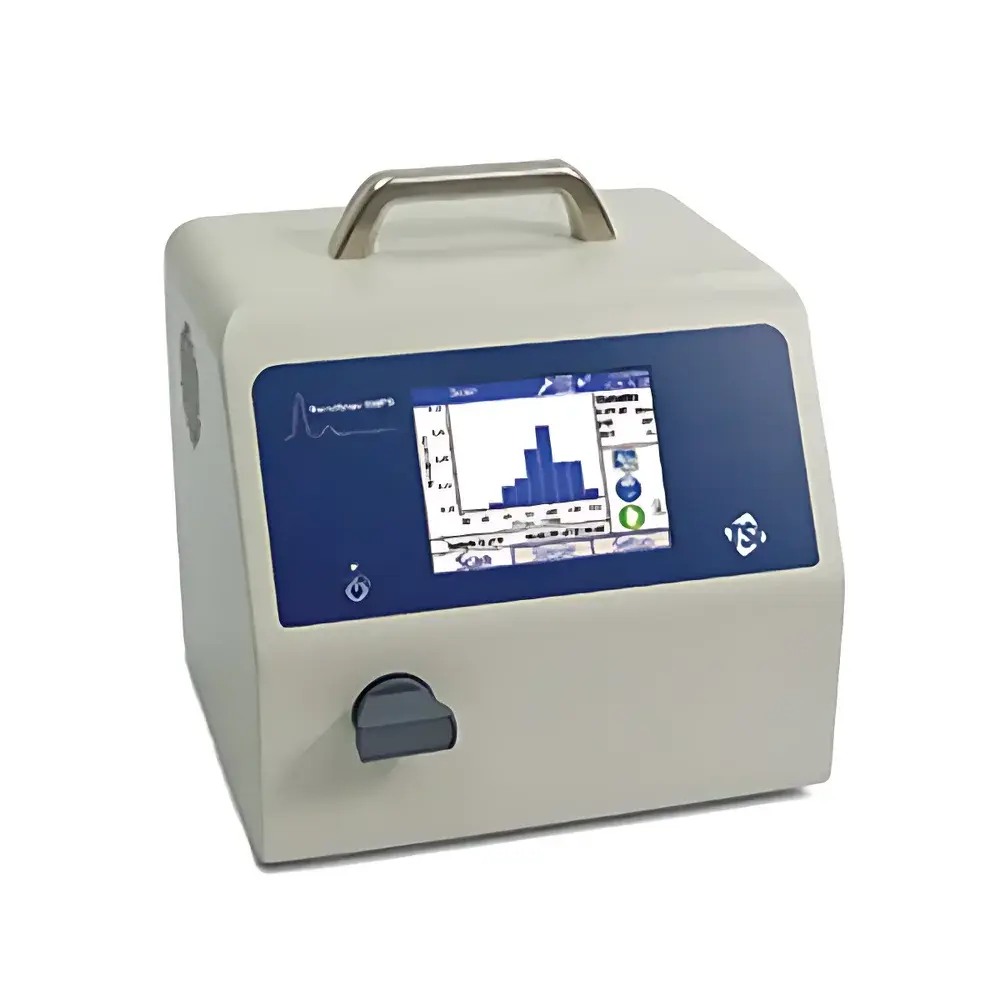
TSI NanoScan SMPS Model 3910 Scanning Mobility Particle Sizer
| Brand | TSI |
|---|---|
| Origin | USA |
| Model | 3910 |
| Particle Size Range | 10–420 nm |
| Measurement Modes | Scanning (size distribution) & Single-Size (concentration) |
| Size Channels | 13 |
| Scan Time | 60 s (45 s forward, 15 s reverse) |
| Single-Size Resolution | 1 s |
| Max Concentration | 1×10⁶ particles/cm³ |
| Inlet Flow Rate | 0.75 L/min ±20% |
| Sample Flow Rate | 0.25 L/min ±10% |
| Condensing Fluid | High-purity isopropanol (≥99.5%) |
| Zero Count | ≤0.01 particles/cm³ |
| Data Storage | Internal (3–8 days), USB optional |
| Display | Color touchscreen |
| Warm-up Time | <15 min |
| Battery Life | ~6 h (hot-swappable rechargeable) |
Overview
The TSI NanoScan SMPS Model 3910 is a compact, field-deployable Scanning Mobility Particle Sizer system engineered for high-temporal-resolution measurement of nanoparticle size distributions in the 10–420 nm range. It operates on the principle of differential mobility analysis (DMA), where charged aerosol particles are classified by electrical mobility in a laminar flow annular classifier, followed by quantitative detection using a condensation particle counter (CPC). This electrostatic classification method enables traceable, calibration-free sizing under ambient or controlled conditions—without reliance on radioactive sources. Designed for real-time environmental and occupational monitoring, the Model 3910 delivers laboratory-grade mobility-based size distribution data with field-portable robustness, supporting both regulatory compliance assessments and fundamental aerosol process studies.
Key Features
- True scanning mobility sizing from 10 nm to 420 nm with 13 discrete size channels per scan
- Dual operational modes: full-size-distribution scanning (60 s per scan, including 45 s classification sweep and 15 s return cycle) and single-size concentration monitoring (1 s temporal resolution)
- Integrated vacuum pump, CPC, DMA, and isopropanol-based condensation system—all housed in a single, self-contained unit
- Hot-swappable, rechargeable lithium-ion battery enabling up to 6 hours of continuous operation—ideal for mobile source characterization, indoor air quality surveys, and workplace exposure mapping
- Onboard color touchscreen interface with intuitive menu navigation and real-time graphical display of size-resolved concentration trends
- Built-in non-volatile memory supporting 3–8 days of continuous logging (depending on sampling frequency); expandable via USB flash drive
- No radioactive materials required—compliant with international transport regulations and institutional radiation safety policies
- Fast warm-up (<15 minutes) and automated zero-check routine (≤0.01 particles/cm³ background count)
Sample Compatibility & Compliance
The NanoScan SMPS Model 3910 accepts ambient, diluted, or duct-sampled aerosols without pre-conditioning beyond standard inlet filtration (e.g., 0.2 µm PTFE membrane for coarse particle removal). It is compatible with gaseous matrices containing common atmospheric constituents (N₂, O₂, CO₂, H₂O vapor) and low-concentration volatile organic compounds, provided condensable vapor load remains below saturation thresholds for isopropanol-based CPC operation. The instrument meets performance benchmarks referenced in ISO 27891:2018 (aerosol instrumentation—requirements for mobility particle sizers), ASTM D8196-21 (standard practice for measuring airborne nanoparticle size distributions), and supports GLP-compliant data acquisition when paired with timestamped, audit-trail-enabled NanoScan Data Management Software. Its design facilitates adherence to OSHA and NIOSH recommended exposure limits (RELs) for ultrafine particles and aligns with EPA’s research protocols for source apportionment and atmospheric nucleation event analysis.
Software & Data Management
NanoScan Data Management Software (included) provides secure, timestamped data acquisition, visualization, and export capabilities. Raw mobility voltage scans, size-binned concentration time series, and metadata (flow rates, temperature, pressure, battery status) are logged in structured CSV and HDF5 formats suitable for post-processing in MATLAB, Python (pandas, xarray), or R environments. The software supports configurable alarm thresholds, automated report generation (PDF/Excel), and integration with TSI’s AEROSOL DASHBOARD™ for multi-instrument fleet monitoring. All data files include embedded instrument serial number, firmware version, and operator-defined site tags—enabling full traceability per FDA 21 CFR Part 11 requirements when deployed in regulated industrial hygiene or pharmaceutical cleanroom validation workflows.
Applications
- Occupational health monitoring: Real-time assessment of worker exposure to engine exhaust, welding fumes, nanomaterial handling, and 3D printing emissions
- Ambient air quality research: Characterization of nucleation-mode particles during photochemical smog events, biomass burning plumes, and urban traffic corridors
- Indoor environment studies: Quantifying nanoparticle penetration through HVAC filters, emission profiles from laser printers and cooking appliances, and ventilation efficiency metrics
- Nanotechnology development: In-process monitoring of nanoparticle synthesis reactors, spray-drying operations, and dry powder inhaler dispersion testing
- Mobile platform deployment: Integration into vehicle-mounted or drone-based air quality monitoring systems for spatially resolved emission mapping
- Toxicological exposure modeling: Providing input parameters (number concentration, geometric mean diameter, GSD) for dosimetry models such as MPPD and ICRP lung deposition algorithms
FAQ
Does the NanoScan SMPS Model 3910 require radioactive neutralization?
No—it uses a soft X-ray charger (TSI Model 3077A) that complies with IEC 61000-4-3 immunity standards and eliminates regulatory burdens associated with radioactive sources.
Can it operate unattended for extended periods?
Yes—when connected to external power and configured with optional USB storage, it supports continuous logging for weeks; internal memory retains ≥3 days at 1-min scan intervals.
Is calibration traceable to national standards?
Yes—DMA transfer function is factory-calibrated against NIST-traceable reference aerosols (e.g., PSL, silver nanoparticles); users may perform periodic verification using TSI’s Calibration Verification Kit (PN# 8030792).
What maintenance is required for the isopropanol condensation system?
The fluid reservoir requires refilling every ~8 hours at 21°C; use only ≥99.5% purity anhydrous isopropanol to prevent CPC nozzle fouling and ensure stable 50% detection efficiency at 10 nm.
How does it handle high-concentration aerosols?
An integrated dilution module (optional PN# 3910-DIL) extends dynamic range to 1×10⁷ particles/cm³ while preserving size resolution and counting linearity.







