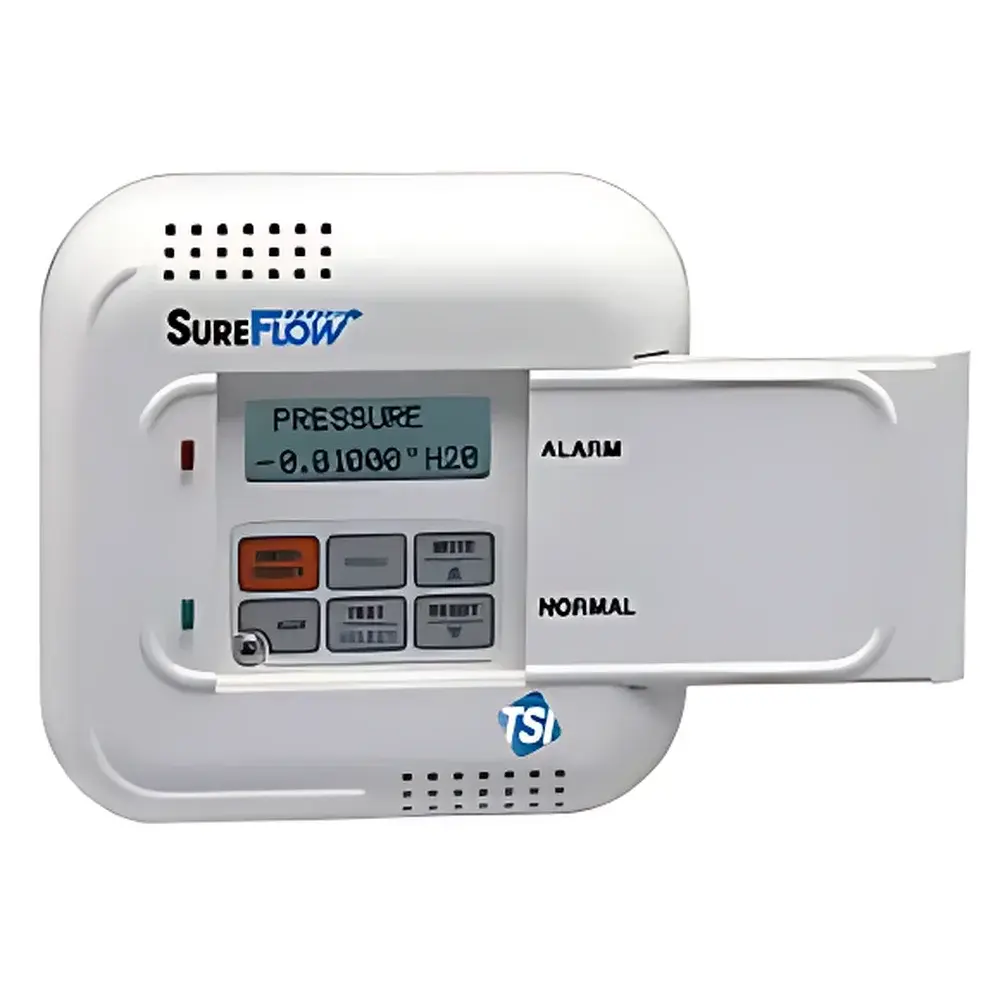
TSI SureFlow™ 8636 Room Pressure Controller
| Brand | TSI |
|---|---|
| Origin | USA |
| Model | 8636 |
| Compliance | NFPA 45-2000, ANSI Z9.5-2003 |
| Communication Protocol | MODBUS RTU (open standard) |
| Power Input | 120 VAC, output: 24 VAC |
| Sensor Type | Wall-mounted differential pressure transducer |
| Control Outputs | Dual analog (0–10 VDC or 4–20 mA) for supply & exhaust dampers, auxiliary outputs for heating/cooling control |
| Alarm Interface | Relay output with visual & audible alert |
| Enclosure Rating | NEMA 1 (indoor use) |
| Operating Temperature | 0–50 °C |
| Relative Humidity | 10–90 % RH (non-condensing) |
Overview
The TSI SureFlow™ 8636 Room Pressure Controller is an engineered solution for maintaining precise, stable differential pressure in laboratory environments where containment integrity and personnel safety are mission-critical. Designed specifically for laboratories equipped with fume hoods and variable air volume (VAV) ventilation systems, the 8636 employs direct, real-time measurement of room-to-corridor or room-to-ambient pressure differentials—typically in the range of –0.01 to +0.05 in. w.c. (–2.5 to +12.5 Pa)—to execute closed-loop control over supply and exhaust airflow. Its core operational principle relies on continuous feedback from a calibrated, wall-mounted differential pressure sensor, enabling dynamic adjustment of VAV terminal units and damper actuators to sustain target pressure setpoints under varying occupancy, hood sash positions, and HVAC load conditions. Unlike pressure-independent airflow controllers, the 8636 prioritizes room static pressure as the primary controlled variable—ensuring compliance with fundamental life-safety and chemical exposure prevention mandates defined in NFPA 45-2000 (Standard on Fire Protection for Laboratories Using Chemicals) and ANSI Z9.5-2003 (Laboratory Ventilation). It operates as a standalone, hardwired controller but is architected for seamless integration into broader building automation systems (BAS) without requiring proprietary gateways.
Key Features
- Direct differential pressure sensing via included wall-mount transducer—eliminates reliance on inferred airflow calculations or duct static pressure proxies
- Dual independent analog outputs (0–10 VDC or 4–20 mA configurable) for simultaneous, coordinated control of supply air and total exhaust dampers
- Integrated thermal management logic: modulates preheat coil and cooling coil actuation to maintain minimum air change rates (ACH) and space temperature setpoints per ASHRAE 110 and laboratory design specifications
- Local HMI with backlit LCD display and membrane keypad—enables full configuration, setpoint adjustment, alarm acknowledgment, and real-time status review without external software
- Configurable password protection (user-defined access levels) safeguards calibration parameters, control algorithms, and system configuration from unauthorized modification
- Fail-safe relay output with visual LED indicator and built-in audible alarm—activates on deviation beyond user-defined deadband, loss of sensor signal, or actuator fault detection
Sample Compatibility & Compliance
The SureFlow 8636 is validated for use in general chemistry, pharmaceutical R&D, and biosafety level 1–2 (BSL-1/2) laboratories where negative or slightly positive room pressure must be maintained relative to adjacent corridors or anterooms. It supports pressure setpoints down to –15 Pa (–0.06 in. w.c.) for containment-critical zones and up to +10 Pa (+0.04 in. w.c.) for cleanroom-adjacent preparation areas. All firmware logic and alarm thresholds comply with the functional safety requirements outlined in NFPA 45-2000 Section 5.3 (Ventilation System Monitoring) and ANSI Z9.5-2003 Clause 6.3.2 (Room Pressure Monitoring and Alarms). The device’s analog I/O architecture meets IEC 61000-6-2 (immunity) and IEC 61000-6-4 (emissions) standards for industrial environments. While not certified to UL 61010-1 or IEC 61508, its deterministic control loop execution and hardware watchdog timer support GLP-aligned operational documentation and audit readiness.
Software & Data Management
The 8636 operates autonomously without embedded software updates or cloud connectivity. Configuration and diagnostics are performed exclusively via the front-panel interface or through MODBUS RTU serial communication (RS-485, 9600 baud, 8N1). This open protocol enables bidirectional data exchange—including real-time pressure readings, damper positions, alarm status, and setpoint history—with third-party BAS platforms such as Siemens Desigo, Honeywell Enterprise Buildings Integrator, or Tridium Niagara. No proprietary drivers or middleware are required. Event logging is limited to local relay activation timestamps; persistent data storage or trend recording requires integration with the host BAS historian. For FDA-regulated facilities, the controller supports 21 CFR Part 11–compliant audit trails when paired with a validated BAS that provides electronic signature, change tracking, and role-based access control at the supervisory layer.
Applications
- Chemistry teaching and research labs requiring consistent negative pressure to prevent vapor migration from fume hood workstations
- Pharmaceutical formulation suites where ISO 14644-compliant pressure cascades must be enforced between gowning, preparation, and dispensing rooms
- Hospital clinical laboratories performing toxicology or hazardous drug compounding under USP and environmental controls
- University core facilities housing electron microscopy or mass spectrometry instrumentation sensitive to air turbulence and particulate ingress
- Government defense labs handling low-volatility organophosphates or metal hydrides under DoD Directive 6055.1 safety protocols
FAQ
Does the 8636 require recalibration after installation?
No—factory-calibrated pressure sensor and internal electronics are designed for long-term stability; however, annual verification against a NIST-traceable reference manometer is recommended per ISO/IEC 17025 quality system requirements.
Can the 8636 control both VAV boxes and electric reheat coils simultaneously?
Yes—the unit provides four configurable analog outputs: two dedicated to supply/exhaust dampers, and two auxiliary outputs assignable to heating valve or cooling coil actuators.
Is the MODBUS implementation certified by the Modbus Organization?
The 8636 implements MODBUS RTU as a slave device conforming to Modbus Application Protocol v1.1b; it is not formally certified but interoperates reliably with all major MODBUS master implementations.
What happens during a power outage?
The controller retains all configuration and setpoint data in non-volatile memory; upon power restoration, it resumes control within ≤2 seconds without manual reset.
Is the wall-mounted pressure sensor included with the base unit?
Yes—the kit includes a calibrated differential pressure transducer, 25-ft shielded cable, and mounting hardware; sensor range is fixed at ±25 Pa (±0.1 in. w.c.) standard.