
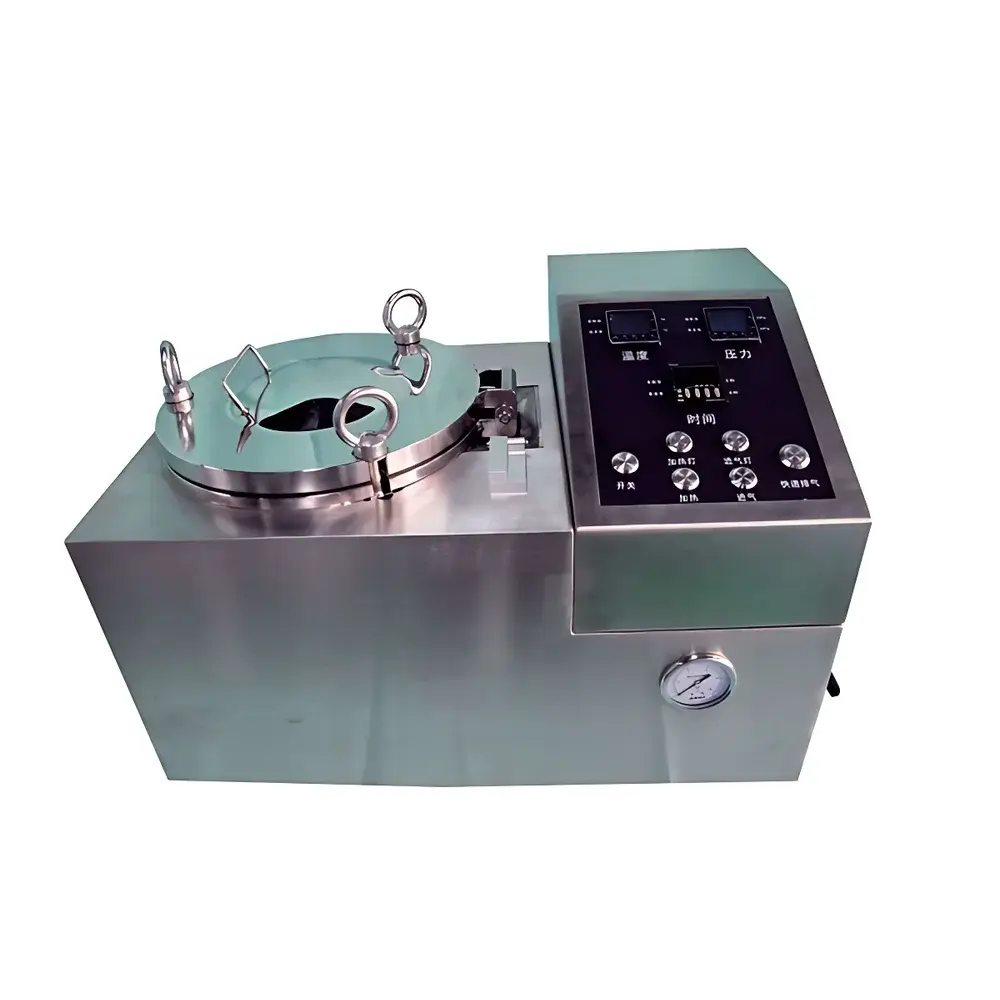
TSIKER Syn-AJY-5L Gas-Phase Ammonolysis Instrument for DNA/RNA Oligonucleotide Deprotection
| Brand | TSIKER |
|---|---|
| Origin | Beijing, China |
| Manufacturer | TSIKER Biotech Co., Ltd. |
| Model | Syn-AJY-5L |
| Pressure Rating | 550 kPa (safety limit) with triple safety protection |
| Max Operating Pressure | 600 kPa (auto rapid vent) |
| Temperature Control Range | Ambient to 90 °C |
| Throughput | Dual 96-well plates (192 oligonucleotide strands per run) |
| Deprotection Efficiency | ≥99% under standard 90 °C / 2 h protocol |
| Dimensions | 600 × 400 × 400 mm (L×W×H) |
| Weight | 40 kg |
| Safety Features | Electronic overpressure alarm, automatic gas cutoff, mechanical pressure relief valve |
| End-of-cycle Alert | Audible tone |
Overview
The TSIKER Syn-AJY-5L Gas-Phase Ammonolysis Instrument is an engineered solution for the controlled, high-throughput deprotection of solid-phase synthesized DNA and RNA oligonucleotides. It operates on the principle of gas-phase ammonolysis—exposing immobilized oligonucleotide-bound synthesis supports (e.g., CPG or polystyrene beads in 96-well plates) to saturated ammonia vapor under precisely regulated temperature and pressure conditions. Unlike liquid-phase deprotection—which requires large volumes of concentrated aqueous ammonia and extended incubation times—the Syn-AJY-5L enables rapid, uniform cleavage of base-labile protecting groups (e.g., benzoyl for adenine/cytosine, isobutyryl for guanine) and linker hydrolysis via thermally accelerated nucleophilic substitution in the vapor phase. This method minimizes side reactions such as depurination, improves batch-to-batch reproducibility, and eliminates solvent handling hazards associated with bulk ammonium hydroxide.
Key Features
- Dual 96-well plate capacity supporting parallel processing of up to 192 oligonucleotide synthesis columns per cycle—optimized for high-throughput core facilities and contract research organizations (CROs).
- Integrated pressure-regulated reaction chamber with dual-stage safety architecture: electronic pressure monitoring triggers automatic gas shutoff at 550 kPa; a redundant mechanical pressure relief valve activates at 600 kPa for fail-safe rapid venting.
- Precise digital PID temperature control (range: ambient to 90 °C ±0.5 °C), ensuring consistent thermal energy delivery across all wells and eliminating cold spots that compromise deprotection completeness.
- Automated end-of-cycle acoustic alert with configurable duration, enabling unattended operation while maintaining traceability in GLP-compliant environments.
- Stainless-steel reaction vessel and sealed gasket system resistant to ammonia corrosion, validated for >5,000 operational cycles under routine maintenance protocols.
- Compact footprint (600 × 400 × 400 mm) designed for integration into automated nucleic acid synthesis workflows—including compatibility with robotic liquid handlers and plate stackers.
Sample Compatibility & Compliance
The Syn-AJY-5L accommodates industry-standard 96-well synthesis plates containing controlled-pore glass (CPG), macroporous polystyrene (MPPS), or other solid supports functionalized with universal or gene-specific linkers (e.g., succinyl, oxalyl, or universal support III). It is compatible with phosphoramidite-based DNA, RNA, and modified oligonucleotide syntheses—including those incorporating 2′-O-methyl, LNA, phosphorothioate, or fluorescent dye-labeled monomers. The instrument meets essential mechanical safety requirements per ISO 13857 (safety distances) and incorporates design elements aligned with IEC 61010-1 for laboratory electrical equipment. While not certified as a medical device, its operational parameters support compliance with USP <1058> Analytical Instrument Qualification frameworks and facilitate audit readiness for FDA 21 CFR Part 11–governed data integrity practices when paired with validated electronic log systems.
Software & Data Management
The Syn-AJY-5L operates via embedded firmware with a tactile LCD interface—no external PC required for basic operation. All critical process parameters (set temperature, actual chamber temperature, elapsed time, internal pressure, cycle status) are logged internally with timestamping and stored in non-volatile memory for ≥1,000 cycles. Optional RS-485 or Ethernet module enables integration into centralized laboratory information management systems (LIMS) for automated data export in CSV or XML format. Audit trail functionality records user ID (via optional RFID badge reader), parameter changes, and safety event logs—including pressure excursions, temperature deviations, and manual aborts—supporting ALCOA+ data integrity principles (Attributable, Legible, Contemporaneous, Original, Accurate, Complete, Consistent, Enduring, Available).
Applications
- Routine deprotection of DNA oligos synthesized on automated synthesizers (e.g., ABI 394, BioAutomation MerMade, or CP GENE machines) prior to HPLC or PAGE purification.
- High-fidelity RNA oligonucleotide processing where minimized depurination is critical—especially for long (>60mer) or GC-rich sequences.
- Scalable support for antisense oligonucleotide (ASO), siRNA, and CRISPR guide RNA manufacturing in preclinical development labs.
- Deprotection of specialty probes including molecular beacons, TaqMan primers, and qPCR standards requiring strict lot-to-lot consistency.
- Integration into end-to-end oligonucleotide production lines—paired with TSIKER’s Syn-HP series synthesizers and Prep-Pure purification platforms for seamless workflow continuity.
FAQ
What types of solid supports are compatible with the Syn-AJY-5L?
Standard CPG, MPPS, and derivatized polystyrene supports used in phosphoramidite chemistry are fully supported. Custom support geometries require validation against chamber sealing integrity.
Can the instrument handle ammonia gas generated from ammonium hydroxide solutions?
Yes—the system is designed to accept either pre-vaporized ammonia gas or liquid ammonium hydroxide (28–30% w/w) placed in the reservoir; vapor generation occurs in situ under heated, pressurized conditions.
Is remote monitoring or control possible?
With the optional communication module, real-time parameter streaming and cycle initiation/termination are supported via Modbus TCP or custom API endpoints.
How is calibration verified?
Temperature sensors are factory-calibrated against NIST-traceable references; users may perform field verification using calibrated PT100 probes inserted through the auxiliary port.
Does the system comply with explosion-proof requirements for Class I, Division 1 environments?
No—it is rated for general laboratory use per IEC 61010-1. Installation in hazardous locations requires additional engineering controls and third-party certification.




