
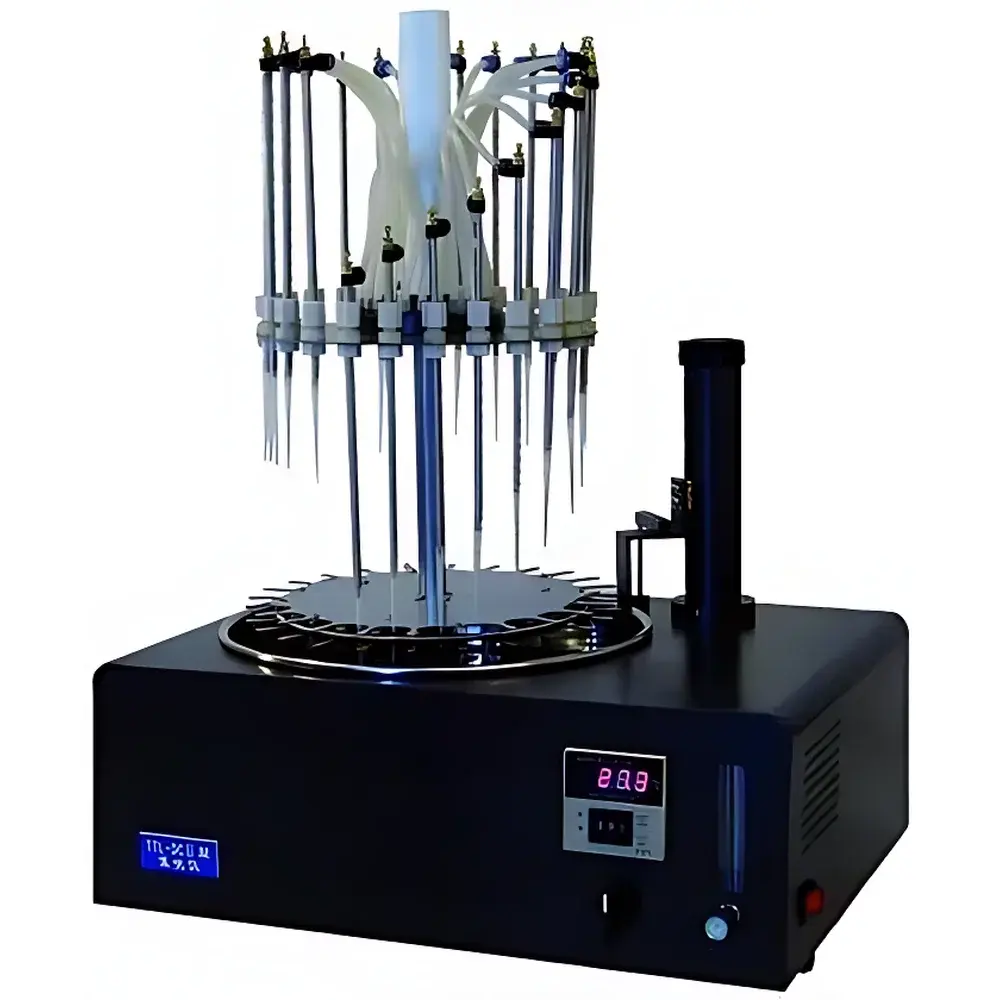
TTL DCII Nitrogen Evaporator
| Brand | TTL |
|---|---|
| Origin | Beijing, China |
| Manufacturer Type | Direct Manufacturer |
| Region of Origin | Domestic (China) |
| Model | TTL-DCII |
| Price Range | USD 2,800–5,600 |
| Heating Method | Water Bath |
| Temperature Range | 0–99.9 °C |
| Temperature Stability | ±1 °C |
| Sample Tube Diameter Compatibility | 10–29 mm |
| Gas Flow Rate | 0–15 L/min |
| Sample Capacity | 24 positions |
| Heating Power | 1000 W |
| Display | Digital LED |
| Dimensions (W×D×H) | 535 × 390 × 620 mm |
| Nitrogen Consumption per Sample | 330 mL/min |
| Optional Accessory | 12-position rack for vessels Ø30–55 mm |
Overview
The TTL DCII Nitrogen Evaporator is an engineered solution for gentle, reproducible solvent removal in analytical laboratories. It operates on the principle of inert gas-assisted surface evaporation—introducing a controlled stream of nitrogen or compressed air directly above liquid samples immersed in a precisely regulated water bath. This method accelerates solvent volatilization by reducing local vapor pressure and enhancing mass transfer at the liquid–gas interface, without subjecting thermally sensitive analytes to excessive thermal stress. Unlike dry-block or infrared-based concentrators, the TTL DCII employs uniform water-bath heating (0–99.9 °C), ensuring minimal temperature gradients across all 24 sample positions. Its design conforms to standard laboratory workflows for preparative chromatography, environmental residue analysis, clinical toxicology, and food safety testing—where quantitative recovery, low blank levels, and inter-run consistency are critical.
Key Features
- 24-position stainless-steel sample holder with motorized vertical lift mechanism for ergonomic access and repeatable positioning.
- Individually adjustable height and gas flow control for each of 24 stainless-steel or PTFE-coated吹气针 (gas delivery needles), enabling precise optimization per sample matrix.
- Dual-mode gas supply: compatible with nitrogen (recommended) or filtered compressed air; integrated needle valve and digital flow meter (0–15 L/min range) provide real-time total gas consumption readout.
- Water bath system with 1000 W heating element and PID temperature controller ensures ±1 °C stability across the full 0–99.9 °C operating range; digital LED display shows setpoint and actual bath temperature.
- Universal tube compatibility: accommodates round-bottom tubes, centrifuge tubes, and conical vials with outer diameters from 10 to 29 mm; optional 12-position adapter supports larger vessels (Ø30–55 mm).
- Corrosion-resistant construction: all wetted and structural components fabricated from electropolished 316 stainless steel or PTFE-coated aluminum; fully compliant with ISO 8573-1 Class 2 compressed air purity requirements when used with appropriate filtration.
- Modular needle assembly allows rapid disassembly, ultrasonic cleaning, or replacement with disposable PTFE-tipped nozzles to eliminate cross-contamination between batches.
Sample Compatibility & Compliance
The TTL DCII supports routine use with aqueous, organic, and mixed-phase extracts—including methanol, acetonitrile, ethyl acetate, hexane, and chloroform solutions—common in EPA Method 525.3, ISO 17070, and AOAC 2007.01 workflows. Its water-bath architecture avoids hot-spot formation, making it suitable for analytes with boiling points below 100 °C (e.g., pesticides, PAHs, pharmaceutical residues). All materials meet USP Class VI biocompatibility criteria. While not certified for GMP environments out-of-the-box, the unit’s mechanical repeatability, traceable temperature calibration capability, and absence of electronic data logging make it suitable for GLP-compliant labs when paired with external validation protocols (e.g., IQ/OQ documentation per ASTM E2500). No embedded software or network connectivity is present, eliminating 21 CFR Part 11 compliance obligations.
Software & Data Management
The TTL DCII operates as a stand-alone electromechanical instrument with no firmware, embedded OS, or digital connectivity. Temperature setpoints and gas flow rates are adjusted manually via front-panel controls; all operational parameters are recorded externally using lab notebooks or LIMS-integrated log sheets. For audit readiness, users may perform periodic calibration verification using NIST-traceable RTDs and calibrated flow meters. The device includes no automated data export, cloud upload, or audit trail functionality—consistent with its classification as a Class I laboratory support instrument under IEC 61010-1.
Applications
- Concentration of environmental water extracts prior to GC-MS analysis of semi-volatile organics (SVOCs).
- Preparative cleanup in multi-residue pesticide methods (e.g., QuEChERS) for fruits, vegetables, and soil matrices.
- Final solvent exchange steps in lipidomics workflows involving chloroform/methanol mixtures.
- Routine evaporation of derivatized amino acid standards in clinical HPLC applications.
- High-throughput sample prep in contract research organizations performing method development under ISO/IEC 17025 accreditation.
FAQ
Is the TTL DCII compatible with vacuum-assisted evaporation?
No—this unit is designed exclusively for positive-pressure inert gas purging. Vacuum integration is not supported.
Can I calibrate the temperature sensor onsite?
Yes—users may verify bath temperature accuracy using a NIST-traceable probe inserted adjacent to the built-in sensor; deviation correction is performed manually via offset adjustment.
What maintenance intervals are recommended?
Inspect gas pathways monthly for moisture or particulate accumulation; clean needle assemblies after every 50 runs or when visible residue is observed; replace water bath fluid quarterly or after contamination events.
Does the unit include a nitrogen generator?
No—external nitrogen supply (≥99.5% purity, dew point ≤−40 °C) is required; connection uses standard 6-mm push-to-connect fittings.
Is CE or UL certification available?
The TTL DCII meets IEC 61010-1:2010 safety requirements for laboratory equipment; CE marking is applied for EU export; UL listing is not pursued due to regional market focus.



