
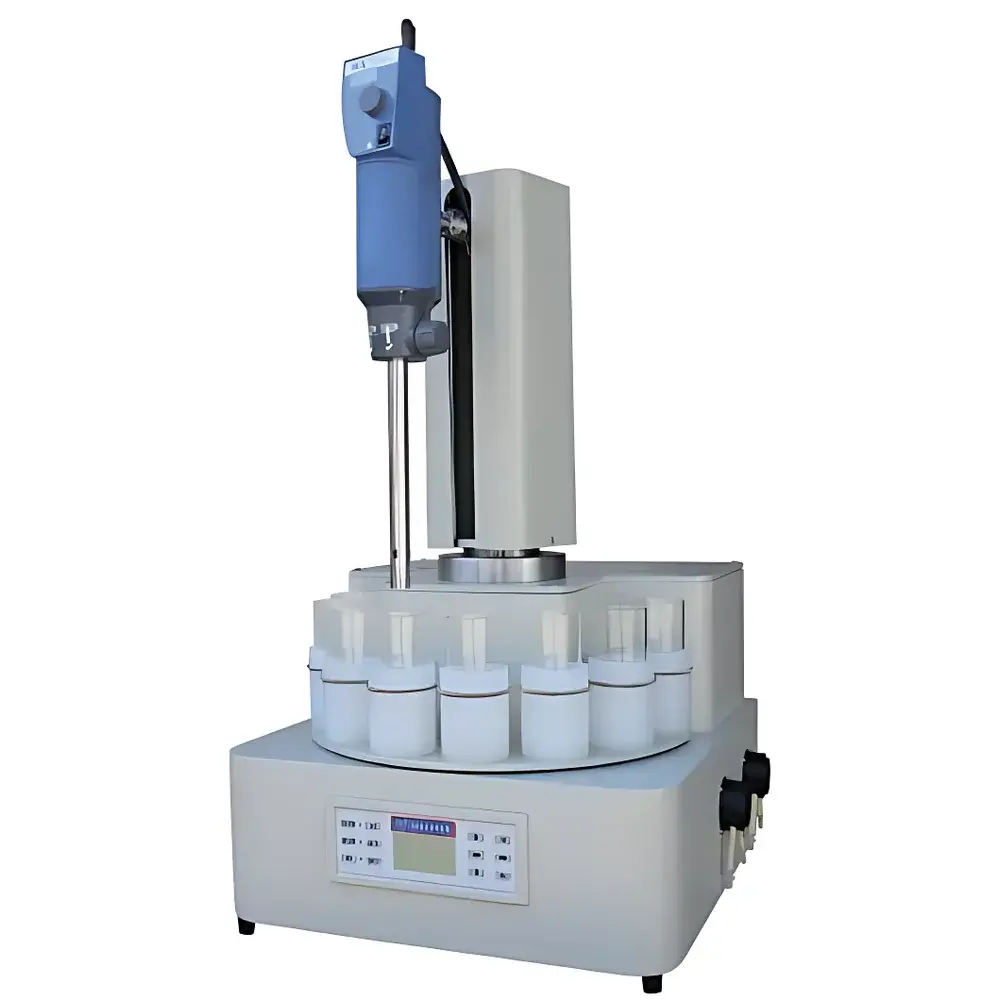
TTL TTL-260 Automated Probe-Type Homogenizer
| Brand | TTL |
|---|---|
| Model | TTL-260 |
| Type | Probe-type (rotor-stator) homogenizer |
| Origin | Beijing, China |
| Manufacturer | TTL (Beijing Tongtai Lian Technology Co., Ltd.) |
| Dimensions (W×D×H) | 440 × 420 × 710 mm |
| Sample Volume Range | 10–150 mL |
| Throughput | Up to 8 samples per batch (configurable for 10/15 mL, 50 mL, 100 mL, or 175 mL vessels) |
| Cleaning System | Dedicated ultrasonic cleaning bath per probe with tap water/organic solvent compatibility |
| Control Interface | LCD display with microprocessor-based automation |
| Pump | External peristaltic pump head with high-grade tubing |
| Safety Features | Dry-run protection for ultrasonic cleaning, real-time fault diagnostics |
Overview
The TTL TTL-260 Automated Probe-Type Homogenizer is an engineered solution for standardized, high-reproducibility sample homogenization in regulated pre-analytical workflows. Based on rotor-stator (probe-type) shear principle, it delivers controlled mechanical disruption of biological, food, and agricultural matrices—including soft tissues, viscous suspensions, and particulate-laden extracts—through high-speed rotation of a titanium alloy probe within a fixed stator sleeve. This generates intense localized shear gradients, cavitation, and turbulent mixing, enabling efficient cell lysis, particle size reduction, and homogeneous suspension formation. Designed specifically for laboratories requiring GLP-compliant, traceable, and operator-independent sample preparation, the TTL-260 eliminates manual variability by automating both homogenization and post-run probe decontamination—critical for residue analysis (e.g., pesticide, veterinary drug), microbiological testing, and functional ingredient quantification in food and pharmaceutical QA/QC.
Key Features
- Fully automated workflow: Sequential execution of sample loading, probe immersion, homogenization (speed/time programmable), probe withdrawal, and multi-stage cleaning—including ultrasonic activation, solvent rinse, and air purge.
- Dedicated per-probe ultrasonic cleaning station: Prevents cross-contamination between batches; supports aqueous and organic solvent (e.g., acetone, ethanol) cleaning protocols.
- Adaptive probe motion: Vertical oscillation during homogenization ensures uniform energy distribution across heterogeneous samples and minimizes vortexing or foaming in low-volume tubes.
- Modular vessel support: Compatible with standardized labware—10/15 mL, 50 mL, 100 mL, and 175 mL conical-bottom threaded tubes or beakers—enabling method transfer across assay platforms.
- Intuitive microprocessor control: Backlit LCD interface with Chinese-language menu navigation (firmware-localized); stores ≥20 user-defined protocols with adjustable RPM, duration, pause intervals, and cleaning cycles.
- Integrated peristaltic fluid handling: External pump head with chemically resistant tubing enables precise delivery of cleaning solvents or rinsing agents without internal wetted-path components.
- Real-time process monitoring: On-screen step-by-step progress tracking, remaining time countdown, and diagnostic alerts for overload, dry ultrasonication, or probe stall.
- One-touch batch repetition: Programmable cycle count (1–99) for unattended multi-batch processing—ideal for high-throughput screening labs.
Sample Compatibility & Compliance
The TTL-260 accommodates a broad range of sample types relevant to ISO/IEC 17025-accredited testing environments: animal tissue homogenates (liver, muscle), plant extracts (grains, leafy greens), dairy emulsions, feed pellets, pesticide-spiked food matrices, and biological fluids (blood, serum). Its closed-vessel operation and dedicated cleaning architecture align with FDA guidance on analytical method validation (ICH Q2(R2)) and support audit readiness for GMP/GLP workflows. While not certified to UL/CE standards out-of-the-box, the system meets essential electrical safety requirements per GB 4793.1 (Chinese equivalent of IEC 61010-1) and includes documented traceability for calibration of motor speed and timer accuracy. All cleaning logs—including ultrasonic activation time, solvent volume dispensed, and cycle count—are timestamped and exportable via USB for internal quality records.
Software & Data Management
The TTL-260 operates via embedded firmware—not PC-dependent software—ensuring deterministic timing and reduced cybersecurity exposure. Protocol parameters (RPM setpoint, homogenization duration, cleaning sequence steps) are stored in non-volatile memory with password-protected access levels (operator vs. administrator). Each run generates a local log file containing: date/time stamp, selected protocol ID, actual measured probe RPM (via tachometric feedback), total elapsed time, and cleaning completion status. Logs are exportable in CSV format for integration into LIMS or electronic lab notebooks (ELN). The system supports 21 CFR Part 11–aligned practices through user authentication, audit trail generation (including parameter changes and error events), and immutable run records—facilitating compliance in regulated bioanalytical and food safety laboratories.
Applications
- Preparation of homogenates for LC-MS/MS analysis of veterinary drug residues in meat and milk.
- Cell lysis and nucleic acid extraction from microbial cultures or clinical specimens prior to qPCR.
- Standardized dispersion of nanomaterials or insoluble active ingredients in formulation development.
- Homogenization of composite food samples (e.g., baby formula, infant cereals) for heavy metal or mycotoxin testing per AOAC Official Methods.
- Generation of reproducible suspensions for particle size analysis (e.g., laser diffraction) in agricultural chemical R&D.
- Processing of environmental samples (soil, sediment) for organophosphate pesticide quantification per EPA Method 8081B.
FAQ
What sample volumes can the TTL-260 process?
The system supports volumes from 10 mL to 150 mL per vessel, with validated performance across 10/15 mL, 50 mL, 100 mL, and 175 mL conical-bottom threaded tubes or beakers.
Does the instrument require external water or solvent connections?
Yes—tap water supply is required for ultrasonic cleaning; optional solvent lines (e.g., ethanol, acetone) can be connected via the peristaltic pump interface for enhanced decontamination.
Is the probe material compatible with aggressive solvents and biological decontaminants?
Probes are constructed from medical-grade titanium alloy (Grade 5, Ti-6Al-4V), resistant to corrosion by common organic solvents, dilute acids/bases, and enzymatic cleaners.
Can cleaning parameters be validated and documented for regulatory audits?
Yes—each cleaning cycle is logged with timestamps, solvent type (if selected), ultrasonic duration, and rinse volume; logs are exportable and support ALCOA+ data integrity principles.
What maintenance is required for long-term reliability?
Routine tasks include periodic inspection of probe tip wear, replacement of peristaltic pump tubing every 6–12 months (depending on usage frequency), and descaling of ultrasonic bath reservoirs when using hard water.



