
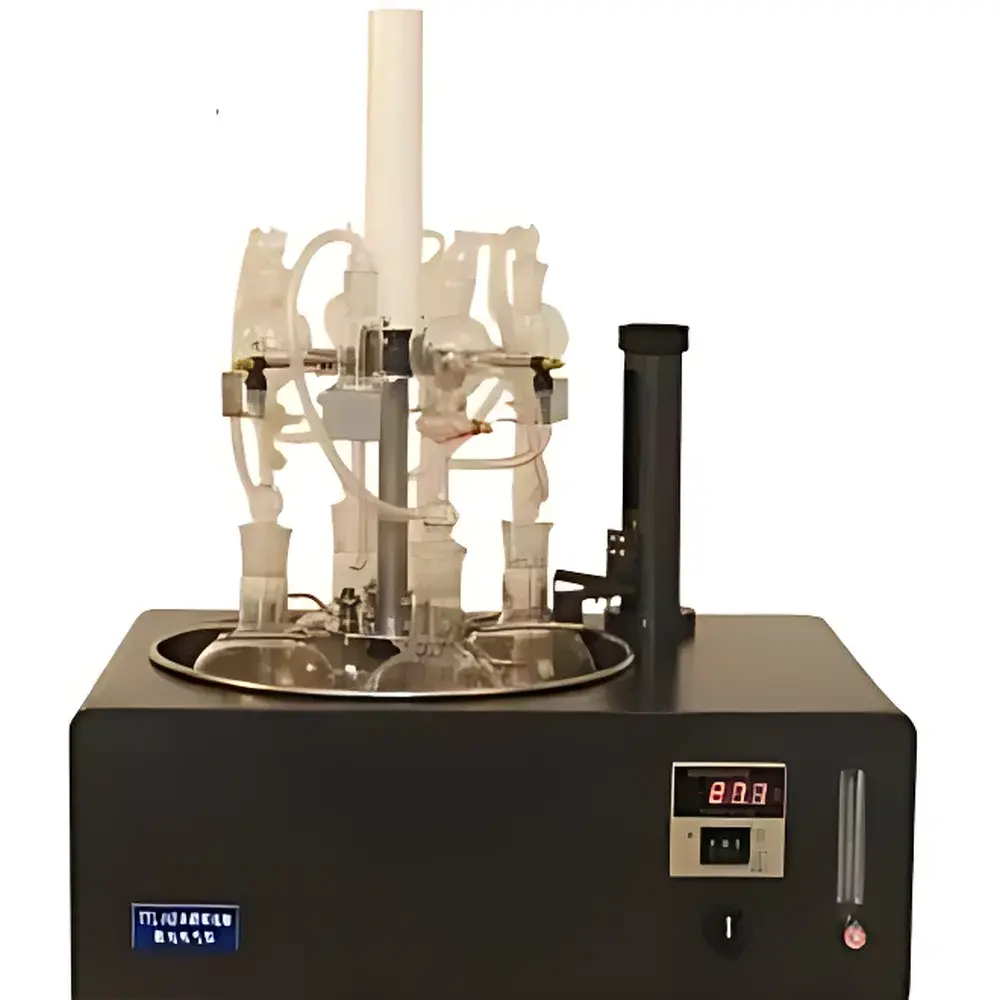
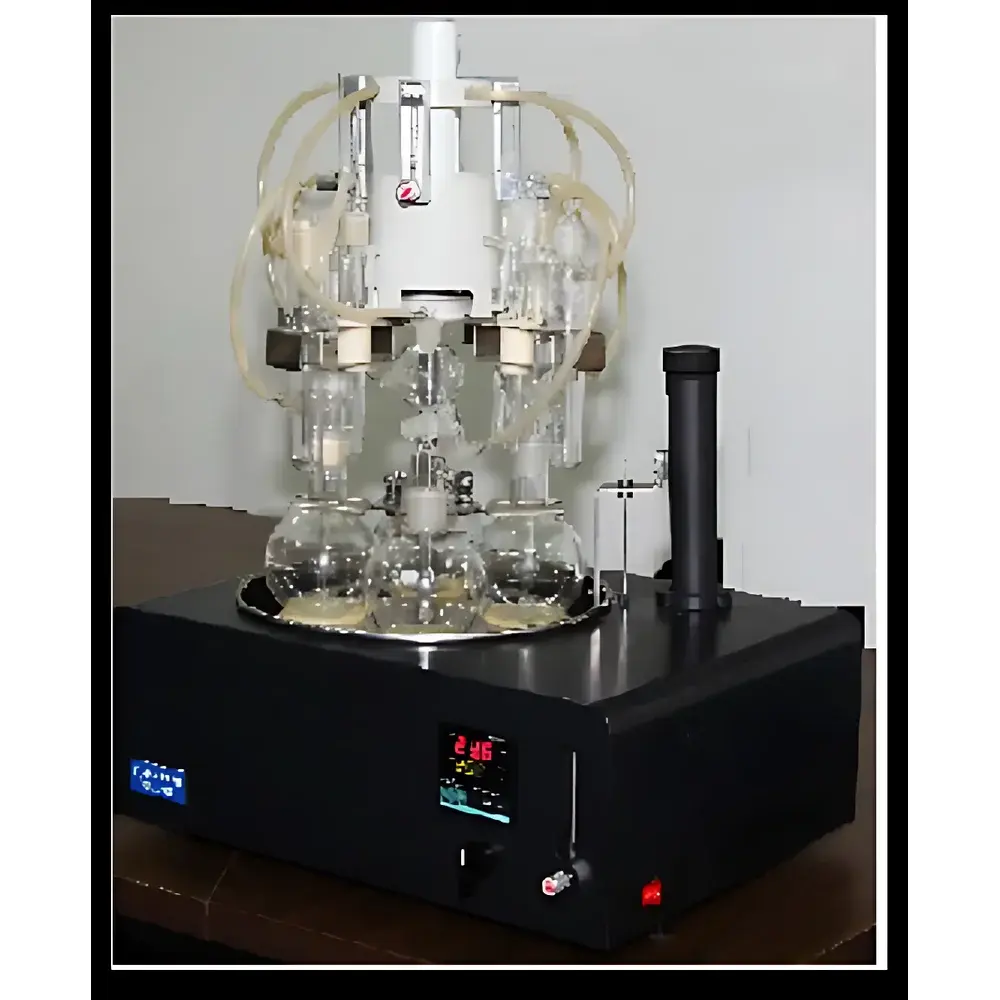
TTL TTL-HS Sulfide Acidification and Purge Instrument
| Brand | TTL |
|---|---|
| Origin | Beijing, China |
| Manufacturer Type | Direct Manufacturer |
| Product Category | Domestic |
| Model | TTL-HS |
| Instrument Type | Laboratory Benchtop System |
| Sample Capacity | 4 positions |
| Heating Method | Constant-Temperature Water Bath (Uniform Thermal Distribution) |
| Heating Power | 1000 W |
| Display | Digital LED Interface |
| Compliance Standard | HJ 1226–2021 (PRC National Ecological and Environmental Standard) |
Overview
The TTL TTL-HS Sulfide Acidification and Purge Instrument is a dedicated laboratory benchtop system engineered for precise, reproducible sample preparation in sulfide quantification workflows. It operates on the principle of acidification-driven volatile sulfide liberation followed by inert gas purging and subsequent trapping—core steps mandated by HJ 1226–2021, the official People’s Republic of China national standard for sulfide determination in water using the methylene blue spectrophotometric method. Unlike generic nitrogen purge setups, the TTL-HS integrates temperature-controlled water bath heating with synchronized gas flow regulation to ensure stoichiometric conversion of sulfide species (e.g., HS⁻, S²⁻) to H₂S under controlled acidic conditions (typically via phosphoric or hydrochloric acid addition), followed by quantitative transfer into an absorbing solution (e.g., zinc acetate or sodium hydroxide). This physical-chemical separation eliminates matrix interferences common in complex aqueous matrices—including turbidity, heavy metal precipitation, and organic sulfur compounds—thereby enhancing method accuracy and analytical robustness across diverse environmental water types.
Key Features
- Four-position parallel sample processing with independent gas flow control per channel, enabling comparative analysis or replicate runs without cross-contamination.
- Constant-temperature water bath heating system (rated at 1000 W) providing uniform thermal distribution across all reaction vessels; temperature stability maintained within ±0.5 °C over extended operation cycles.
- Digital LED interface for real-time monitoring of operating parameters including bath temperature and elapsed purge time—no analog dials or manual timers required.
- Chemically resistant gas pathways constructed from borosilicate glass and PTFE-lined tubing, minimizing adsorption losses and ensuring compatibility with aggressive acid reagents and H₂S gas.
- Benchtop footprint optimized for standard fume hood integration; includes integrated gas manifold with precision needle valves and pressure relief safeguards compliant with ISO 5171 requirements for laboratory gas handling systems.
Sample Compatibility & Compliance
The TTL-HS is validated for use with surface water, groundwater, domestic wastewater, and industrial effluents—covering the full scope defined in HJ 1226–2021. Its design supports sample volumes ranging from 50 mL to 500 mL, accommodating both low-concentration natural waters and high-sulfide industrial discharges. All wetted components meet USP Class VI biocompatibility standards, and the instrument’s operational protocol aligns with GLP principles for trace-level environmental analysis. While not certified to ISO/IEC 17025 as a standalone measurement device, it fulfills critical pre-analytical requirements referenced in ISO 5667-3 (water sampling—preservation and handling) and ASTM D4129 (standard test method for total sulfur in water by oxidative combustion and ion chromatography), making it suitable for laboratories undergoing regulatory audits under CNAS or provincial ecological monitoring accreditation frameworks.
Software & Data Management
The TTL-HS operates as a hardware-only platform with no embedded firmware or proprietary software. All operational parameters are manually configured and recorded externally—consistent with standard practice for sample preparation instrumentation in accredited environmental labs. Users maintain traceability through paper-based or LIMS-integrated logbooks documenting batch numbers, acid addition volumes, purge duration, bath temperature setpoints, and analyst identifiers. This architecture ensures full compliance with data integrity expectations under China’s “Measures for the Administration of Environmental Monitoring Data Quality” (Ministry of Ecology and Environment Order No. 37) and facilitates audit readiness for GLP/GMP-aligned quality systems requiring manual intervention logs and change control documentation.
Applications
- Routine monitoring of sulfide in municipal wastewater treatment plant influent and effluent streams per HJ 1226–2021 compliance reporting.
- Field-collected groundwater assessment where sulfide speciation must be stabilized prior to transport to central laboratories.
- Industrial discharge verification for petrochemical, pulp & paper, and food processing facilities subject to local environmental permit limits.
- Method validation studies supporting interlaboratory comparison exercises coordinated by provincial environmental monitoring centers.
- Educational use in university environmental chemistry laboratories for teaching standardized EPA-aligned and China-specific water analysis protocols.
FAQ
Is the TTL-HS compatible with automated sulfur analyzers such as IC or ICP-MS?
Yes—when paired with appropriate trapping solutions (e.g., alkaline hydrogen peroxide for sulfate conversion), the purified H₂S stream can be interfaced with downstream ion chromatography or mass spectrometry systems, though direct coupling requires custom adapter fittings and flow calibration.
What maintenance is required for long-term reliability?
Routine cleaning of glass reaction tubes and gas dispersion frits with dilute nitric acid is recommended after every 20 sample batches; water bath fluid should be replaced monthly to prevent microbial growth and mineral scaling.
Does the instrument support nitrogen and argon interchangeably?
Yes—the gas inlet is rated for inert gases up to 0.3 MPa; argon offers marginally better H₂S recovery in high-ionic-strength samples due to reduced solubility, while nitrogen remains the default per HJ 1226–2021.
Can the TTL-HS be used for other volatile analytes beyond sulfide?
Its core architecture is adaptable to cyanide (under HJ 484–2009) and volatile phenols (HJ 502–2009) with minor modifications to acid concentration, trapping solution, and purge timing—though formal validation per each standard is the user’s responsibility.
Is technical support available outside mainland China?
TTL provides remote troubleshooting and English-language operation manuals upon request; however, field service and calibration certification are currently limited to authorized distributors within Greater China.
Related Products







