
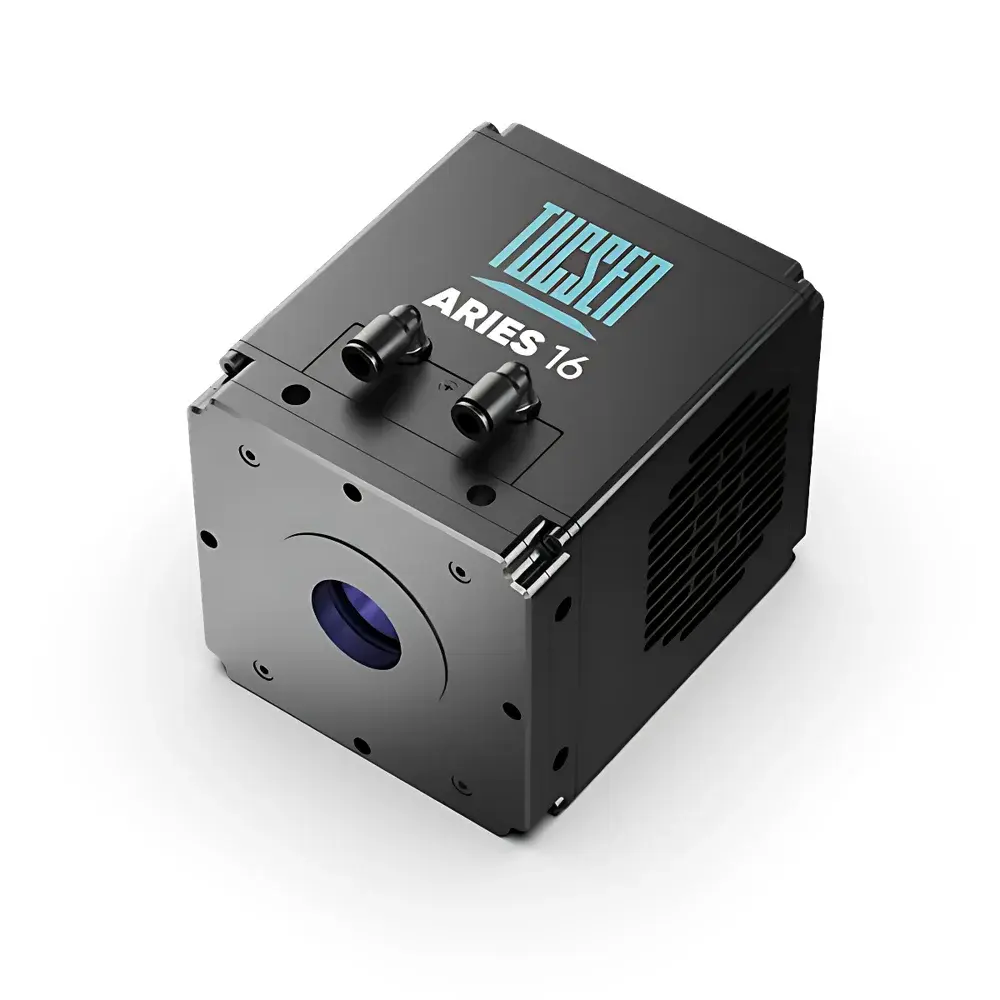
Tucsen Aries 16 Back-Illuminated sCMOS Camera for Quantum Physics, Super-Resolution Microscopy, and Single-Molecule Detection
| Brand | Tucsen |
|---|---|
| Origin | Fujian, China |
| Manufacturer Type | OEM Manufacturer |
| Origin Category | Domestic (China) |
| Model | Aries 16 |
| Image Resolution | 800 × 600 |
| Pixel Size | 16 µm × 16 µm |
| Sensor Dimensions | 12.8 mm × 9.6 mm |
| Readout Speed | 60 fps @ HDR Mode |
| Quantum Efficiency | 90.7% @ 550 nm |
| Read Noise | 0.9 e⁻ (typ.) @ Low-Noise Mode |
| Full Well Capacity | 73 ke⁻ (typ.) |
| Dynamic Range | 94.8 dB (typ.) |
| Cooling | Active Air/Water Cooling to −60 °C ΔT below ambient |
| Dark Current | 0.2 e⁻/pixel/s |
| Binning | 2×2, 4×4, arbitrary ROI |
| Interface | USB 3.0 & Camera Link |
| Bit Depth | 12-bit & 16-bit |
| Optical Mount | C-mount |
Overview
The Tucsen Aries 16 is a high-performance, back-illuminated scientific CMOS (sCMOS) camera engineered for photon-starved applications in quantum optics, cold atom imaging, fluorescence correlation spectroscopy (FCS), total internal reflection fluorescence (TIRF), Förster resonance energy transfer (FRET), bioluminescence detection, and super-resolution microscopy (e.g., STORM, PALM). Its core architecture leverages a 16 µm pixel pitch back-illuminated sensor, delivering exceptional photon collection efficiency and signal-to-noise ratio (SNR) at ultra-low illumination levels. Unlike front-illuminated sensors or electron-multiplying CCDs (EMCCDs), the Aries 16 achieves sub-electron read noise (0.9 e⁻) without multiplicative gain noise or gain drift—enabling quantitative, linear, and reproducible intensity measurements across decades of signal amplitude. The sensor operates with true 16-bit digitization and supports both global reset and rolling shutter modes, ensuring compatibility with pulsed excitation sources and time-gated acquisition protocols common in quantum and single-molecule experiments.
Key Features
- Back-illuminated sCMOS sensor with 90.7% peak quantum efficiency at 550 nm—optimized for visible and near-UV fluorescence emission bands.
- 16 µm × 16 µm pixels yielding >5× higher photon collection efficiency versus conventional 6.5 µm-pitch sCMOS sensors—critical for low-flux quantum imaging and sparse emitter localization.
- Sub-electron read noise (0.9 e⁻ typ.) in low-noise mode—enabling reliable single-photon-level detection without EM gain artifacts or calibration drift.
- Active dual-mode cooling: air-cooled to −50 °C ΔT and water-cooled to −60 °C ΔT below ambient—suppressing dark current to 0.2 e⁻/pixel/s and enabling long-exposure stability up to 60 seconds.
- Dual operating modes: 60 fps HDR mode (1.6 e⁻ read noise) for dynamic range-critical applications; 25 fps low-noise mode (0.9 e⁻) for ultimate sensitivity in static or time-lapse single-molecule assays.
- Hardware-triggered acquisition with programmable TTL outputs (exposure start/end, global reset) and microsecond-level timestamping—essential for synchronization with laser pulses, AOMs, or atomic trap sequencing.
- Fully compliant with GenICam standard; supports USB 3.0 and Camera Link interfaces for flexible integration into custom optical benches or OEM systems.
Sample Compatibility & Compliance
The Aries 16 is designed for use with standard C-mount optical pathways and integrates seamlessly into inverted and upright microscope platforms, vacuum-compatible quantum imaging chambers, and custom-built cold atom apparatuses. Its mechanical footprint (95 × 95 × 114 mm) and low power consumption (~38 W) facilitate integration into space-constrained cryogenic or magnetic-shielded environments. The camera meets CE and FCC electromagnetic compatibility requirements. While not certified under FDA 21 CFR Part 11, its SDK supports audit-trail–capable data logging when deployed in GLP/GMP-aligned research infrastructure. All firmware and acquisition parameters are fully scriptable—ensuring traceability and reproducibility in regulated academic and industrial labs conducting ISO/IEC 17025–compliant optical metrology.
Software & Data Management
The Aries 16 is supported by Tucsen’s Mosaic 3.0 acquisition suite (Windows-native, GPU-accelerated), offering real-time histogram analysis, multi-channel time-series registration, and ROI-based binning. It provides native APIs for C, C++, C#, and Python—enabling direct integration with open-source platforms including Micro-Manager 2.0, MATLAB Image Acquisition Toolbox, and LabVIEW Vision Development Module. Raw frame buffers are accessible via memory-mapped I/O, supporting on-the-fly processing pipelines for FCS autocorrelation, TIRF background subtraction, or single-particle tracking (SPT). Metadata—including exposure time, temperature, trigger latency, and sensor gain state—is embedded in TIFF and HDF5 output formats per frame, satisfying FAIR (Findable, Accessible, Interoperable, Reusable) data principles.
Applications
- Cold Atom Imaging: High-fidelity absorption imaging of Bose-Einstein condensates (BECs) and optical lattice-trapped atoms, where low read noise and deep cooling minimize shot-noise–limited uncertainty in density reconstruction.
- Super-Resolution Localization Microscopy: Sub-diffraction mapping of protein clusters via STORM/PALM, leveraging large pixels for improved localization precision (σ ≈ 10–15 nm) under sparse activation conditions.
- Fluorescence Correlation Spectroscopy (FCS): Accurate autocorrelation decay fitting enabled by linear response, negligible read noise floor, and precise timing control for diffusion coefficient and concentration quantification.
- TIRF & FRET Assays: High-contrast evanescent-field imaging of membrane-proximal dynamics and conformational changes, with optimized QE across donor/acceptor emission bands (e.g., Cy3/Cy5).
- Bioluminescence & Chemiluminescence Imaging: Long-exposure capture of weak, non-excited luminescent signals from luciferase reporters—benefiting from ultra-low dark current and high dynamic range.
FAQ
What is the effective full-well capacity of the Aries 16 sensor?
The typical full-well capacity is 73,000 electrons per pixel, supporting wide-intensity-range imaging without saturation in heterogeneous samples.
Does the camera support hardware triggering with microsecond timing resolution?
Yes—external TTL triggers are accepted via SMA connector with configurable polarity and latency compensation; timestamps are recorded with ≤1 µs jitter.
Can the Aries 16 be operated in vacuum or magnetic environments?
The camera body is non-magnetic and rated for operation at atmospheric pressure; for vacuum integration, optional feedthrough kits and thermal isolation mounts are available upon request.
Is the SDK compatible with Python-based automation frameworks like Pycro-Manager?
Yes—the Tucsen Python SDK provides full device control and frame streaming, and has been validated with Pycro-Manager v2.0 and Napari-based visualization pipelines.
How does the Aries 16 compare to EMCCD cameras in FCS applications?
It eliminates EM gain noise and aging-related calibration drift while maintaining comparable single-photon sensitivity—yielding superior quantitative accuracy and long-term measurement stability.





