
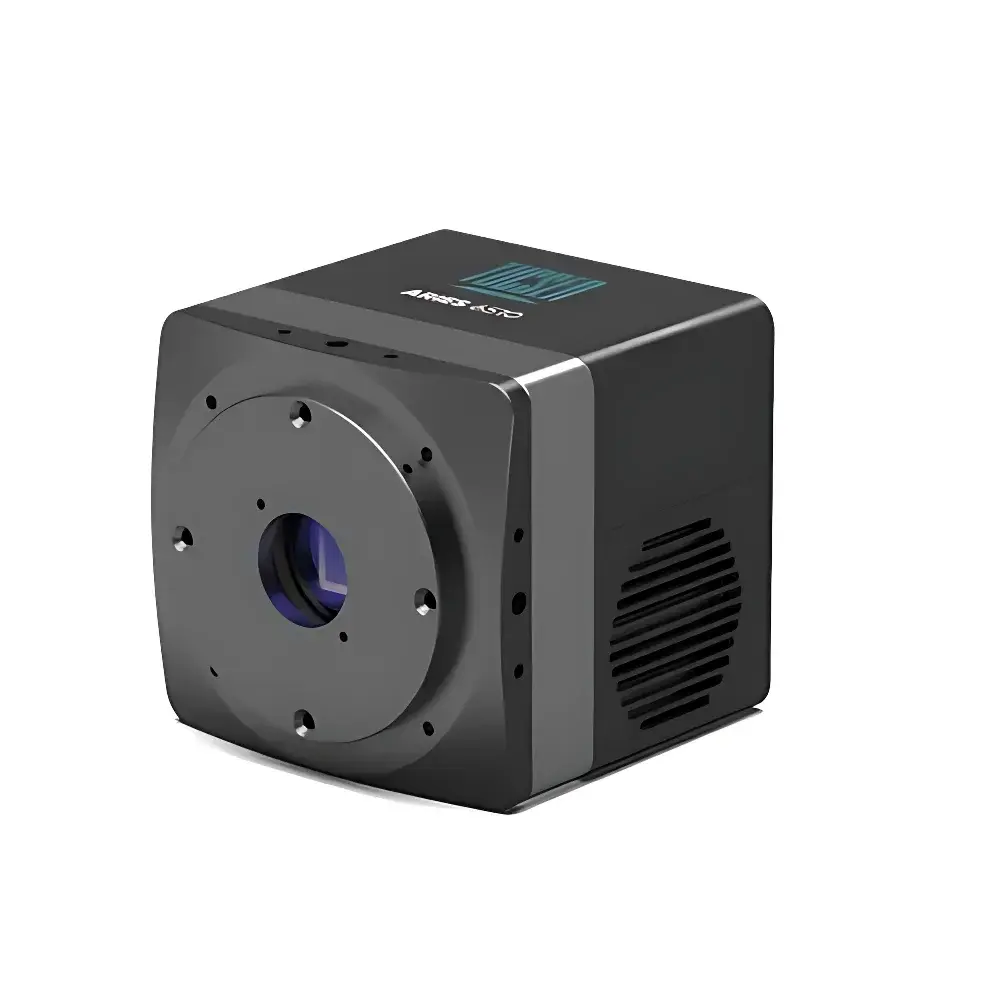
Tucsen Aries 6510 BSI sCMOS Microscopy Camera
| Brand | Tucsen |
|---|---|
| Origin | Fujian, China |
| Manufacturer Type | OEM Manufacturer |
| Origin Category | Domestic (China) |
| Model | Aries 6510 |
| Image Resolution | 3200 (H) × 3200 (V) |
| Pixel Size | 6.5 µm × 6.5 µm |
| Sensor Active Area | 20.8 mm × 20.8 mm |
| Readout Speeds | 83 fps / 150 fps / 88 fps / 5.2 fps |
| Peak Quantum Efficiency | 95% |
| Sensor Type | Back-Illuminated sCMOS |
| Diagonal Field of View | 29.4 mm |
| Read Noise | 0.7 e⁻ (Super-Sensitivity mode) |
| Full Well Capacity | 1,000 e⁻ or 15,000 e⁻ selectable |
| Bit Depth | 11–16 bit (mode-dependent) |
| Cooling | Air-cooled to 0°C (ambient 25°C) / Water-cooled to −10°C (coolant 20°C) |
| Interface | Dual 10GigE |
| Mount | T-mount / F-mount / C-mount compatible |
| Power | 12 V / 8 A |
| Max Power Consumption | ≤55 W |
| Dimensions | 95 mm (H) × 100 mm (W) × 100 mm (L) |
Overview
The Tucsen Aries 6510 is a high-performance back-illuminated scientific CMOS (BSI sCMOS) camera engineered for demanding quantitative microscopy applications—including live-cell calcium imaging, wide-field fluorescence time-lapse, high-throughput slide scanning, and digital pathology. Its core architecture centers on the Gpixel GSENSE6510 sensor, a monochrome BSI sCMOS device delivering 95% peak quantum efficiency across the visible to near-UV spectrum (400–700 nm), enabling exceptional photon capture efficiency at low-light conditions typical in confocal, TIRF, and light-sheet modalities. With a native resolution of 3200 × 3200 pixels and a 20.8 mm × 20.8 mm active area, the Aries 6510 provides a 29.4 mm diagonal field of view—2.5× larger than standard 4 MP sCMOS sensors—reducing tile count and stage movement in whole-slide imaging while preserving single-cell spatial fidelity. The camera operates on a dual 10 Gigabit Ethernet interface, eliminating dependency on proprietary frame grabbers and supporting deterministic, low-latency data streaming in multi-camera or synchronized acquisition environments.
Key Features
- Ultra-High Quantum Efficiency & Low Noise: 95% peak QE combined with sub-1 e⁻ read noise (0.7 e⁻ in Super-Sensitivity mode) enables reliable detection of weak, transient signals—critical for low-dose calcium dynamics or sparse fluorophore labeling.
- Configurable Full-Well Capacity: Selectable full-well modes (1,000 e⁻ for ultra-high speed; 15,000 e⁻ for high dynamic range) allow optimization between temporal resolution and signal linearity—essential for quantifying rapid intensity shifts in electrophysiology-coupled imaging or FRAP recovery kinetics.
- Multi-Mode Readout Architecture: Four distinct readout modes—HDR, Speed, Sensitivity, and Super-Sensitivity—deliver tailored trade-offs among frame rate (up to 150 fps at reduced ROI), dynamic range (>85 dB), and noise floor without hardware reconfiguration.
- Thermal Stability for Quantitative Consistency: Integrated air- or water-cooling maintains sensor temperature at 0°C (air) or −10°C (water), suppressing dark current to ≤0.5 e⁻/pixel/s and ensuring stable baseline performance over hours-long acquisitions required in circadian or developmental studies.
- Flexible Optical Integration: Standard T-mount, F-mount, and C-mount compatibility simplifies integration into inverted, upright, or custom optical tables; ROI control, hardware binning (2×2, 4×4), and dynamic pixel correction (DPC) support adaptive experimental workflows.
Sample Compatibility & Compliance
The Aries 6510 supports a broad range of biological specimens—from subcellular organelles in primary neurons to tissue sections up to 15 × 15 cm via motorized stage coupling. Its 16-bit digitization and linear response (±0.5% nonlinearity) ensure compliance with quantitative imaging standards referenced in ISO 17025-accredited labs. While not FDA-cleared as a diagnostic device, the camera’s deterministic triggering (hardware/software), timestamped metadata embedding, and audit-ready SDK logging align with GLP/GMP-aligned documentation practices for preclinical assay development. All firmware and driver versions are version-controlled and traceable—supporting 21 CFR Part 11-compliant workflow validation when deployed with validated host software (e.g., MicroManager 2.0, NIS-Elements AR, or custom Python-based acquisition platforms).
Software & Data Management
Tucsen provides a cross-platform SDK supporting C/C++, C#, and Python APIs, enabling seamless integration into open-source (ImageJ/Fiji, Napari) and commercial (MATLAB, LabVIEW) environments. The SDK exposes low-level register access for precise exposure synchronization, ROI definition, and real-time gain/offset adjustment—critical for closed-loop optogenetic stimulation or multi-channel spectral unmixing. Raw image streams are delivered in lossless 16-bit TIFF or HDF5 format with embedded EXIF-like metadata (exposure time, temperature, trigger source, binning factor). Time-stamped frame headers facilitate post-hoc alignment with electrophysiology or environmental sensor data. Firmware updates are delivered via signed packages with SHA-256 verification, maintaining integrity in regulated research settings.
Applications
- Calcium Imaging: High-speed (≥83 fps) acquisition with low read noise captures fast Ca²⁺ transients in neuronal ensembles or cardiomyocyte networks without motion blur or photon starvation.
- Live-Cell Long-Term Imaging: Reduced phototoxicity enabled by high QE allows lower excitation intensities and shorter exposures—preserving viability over >24-hour timelapses in stem cell differentiation assays.
- Digital Pathology Scanning: Large FOV minimizes stitching artifacts and accelerates whole-slide digitization at 20×–40× magnification; calibrated flat-field correction ensures consistent intensity across multi-tile mosaics.
- High-Throughput Screening (HTS): GigE interface supports synchronized multi-camera operation in automated microplate readers; ROI streaming reduces bandwidth demand during kinetic assay readouts.
- Super-Resolution Correlative Microscopy: Sub-pixel registration stability (<0.05 pixel RMS drift over 1 hr at 25°C) supports PALM/STORM localization pipelines requiring precise drift correction.
FAQ
What cooling options are available, and how do they affect dark current performance?
The Aries 6510 offers air-cooling (stabilized at 0°C ambient 25°C) and water-cooling (−10°C at 20°C coolant inflow). Dark current is reduced to ≤0.5 e⁻/pixel/s under both configurations—critical for long-exposure applications such as bioluminescence or low-signal FRET.
Is the camera compatible with third-party microscope control software?
Yes—the Tucsen SDK includes native drivers for Micro-Manager 2.0, Thorlabs Kinesis, and Hamamatsu HCImage Live, and provides documented API hooks for custom integration with MATLAB, Python (via ctypes), or LabVIEW.
Does the camera support global shutter operation?
No—the Aries 6510 uses a rolling shutter architecture optimized for low-noise, high-QE performance. For global shutter requirements, users should consider synchronized external illumination gating or consult Tucsen’s application engineering team for timing calibration guidance.
Can I perform on-camera binning without sacrificing resolution control?
Yes—FPGA-based 2×2 and 4×4 hardware binning is supported alongside full-resolution ROI selection, allowing flexible trade-offs between SNR, frame rate, and field coverage without host-CPU overhead.
What is the maximum sustained data throughput over GigE?
With dual 10GigE ports and jumbo frame support (9000-byte MTU), the camera achieves sustained throughput up to 1.8 GB/s—sufficient for full-frame 150 fps streaming or ROI-constrained >500 fps acquisition in high-speed physiology setups.




