
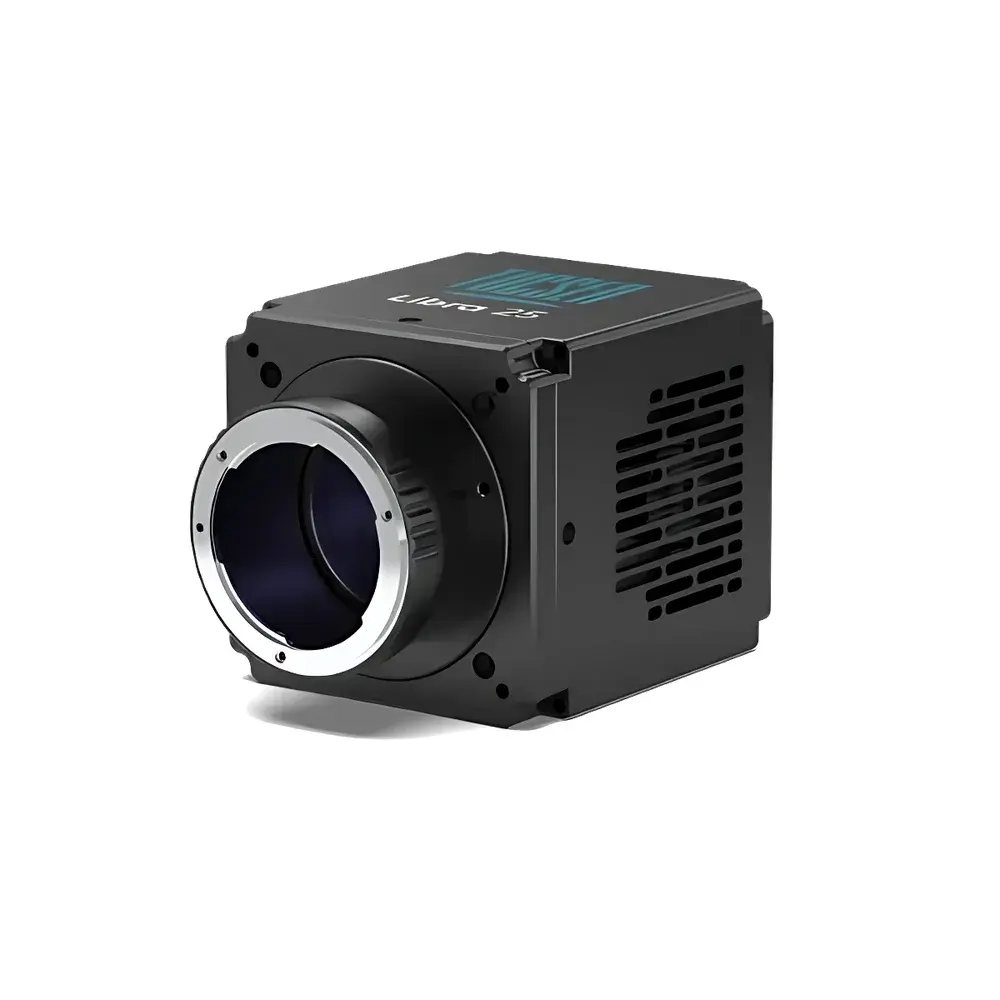
Tucsen Libra 25 Scientific CMOS Camera for Fluorescence Imaging, Tissue Slide Scanning, High-Throughput Microscopy, and Live-Cell Observation
| Brand | Tucsen |
|---|---|
| Origin | Fujian, China |
| Manufacturer Type | OEM Manufacturer |
| Origin Category | Domestic (China) |
| Model | Libra 25 |
| Pricing | Upon Request |
| Image Resolution | 5200 × 4096 |
| Pixel Size | 3.76 µm × 3.76 µm |
| Sensor Diagonal | 25 mm |
| Sensor Active Area | 19.55 mm × 15.4 mm |
| Peak Quantum Efficiency | 92% @ 530 nm |
| Read Noise | 1.0 e⁻ (high-gain mode) |
| Readout Speed | 6.5 fps @ full resolution (HR), 32 fps @ high-sensitivity binning mode (HS) |
| Bit Depth | 14-bit / 16-bit selectable |
| Full Well Capacity | 3.2 ke⁻ (HG), 48 ke⁻ (LG) |
| Dark Current | < 0.01 e⁻/pixel/s @ 0°C |
| Cooling | TEC air-cooled to 0°C (ambient 26°C) |
| Interface | USB 3.0 |
| Optical Mount | C-mount |
| Trigger Modes | Hardware/software-triggered (exposure start, global reset, readout end, TTL high/low) |
| SDK Support | C, C++, C#, LabVIEW, MATLAB, Micro-Manager 2.0, SamplePro |
Overview
The Tucsen Libra 25 is a high-performance scientific CMOS camera engineered for demanding optical microscopy applications requiring high spatial fidelity, exceptional photon sensitivity, and thermal stability. Built around a back-illuminated (BSI) Sony CMOS sensor with a 25 mm diagonal format, the Libra 25 delivers native 5200 × 4096 resolution imaging—optimized for wide-field fluorescence, whole-slide tissue scanning, time-lapse live-cell observation, and high-throughput assay screening. Its large-format sensor enables seamless integration with modern microscope systems featuring field numbers ≥25 mm, eliminating vignetting and ensuring uniform illumination across the entire field of view. The camera operates on the principle of photon-limited detection in low-light regimes, leveraging quantum efficiency (QE) peaking at 92% at 530 nm—a spectral region critical for common fluorophores including FITC, GFP, and YFP. Coupled with sub-electron read noise (1.0 e⁻ in high-gain mode) and thermoelectric cooling stabilized at 0°C, the Libra 25 maintains consistent signal-to-noise performance over extended acquisition periods—essential for quantitative intensity measurements and longitudinal biological studies.
Key Features
- 25 mm diagonal BSI CMOS sensor with 5200 × 4096 active pixels and 3.76 µm pixel pitch—designed for high-resolution, wide-field optical compatibility
- Dual-readout architecture: high-resolution (HR) mode (3.76 µm pixels) for ≤40× objectives; high-sensitivity (HS) mode (7.5 µm effective pixel size via hardware binning) for ≥60× objectives and ultra-low-light conditions
- Thermally stabilized TEC cooling system maintaining sensor temperature at 0°C ±0.5°C (ambient 26°C), reducing dark current to 30 s) acquisitions without thermal drift
- Flexible bit-depth selection (14-bit or 16-bit) and dual-gain architecture supporting dynamic range up to 78 dB (low-gain) and optimized SNR in photon-starved scenarios (high-gain)
- USB 3.0 interface with deterministic latency and full SDK support—including C/C++/C# APIs, LabVIEW VIs, MATLAB toolboxes, and native compatibility with Micro-Manager 2.0 and open-source acquisition frameworks
- Programmable triggering with TTL-compatible inputs/outputs for synchronization with external hardware (e.g., shutters, stage controllers, LED illuminators) under precise timing constraints required by FRAP, FRET, or optogenetics workflows
Sample Compatibility & Compliance
The Libra 25 supports diverse sample types—from fixed immunofluorescent tissue sections and 3D organoid cultures to adherent and suspension live-cell populations imaged under physiological CO₂ and temperature control. Its C-mount interface ensures mechanical and optical alignment compatibility with standard upright, inverted, and light-sheet microscopes. The camera’s firmware and driver stack comply with Windows and Linux kernel standards (UVC-compliant enumeration where applicable), and its metadata-rich TIFF output conforms to OME-TIFF specifications for interoperability with downstream analysis platforms such as ImageJ/Fiji, QuPath, and commercial digital pathology viewers. While not certified for clinical diagnostics, the Libra 25 meets key engineering benchmarks aligned with ISO 13660 (image quality assessment), ASTM E2912 (microscopy camera performance evaluation), and GLP-aligned data integrity practices—including timestamped frame headers, non-destructive ROI readout, and audit-ready exposure logs exportable via Mosaic 3.0.
Software & Data Management
Mosaic 3.0—the proprietary acquisition and analysis suite—is fully integrated with the Libra 25 and provides advanced computational imaging capabilities beyond basic capture. It features real-time background subtraction, flat-field correction, multi-channel registration, and GPU-accelerated deconvolution using constrained iterative algorithms. The software supports automated mosaic stitching for whole-slide scanning (with stage position feedback via optional serial/USB stage drivers), Z-stack acquisition with focus drift compensation, and batch processing pipelines compliant with FAIR (Findable, Accessible, Interoperable, Reusable) data principles. All acquired images embed EXIF- and OME-compliant metadata—including exposure time, gain, temperature, lens ID, and objective magnification—enabling traceability in regulated research environments. Raw data export options include lossless TIFF, HDF5, and ND2 formats; metadata schemas are extensible to support institutional LIMS or ELN integration.
Applications
- High-content screening (HCS) in drug discovery, where consistent quantitation across hundreds of wells requires stable QE and minimal inter-frame variability
- Whole-slide digital pathology scanning at 20×–40× magnification, leveraging the 25 mm field coverage to reduce tile count and accelerate throughput
- Long-term live-cell imaging experiments (e.g., mitosis tracking, migration assays), enabled by low phototoxicity operation due to high QE and minimal exposure duration requirements
- Super-resolution localization microscopy (e.g., PALM/STORM) pre-screening and validation, benefiting from single-photon sensitivity and precise timing control
- Quantitative immunofluorescence in neuroscience and oncology research, where absolute intensity calibration is supported via NIST-traceable reference standards and built-in flat-field normalization
FAQ
What microscope configurations is the Libra 25 optimized for?
It is designed for wide-field epifluorescence, transmitted-light brightfield, and phase contrast systems with field numbers ≥25 mm—particularly inverted and upright platforms equipped with 25 mm eyepiece tubes or infinity-corrected optics with appropriate relay lenses.
Does the camera support hardware triggering for synchronized multi-modal acquisition?
Yes—it provides four programmable TTL I/O lines for exposure start, global reset, readout completion, and user-defined signals, enabling tight synchronization with lasers, shutters, piezo stages, or electrophysiology rigs.
Can the Libra 25 be used in regulated GxP laboratory environments?
While not FDA 21 CFR Part 11–certified out-of-the-box, its logging capabilities, metadata embedding, and deterministic acquisition behavior support validation protocols for GLP/GMP-aligned research; full compliance requires site-specific IQ/OQ/PQ documentation.
Is there a Linux driver available for custom acquisition pipelines?
Yes—Tucsen provides open-source Linux kernel modules and user-space libraries compatible with Ubuntu 20.04+/CentOS 8+, along with Python bindings for integration into Jupyter-based analysis workflows.
How does the dual-gain architecture improve dynamic range without sacrificing speed?
The sensor implements parallel analog signal paths: one optimized for low-noise amplification (high-gain) and another for wide linear response (low-gain). Switching between them occurs at the pixel level during readout—preserving frame rate while extending usable intensity span across orders of magnitude.




