
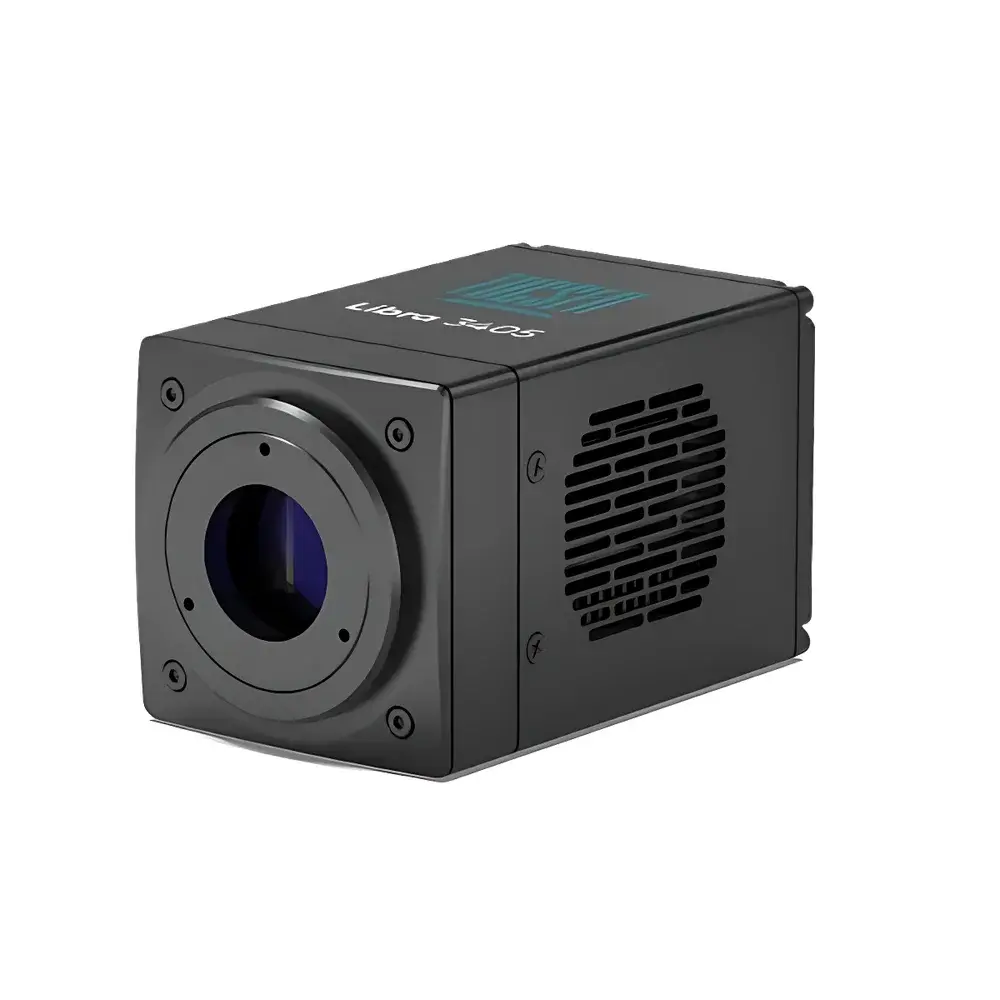
Tucsen Libra 3412C sCMOS Camera for Digital Pathology Scanning, Microscopy Imaging, and Industrial Inspection
| Brand | Tucsen |
|---|---|
| Origin | Fujian, China |
| Manufacturer Type | Original Equipment Manufacturer (OEM) |
| Region of Origin | Domestic (China) |
| Model | Libra 3412C |
| Pricing | Upon Request |
| Image Resolution | 4096 (H) × 3072 (V) |
| Pixel Size | 3.4 µm × 3.4 µm |
| Readout Speed | 98 fps @ 8-bit |
| Sensor Type | Front-Side Illuminated (FSI) sCMOS |
| Sensor Model | Gpixel GMAX3412 |
| Color/monochrome | Color |
| Diagonal Sensor Size | 17.4 mm (1.1″) |
| Active Area | 14.0 mm × 10.5 mm |
| Quantum Efficiency | Peak QE per datasheet curve |
| Gain Modes | High Full-Well, Balanced, High Sensitivity |
| Full-Well Capacity (12-bit) | 9 ke⁻ (High), 4.5 ke⁻ (Balanced), 0.7 ke⁻ (Sensitive) |
| Frame Rates | 98 fps @ 8-bit, 65 fps @ 10-bit, 62 fps @ 12-bit |
| Read Noise (12-bit median) | 3.8 e⁻ (High), 2.5 e⁻ (Balanced), 1.6 e⁻ (Sensitive) |
| Shutter Type | Global Shutter |
| Exposure Range | 1 µs – 10 s |
| AI Auto White Balance | Supported |
| Image Corrections | Defect Pixel Correction (DPC), ROI, FPGA-based Binning (1×1, 2×2, 4×4) |
| Cooling Method | Air-cooled |
| Operating Temperature | 10 °C below ambient (at 25 °C ambient) |
| Dark Current | 0.5 e⁻/pixel/s @ 10 °C |
| Trigger Modes | Hardware & Software (TTL-compatible) |
| Trigger Interface | Hirose 12-pin |
| Data Interface | 10G GigE Vision |
| Bit Depth | 8/10/12-bit |
| Optical Mount | C-Mount (customizable) |
| Power Supply | 12 V / 5 A |
| Power Consumption | 32 W |
| Dimensions | 60 mm × 60 mm × 100 mm |
| Weight | ~489 g |
| Compatible Software | SamplePro, MosaicV3, Micro-Manager 2.0 |
| SDK | C/C++/C#/Python |
| OS Support | Windows & Linux |
| Environmental Rating | Operating Temp. 0–40 °C, Humidity 10–85% RH |
| Storage | −10–60 °C, 0–85% RH |
Overview
The Tucsen Libra 3412C is a high-performance, color scientific CMOS camera engineered for demanding applications in digital pathology slide scanning, high-fidelity brightfield and fluorescence microscopy, and precision industrial surface inspection. Built around the Gpixel GMAX3412 front-side illuminated (FSI) sCMOS sensor, it delivers native 4096 × 3072 resolution with 3.4 µm pixels and a 1.1″ optical format — optimized for high spatial fidelity and light collection efficiency across a broad spectral range (350–1100 nm). Its global shutter architecture eliminates motion-induced distortion, enabling artifact-free imaging of dynamic biological specimens, moving conveyor-belt components, or vibration-sensitive optical setups. Unlike rolling-shutter sensors, the Libra 3412C ensures pixel-synchronous exposure and readout — critical for quantitative intensity measurements, time-lapse registration, and multi-channel fluorescence co-localization where temporal alignment is non-negotiable.
Key Features
- Ultra-Broad Spectral Response: Enhanced quantum efficiency in UV (350 nm) and near-infrared (NIR, up to 1100 nm) enables direct brightfield color imaging and compatibility with common fluorophores including DAPI, FITC, TRITC, Cy5, and Alexa Fluor dyes without external filter optimization.
- Global Shutter sCMOS Architecture: Eliminates skew, wobble, and partial-frame exposure artifacts — essential for high-speed acquisition of live cells, microfluidic flows, or automated inspection systems requiring frame-accurate synchronization.
- 10GigE Vision Interface: Delivers sustained full-resolution throughput at 98 fps (8-bit), exceeding USB3.0 bandwidth limitations by >3×; supports deterministic packet delivery, Jumbo Frame configuration, and IEEE 1588 Precision Time Protocol (PTP) for multi-camera system timing alignment.
- On-Camera AI-Powered White Balance: Proprietary embedded AI algorithm dynamically adjusts color rendering based on illumination spectrum and correlated color temperature (CCT), eliminating manual white balance calibration and ensuring consistent colorimetric reproducibility across instruments and operators.
- Triple-Gain Operational Modes: Configurable analog/digital gain paths — High Full-Well (9 ke⁻), Balanced (4.5 ke⁻), and High Sensitivity (0.7 ke⁻) — allow users to optimize signal-to-noise ratio (SNR) for varying photon flux conditions without hardware modification.
- Active Air Cooling & Thermal Stability: Maintains sensor temperature at 10 °C below ambient (25 °C reference), reducing dark current to ≤0.5 e⁻/pixel/s and enabling long-exposure low-light imaging with minimal thermal noise accumulation.
Sample Compatibility & Compliance
The Libra 3412C is designed for integration into ISO 13485-aligned medical device platforms (e.g., whole-slide scanners), GLP-compliant microscopy workstations, and IEC 61000-6-2/6-4-certified industrial vision systems. Its C-mount interface supports standard microscope couplers and telecentric lenses; optional custom mounts accommodate OEM optical train integration. The camera complies with GigE Vision 2.0 and GenICam3 standards, ensuring interoperability with third-party acquisition software and machine vision libraries. While not FDA-cleared as a standalone diagnostic device, its performance characteristics meet ASTM E2912-22 requirements for digital pathology image quality assessment, including uniformity, color fidelity, and geometric accuracy. Firmware supports audit-trail logging of acquisition parameters (exposure, gain, binning, ROI) — facilitating 21 CFR Part 11 compliance when deployed in regulated environments with validated software layers.
Software & Data Management
Native support includes Tucsen’s SamplePro (for pathology tile stitching and focus mapping), MosaicV3 (multi-modal acquisition and annotation), and open-source Micro-Manager 2.0 (with full sCMOS metadata tagging). The cross-platform SDK provides thread-safe C/C++, C#, and Python bindings compatible with NumPy, OpenCV, and PyTorch pipelines — enabling real-time AI inference (e.g., tissue segmentation, defect classification) directly on acquired frames. All firmware updates, configuration profiles, and calibration files are stored internally with SHA-256 checksum validation. Metadata embedding follows DICOM Supplement 145 (Whole Slide Imaging) conventions where applicable, and TIFF exports include EXIF/XMP tags for exposure, sensor temperature, and color matrix coefficients — ensuring traceability and reprocessing capability.
Applications
- Digital Pathology: High-throughput whole-slide scanning at 20×–40× magnification with sub-micron pixel sampling; supports Z-stack acquisition for extended depth-of-field reconstruction.
- Fluorescence Microscopy: Multi-channel time-lapse imaging of live-cell dynamics (e.g., Ca²⁺ signaling, mitochondrial trafficking) with precise inter-channel temporal registration.
- Industrial Metrology: Sub-pixel edge detection on PCB traces, semiconductor wafers, and additive-manufactured parts using calibrated brightfield/NIR reflectance.
- Life Science Instrumentation: OEM integration into automated colony pickers, microplate readers, and high-content screening platforms requiring low-latency, high-dynamic-range capture.
- Remote Field Imaging: Deployable in ruggedized enclosures for outdoor vegetation monitoring or solar cell inspection, leveraging NIR sensitivity and thermal stability.
FAQ
Does the Libra 3412C support hardware triggering with external TTL signals?
Yes — via the Hirose 12-pin connector, supporting exposure start, readout strobe, trigger-ready, and programmable output signals with configurable polarity and timing delays.
Is the AI white balance algorithm executed on-device or host-dependent?
Fully on-camera using embedded FPGA-accelerated inference; no host CPU/GPU resources required — ideal for resource-constrained embedded systems.
Can the camera operate continuously at full frame rate without thermal throttling?
Yes — the air-cooling system maintains stable sensor temperature under sustained 98 fps operation at ambient temperatures ≤35 °C; derating begins above 35 °C ambient.
What level of radiometric calibration is provided with the camera?
Factory-calibrated flat-field and defect pixel maps are stored in non-volatile memory; NIST-traceable uniformity and linearity reports available upon request for GxP validation.
Is GenICam XML file generation supported for custom configuration persistence?
Yes — the SDK includes tools to export/import GenICam-compliant XML feature files, enabling version-controlled configuration management across instrument fleets.





