
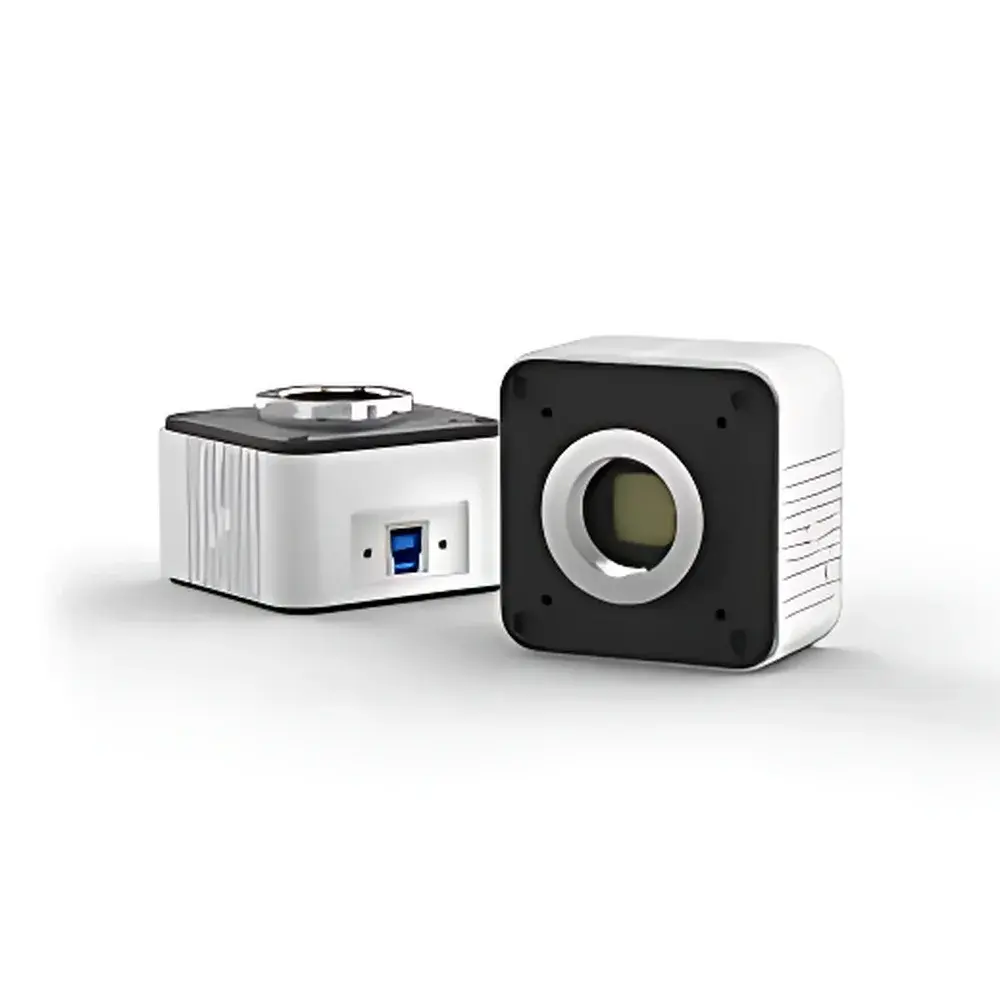
TUCSEN MIchrome 20 USB 3.0 Scientific CMOS Camera for Fluorescence, Polarized, Metallurgical & Stereo Microscopy
| Brand | TUCSEN |
|---|---|
| Origin | Fujian, China |
| Manufacturer Type | OEM/ODM Manufacturer |
| Regional Classification | Domestic (China) |
| Model | MIchrome 20 |
| Image Resolution | 5472 × 3648 |
| Pixel Size | 2.4 µm |
| Sensor Format | 1-inch |
| Readout Speed | 15 fps (full resolution) |
| Quantum Efficiency | 84% |
| Interface | USB 3.0 |
| Optical Mount | Standard C-Mount |
| Dimensions | 68 × 68 × 47 mm |
| Weight | 327 g |
| Sensor Model | Sony IMX183CQJ-J |
| Shutter Type | Rolling Shutter |
| Color | Color |
| SDK Support | Up to 4 cameras simultaneously |
Overview
The TUCSEN MIchrome 20 is a high-performance, USB 3.0–enabled scientific CMOS camera engineered for integration with fluorescence, polarized light, metallurgical, and stereo microscopy systems. Built around the Sony IMX183CQJ-J 1-inch CMOS sensor—a globally recognized imaging platform—the MIchrome 20 delivers 20.4 megapixels of native resolution (5496 × 3672) with exceptional quantum efficiency (84% peak QE) and pixel-level uniformity. Its 2.4 µm pixel pitch balances spatial resolution and photon collection capability, enabling high-fidelity imaging across visible and near-UV spectral bands—critical for low-light fluorescence applications and quantitative polarization analysis. Unlike consumer-grade sensors, the IMX183 features on-chip analog signal processing optimized for scientific use, including low-noise correlated double sampling (CDS) and precise gain control. The camera operates exclusively in rolling shutter mode, ensuring compatibility with synchronized illumination sources such as LED or laser-based excitation systems common in regulated laboratory environments.
Key Features
- Real-time computational imaging powered by Mosaic 2.0 software suite—including live image stitching and depth-of-field (DoF) fusion during acquisition
- Native 15 fps at full 5472 × 3648 resolution via USB 3.0 interface, with scalable frame rates up to 67 fps at reduced ROI (1824 × 1216)
- True-color fidelity maintained through TUCSEN’s proprietary ISP pipeline, correcting spectral response non-uniformity across the sensor array per ISO 12233-compliant calibration
- Standard C-mount optical interface ensures mechanical and optical compatibility with all major microscope brands (Olympus, Nikon, Leica, Zeiss, and Meiji)
- Compact form factor (68 × 68 × 47 mm) and lightweight design (327 g) minimize stage loading and vibration coupling in sensitive setups
- Multi-camera support via TUCSEN SDK: up to four MIchrome 20 units can be synchronized and controlled concurrently under Windows/Linux environments
Sample Compatibility & Compliance
The MIchrome 20 supports broad sample modalities without hardware modification: transmitted brightfield, epi-fluorescence (with standard filter cube sets), differential interference contrast (DIC), polarized light (including retardation quantification when paired with calibrated waveplates), and reflected-light metallurgical imaging. Its linear response across 12-bit ADC output enables compliance with ASTM E2015 (Standard Guide for Digital Imaging in Microscopy) and supports traceable intensity calibration workflows. While not FDA-cleared as a medical device, the camera meets CE/EMC Directive 2014/30/EU and RoHS 2011/65/EU requirements. Data integrity features—including timestamped metadata embedding (EXIF + custom tags) and lossless TIFF/PNG export—facilitate GLP/GMP-aligned documentation practices.
Software & Data Management
Mosaic 2.0 provides a deterministic, scriptable acquisition environment compatible with Python (via PyTUCSEN), MATLAB, and LabVIEW. All image operations—including real-time stitching, Z-stack fusion, measurement annotation, and report generation—are performed in-memory without intermediate file writes, reducing I/O latency. Raw sensor data (12-bit linear) is preserved throughout processing; gamma correction and color space conversion (sRGB, Adobe RGB) are applied only at display or export stages. Audit trails record operator actions, timestamps, and system parameters—supporting 21 CFR Part 11 readiness when deployed with validated IT infrastructure. Export formats include multi-page TIFF (for Z-stacks), CSV (for measurement logs), and PDF reports with embedded scale bars and metadata.
Applications
- Materials science: Grain boundary mapping in metallographic samples using polarized reflectance; inclusion analysis in aluminum alloys
- Life sciences: Wide-field fluorescence screening of fixed-cell immunofluorescence assays; time-lapse imaging of mitotic progression
- Quality control: PCB solder joint inspection under brightfield and oblique illumination; fiber morphology assessment in composite materials
- Geology: Thin-section mineral identification via birefringence patterns under cross-polarized light
- Forensics: Toolmark comparison using stereo microscopy with extended-depth rendering
FAQ
Is the MIchrome 20 compatible with third-party microscope control software?
Yes—TUCSEN provides open-source SDKs (C/C++, Python bindings) and TWAIN/WIA drivers for seamless integration with commercial platforms including NIS-Elements, ZEN Blue, and MetaMorph.
Does the camera support hardware triggering or external synchronization?
It supports TTL-level trigger input (rising-edge active) for precise timing with pulsed light sources or motorized stages; trigger latency is <100 µs RMS.
Can I perform quantitative intensity measurements directly from the raw sensor data?
Yes—the SDK exposes unprocessed 12-bit linear pixel values, enabling radiometric calibration using NIST-traceable neutral density filters or calibrated light sources.
What is the maximum cable length supported for stable USB 3.0 operation?
Up to 3 meters with certified passive cables; active optical USB 3.0 extenders enable reliable operation beyond 10 meters without frame drop or timing jitter.




