
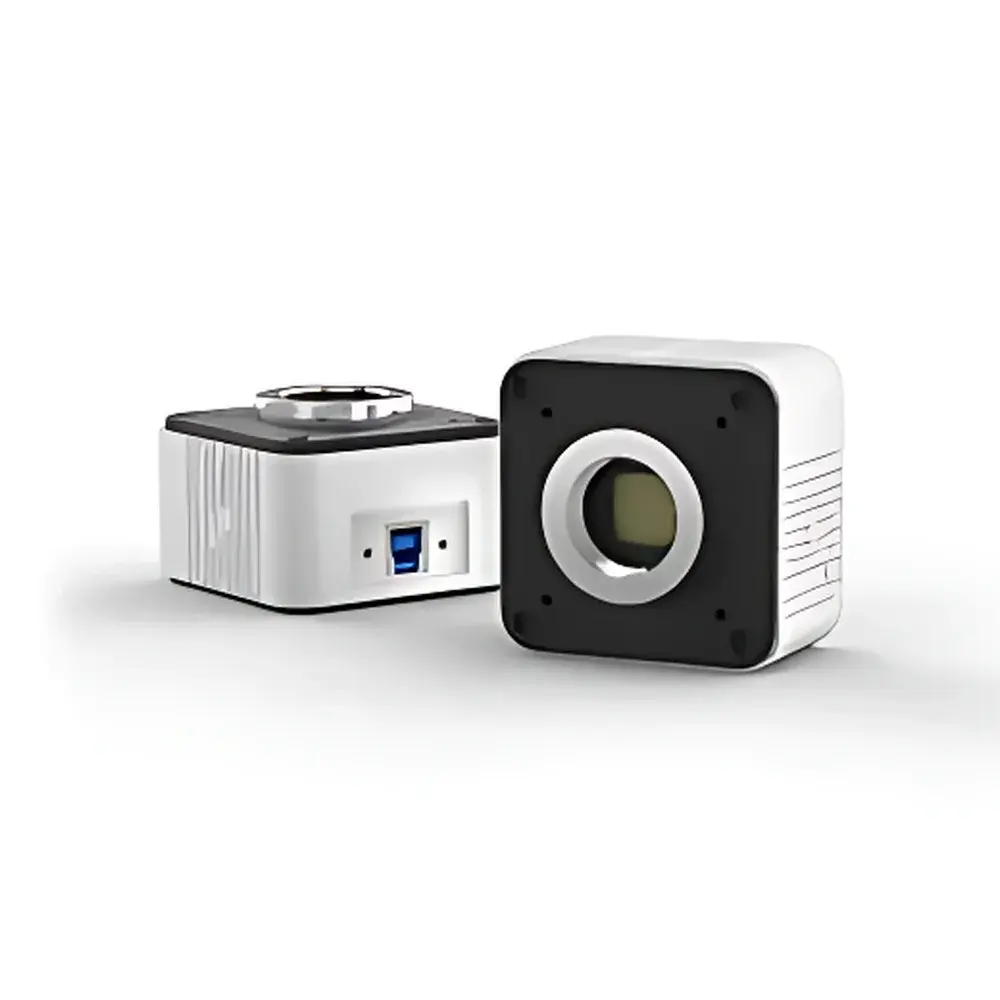
TUCSEN MIchrome 6 USB 3.0 CMOS Microscopy Camera
| Brand | TUCSEN |
|---|---|
| Origin | Fujian, China |
| Manufacturer Type | Direct Manufacturer |
| Region Category | Domestic (China) |
| Model | MIchrome 6 |
| Image Resolution | 3072 × 2048 |
| Pixel Size | 2.4 µm |
| Sensor Format | 1/1.8" |
| Onboard Memory | None |
| Readout Speed | 41 fps |
| Sensor Model | Sony IMX178LQJ-C |
| Color Type | Color |
| Shutter Type | Rolling Shutter |
| Multi-Camera Support | Up to 4 simultaneous units |
| Interface | USB 3.0 |
| Optical Mount | Standard C-Mount |
| Dimensions | 68 × 68 × 47 mm |
| Weight | 327 g |
Overview
The TUCSEN MIchrome 6 is a high-performance, USB 3.0–enabled color CMOS microscopy camera engineered for integration with fluorescence, brightfield, polarized light, metallurgical, and stereo microscopes. Built around the Sony IMX178LQJ-C global-shutter–compatible rolling-shutter sensor, it delivers native resolution of 3072 × 2048 pixels (6.3 MP) with a pixel pitch of 2.4 µm and an optical format of 1/1.8″. Its architecture supports real-time imaging workflows at up to 41 frames per second (fps) at full resolution—enabling rapid focusing, dynamic sample observation, and time-resolved documentation without frame drop or latency-induced artifacts. Designed specifically for laboratory and industrial microscopy environments, the MIchrome 6 functions as a core imaging engine—not merely a capture device—but a calibrated, reproducible component within standardized optical measurement chains.
Key Features
- Real-time image stitching via Mosaic 2.0 computational imaging software: Enables seamless, low-latency panoramic reconstruction during stage translation—no post-acquisition alignment required.
- Live extended depth-of-field (EDF) synthesis: Dynamically fuses focus-stacked frames in real time as the user adjusts the objective’s focus ring, producing fully resolved, artifact-free composite images without manual Z-stack acquisition or offline processing.
- Proprietary ISP-based color fidelity pipeline: Implements TUCSEN’s hardware-accelerated image signal processing to correct spectral response non-uniformity across the sensor, ensuring accurate color reproduction compliant with sRGB and Adobe RGB color spaces—critical for comparative histopathology, material phase identification, and fluorescence channel quantification.
- USB 3.0 interface with deterministic bandwidth allocation: Guarantees sustained 41 fps throughput at full resolution while maintaining stable power delivery and thermal management—eliminating packet loss or driver-level timeouts common in legacy USB 2.0 microscope cameras.
- C-mount mechanical standardization: Ensures mechanical and optical compatibility with OEM and third-party microscope systems including Olympus, Nikon, Zeiss, Leica, and Mitutoyo platforms—supporting both infinity-corrected and finite-conjugate optical paths.
- Multi-camera synchronization readiness: Firmware-level support for coordinated trigger timing and frame alignment across up to four MIchrome 6 units—enabling multi-angle, multi-spectral, or dual-plane acquisition architectures used in automated inspection and 3D surface metrology.
Sample Compatibility & Compliance
The MIchrome 6 is validated for use across regulated and non-regulated imaging modalities, including ISO 10993-compliant biomedical specimen documentation, ASTM E3-22–aligned metallographic analysis, and USP –referenced pharmaceutical particle morphology assessment. Its color calibration traceability aligns with CIE 1931 XYZ chromaticity standards, and raw data output preserves linear sensor response for downstream quantitative intensity analysis. While the camera itself does not carry CE/UKCA or FDA 510(k) certification as a standalone medical device, its firmware and SDK comply with GLP/GMP-aligned development practices—including audit-trail–enabled metadata logging (timestamp, exposure, gain, ROI coordinates) and DICOM-SR export capability via optional TUCSEN SDK extensions.
Software & Data Management
The MIchrome 6 operates natively with TUCSEN’s Mosaic 2.0 software suite—a modular, Windows-based application framework supporting ISO/IEC 17025–compatible workflow validation. Core modules include live measurement annotation (distance, area, angle, particle count), batch report generation (PDF/Excel), and TIFF-64 bit linear RAW export with embedded EXIF and custom metadata fields. The SDK provides C++, Python, and .NET APIs with thread-safe callbacks, memory-mapped frame buffers, and hardware-triggered acquisition modes—facilitating integration into custom LIMS, MES, or automated QA/QC platforms. All software binaries undergo SHA-256 integrity verification and are distributed with version-controlled release notes aligned to semantic versioning (SemVer 2.0).
Applications
- Industrial quality control: Real-time defect mapping on PCBs, semiconductor wafers, and precision machined components using brightfield + polarized contrast.
- Life science research: Time-lapse fluorescence imaging of live-cell cultures, immunofluorescence tissue sections, and GFP-tagged organelle dynamics.
- Materials science: Grain boundary analysis in alloys, inclusion characterization in steel, and birefringence quantification in polymer films.
- Educational microscopy labs: High-fidelity digital projection of stereoscopic and metallurgical specimens with synchronized annotation tools for remote instruction.
- Forensic document examination: Multi-spectral surface topography capture under oblique illumination and UV excitation.
FAQ
Is the MIchrome 6 compatible with Linux or macOS operating systems?
TUCSEN provides official Linux drivers (x86_64, ARM64) and kernel module support for Ubuntu 20.04 LTS and later; macOS support is limited to USB video class (UVC) mode with reduced feature set—full functionality requires Windows 10/11.
Does the camera support hardware triggering for synchronized multi-camera setups?
Yes—GPIO pins accessible via optional DB9 adapter enable TTL-level external trigger input/output, with programmable delay and pulse width control through the SDK.
Can raw sensor data be exported without ISP processing?
Yes—Mosaic 2.0 and the SDK allow direct access to uncorrected 12-bit linear RAW frames, preserving full dynamic range for radiometric calibration and custom pipeline development.
What is the maximum cable length supported for stable USB 3.0 operation?
With active USB 3.0 extension cables (certified to USB-IF specifications), reliable operation is maintained up to 5 meters; passive cables are recommended only up to 3 meters to ensure signal integrity and power delivery.
Is firmware update capability available over USB?
Yes—firmware updates are delivered via signed .bin packages and applied through Mosaic 2.0’s built-in updater, with rollback protection and CRC-32 validation at each boot stage.




