
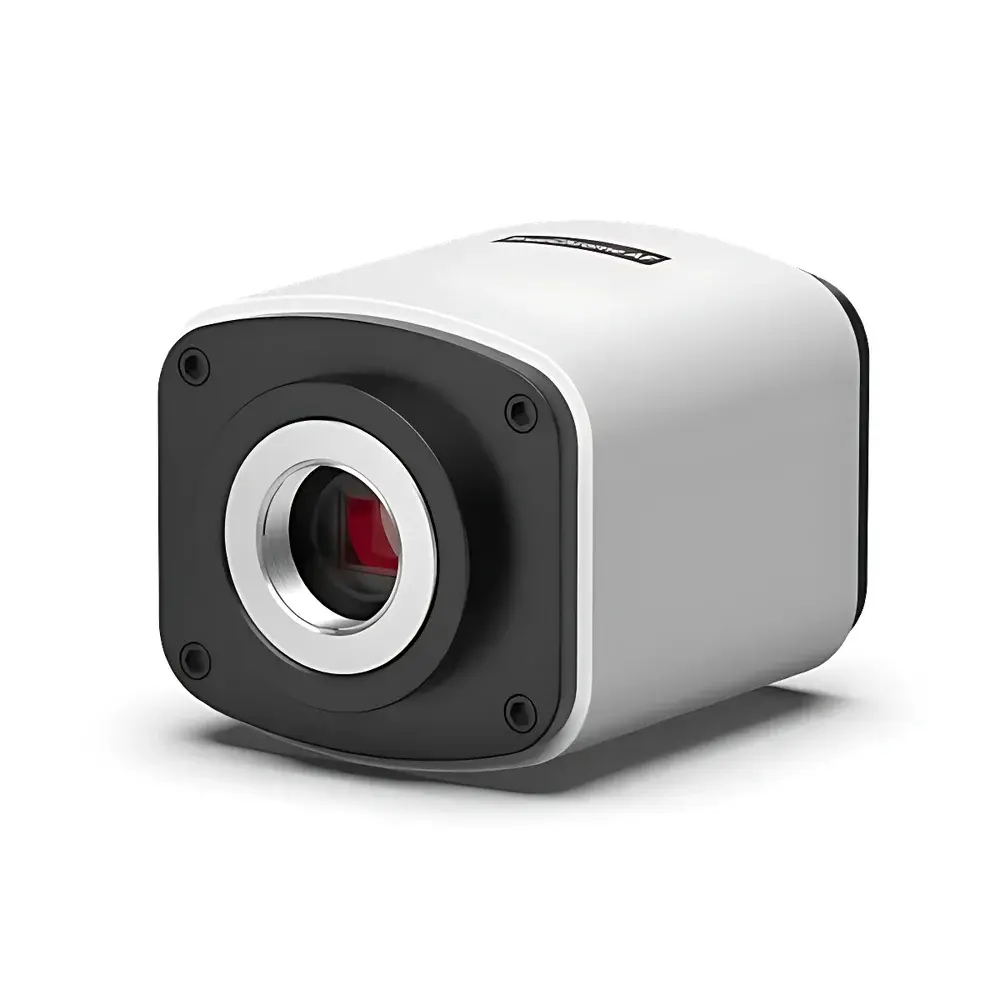
Tucsen TrueChrome PDAF CMOS Microscopy Camera
| Brand | Tucsen |
|---|---|
| Origin | Fujian, China |
| Manufacturer Type | OEM/ODM Manufacturer |
| Region of Origin | Domestic (China) |
| Model | TrueChrome PDAF |
| Image Resolution | 4 MP (2880 × 1620) |
| Pixel Size | 1.6 µm × 1.6 µm |
| Sensor Size | 4.6 mm × 2.6 mm |
| Readout Speed | 60 fps @ HDMI |
| Interface | HDMI, USB 2.0, SD Card |
| Power Consumption | 2.4 W |
| Weight | 452 g |
| Dimensions | 90.7 mm × 78 mm × 70.8 mm |
| Operating Temperature | −10 °C to 45 °C |
| Humidity Range | 10%–85% RH |
| OS Support | Windows 7/10 (32/64-bit), macOS |
| Minimum CPU | Intel Core i5 (quad-core or higher) |
| Minimum RAM | 8 GB |
| Shutter Mode | Rolling |
| Exposure Time | 0 ms – 5 s |
| Color Temperature Range | 1800 K – 10,000 K |
| Image Formats | HDMI: JPG, TIFF |
| USB | TIFF, JPG, PNG, DICOM |
| Video Output | 25 fps @ 1920×1080 (HDMI) |
| Lens Mount | Standard C-mount |
| SDK Support | Multi-camera synchronization (up to 4 units) |
Overview
The Tucsen TrueChrome PDAF CMOS Microscopy Camera is a high-performance, multi-modal imaging solution engineered for integration with fluorescence, biological, polarized light, metallurgical, and stereo microscopes. Built around the Sony IMX586 1/3″ CMOS sensor, it delivers 4 megapixel resolution (2880 × 1620) with a pixel pitch of 1.6 µm — optimized for high spatial fidelity in demanding optical configurations. Its core innovation lies in on-sensor Phase Detection Auto-Focus (PDAF), a technology adapted from professional imaging systems to enable rapid, reliable, and repeatable focus acquisition without mechanical stage movement or contrast-based search algorithms. This architecture significantly reduces latency during live imaging, real-time measurement, and time-lapse acquisition — particularly critical in dynamic sample observation, routine QC inspection, and educational microscopy workflows. The camera operates natively at 60 fps over HDMI for low-latency preview and annotation, while maintaining full-resolution capture via USB 2.0 at 50 fps. Designed for laboratory-grade reproducibility, it supports precise exposure control (0 ms – 5 s), adjustable white balance across a 1800–10,000 K color temperature range, and calibrated gamma and gain linearity.
Key Features
- On-chip Phase Detection Auto-Focus (PDAF) enabling sub-100 ms focus lock under variable illumination and magnification conditions
- Dual-output architecture: HDMI for real-time display and embedded measurement (cm/mm/µm), USB 2.0 for high-fidelity image capture and metadata-rich file export
- Proprietary ISP pipeline with spectral response compensation, delivering accurate colorimetric reproduction aligned with CIE 1931 chromaticity standards
- FAT32-compatible SD card recording for standalone operation — supports lossless TIFF and JPEG formats with embedded EXIF and microscope metadata
- C-mount interface with mechanical back-focus adjustability (0.5–1.0 mm tolerance) for seamless compatibility with infinity-corrected and finite-conjugate optical paths
- Comprehensive SDK with C/C++, Python, and .NET bindings — enabling custom automation, multi-camera synchronization (up to 4 units), and integration into LIMS or MES environments
Sample Compatibility & Compliance
The TrueChrome PDAF supports a broad spectrum of specimen types across life science and materials analysis applications, including unstained live cells, fluorescently labeled tissues, birefringent polymer films, polished metal cross-sections, and macroscopic botanical or entomological specimens. Its wide dynamic range (>60 dB) and low read noise (<2.5 e⁻ RMS) ensure quantitative integrity in both low-light fluorescence and high-contrast reflected-light imaging. The device complies with IEC 61000-6-2 (immunity) and IEC 61000-6-4 (emissions) for electromagnetic compatibility. While not certified as medical device hardware, its DICOM-compliant output mode and audit-trail-capable software interfaces (Mosaic V3) support alignment with GLP and GMP documentation requirements when deployed in regulated QA/QC laboratories.
Software & Data Management
Two primary software ecosystems are provided: HDMI-side Cloud firmware for embedded real-time processing (including distance, area, angle, and particle count measurements), and host-side Mosaic V2/V3 applications for Windows and macOS. Mosaic V3 implements role-based user permissions, timestamped acquisition logs, and export templates compliant with ISO/IEC 17025 documentation frameworks. All captured images embed standardized EXIF tags (including objective magnification, filter set ID, exposure parameters, and sensor temperature). Raw data export supports 12-bit linear TIFF for downstream analysis in ImageJ/Fiji, MATLAB, or HALCON. The SDK includes full support for FDA 21 CFR Part 11–compliant electronic signatures when integrated with validated third-party laboratory software.
Applications
- Fluorescence microscopy: Co-localization studies using dual-channel overlay and intensity profiling with background-subtracted ROI analysis
- Metallurgical inspection: Grain boundary delineation, inclusion mapping, and hardness correlation via reflected-light contrast segmentation
- Polarized light imaging: Quantitative retardation assessment in pharmaceutical crystallinity analysis and polymer stress evaluation
- Educational microscopy: Real-time student annotation, side-by-side comparison, and automated report generation for histology labs
- Industrial QC: Automated defect detection on PCBs, semiconductor wafers, and precision-machined components using edge-detection and threshold-based classification
FAQ
Does the TrueChrome PDAF support hardware triggering for synchronized multi-camera acquisition?
Yes — the SDK provides TTL-compatible trigger input/output pins, enabling frame-accurate synchronization across up to four cameras in a single acquisition sequence.
Can the HDMI output be used for regulatory-compliant record keeping?
HDMI output itself is not archivable; however, simultaneous USB+SD recording ensures traceable, timestamped, and checksum-verified image archives required for ISO 13485 or ASTM E2912 compliance.
Is the PDAF functionality dependent on microscope-specific optics or adapter hardware?
No — PDAF operates autonomously using dedicated phase-detection pixels on the IMX586 sensor and requires no additional beam-splitting optics or external focus sensors.
What calibration options are available for quantitative intensity measurements?
NIST-traceable flat-field and dark-frame calibration routines are included in Mosaic V3, supporting pixel-level gain/offset correction and photometric linearity verification per ISO 15739.




